

The second half of August 2026 has brought two notable additions to the global electric SUV market, but at very different ends of the premium spectrum.
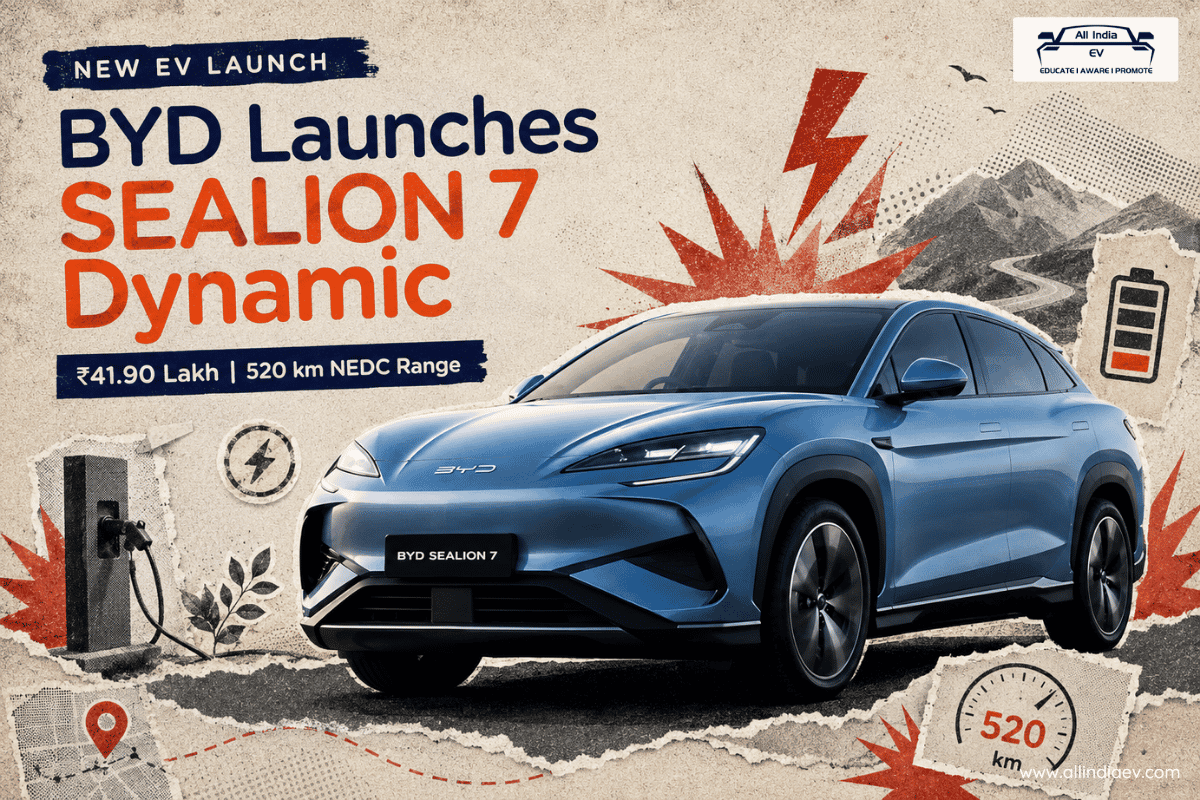
In India, BYD has expanded the SEALION 7 range with a new Dynamic variant priced at ₹41.90 lakh, substantially lowering the entry point into its premium electric SUV line-up.
Globally, Hyundai Motor Group’s luxury brand Genesis has unveiled the GV90, its first full-size flagship electric SUV, bringing a 123.5 kWh battery, advanced software, ultra-luxury interiors and several new safety technologies to the top end of the EV market.
Together, the launches show how electric SUVs are spreading across increasingly distinct price and technology tiers.
BYD SEALION 7 Dynamic lowers the entry price in India
BYD India launched the SEALION 7 Dynamic on August 20, 2026, at an introductory ex-showroom price of ₹41.90 lakh.
The most important part of the announcement is not simply the addition of another variant. It is the pricing.
The Dynamic sits below the existing Premium and Performance versions, significantly reducing the cost of entering the SEALION 7 family.
BYD has achieved this partly by using a smaller battery.
The Dynamic gets a 71.8 kWh Blade Battery, compared with the 82.56 kWh battery available in higher variants.
Key specifications include:
- Battery: 71.8 kWh Blade Battery
- Claimed range: 520 km under NEDC
- 0-100 km/h: 7.3 seconds
- Price: ₹41.90 lakh, introductory ex-showroom
- Battery chemistry: LFP
Despite its lower positioning, BYD has retained several technologies associated with the SEALION 7, including Cell-to-Body construction, Intelligent Torque Adaptation Control, a panoramic glass roof, rotating touchscreen and driver-assistance technologies.
The company is also bundling a 7 kW home charger with installation, along with extended roadside assistance and battery warranty benefits as part of its festive offer.
Why the Dynamic variant matters
BYD is effectively using battery sizing to create another price tier without developing an entirely different vehicle.
That approach is increasingly relevant for India’s premium EV market.
Instead of forcing buyers to choose between a completely different model at a lower price or a larger-battery flagship, manufacturers can create more accessible variants by adjusting battery capacity, performance and equipment while retaining the same underlying vehicle architecture.
For BYD, the move also reduces the starting price of the SEALION 7 by roughly ₹7 lakh compared with the earlier entry point, widening its addressable market among premium EV buyers.
Genesis GV90 takes a very different route
While BYD is attempting to make a premium EV more accessible, Genesis is moving upward.
The company unveiled the GV90 on August 19 in San Francisco, marking the arrival of its first full-size flagship electric SUV.
Genesis will offer the vehicle as the GV90 and GV90 Neolun, with the latter positioned as the more exclusive interpretation of the platform.
The vehicle is based on the company’s new eMP electric platform for flagship Genesis models and uses a 123.5 kWh battery.
According to Genesis, major specifications and technologies include:
- 123.5 kWh high-voltage battery
- Up to 500 km driving range based on company testing for the seven-seat model
- 10-80% DC charging in around 22 minutes using a 350 kW charger
- Up to 657 hp combined output
- Multi-chamber air suspension
- Dual electronic limited-slip differential
- Pleos Connect infotainment platform
- 25-inch head-up display
- Pop-up OLED Cinematic Display
But the GV90 is not primarily competing on battery size.
Its bigger technology story is the attempt to redefine what a flagship EV cabin can offer.
Coach doors, roof airbags and software-led luxury
The GV90 Neolun introduces what Genesis calls the Neolun Arch Gate, using independently operating coach-style doors with a hidden B-pillar arrangement.
Genesis has also introduced a 12-airbag system that includes a roof airbag, designed to provide additional protection during rollover events.
The interior combines large digital interfaces with comfort technologies such as massage seating, premium audio and lounge-oriented seating configurations.
This puts the GV90 into a segment where EV competition is moving beyond conventional metrics such as range and acceleration.
The battleground is increasingly becoming software, cabin experience, charging performance, safety systems and highly differentiated user interfaces.
Two launches, two different EV strategies
The BYD SEALION 7 Dynamic and Genesis GV90 demonstrate two very different directions emerging within the electric SUV market.
BYD is widening access.
A smaller battery and lower starting price allow the company to target a broader section of India’s premium EV customer base without creating a new vehicle platform.
Genesis is pushing the technology ceiling upward.
Its 123.5 kWh flagship uses electrification as the foundation for advanced safety, software, luxury and cabin technologies rather than treating the drivetrain itself as the headline feature.
That distinction matters.
As EV platforms mature, manufacturers are gaining more freedom to segment vehicles in much the same way the conventional automotive industry did, but with battery size, charging capability, software and electronics becoming new levers for differentiation.
For India’s EV market, BYD’s strategy is immediately more relevant because the SEALION 7 Dynamic is already being offered locally.
Genesis represents the other side of the equation: where the global premium EV market is heading as manufacturers use dedicated electric architectures to build products that would have been far harder to execute around an internal-combustion drivetrain.
August’s latest launches therefore point to a maturing EV market where simply being electric is no longer enough.
The next competition is about how intelligently manufacturers package the battery, technology, price and customer experience around it.