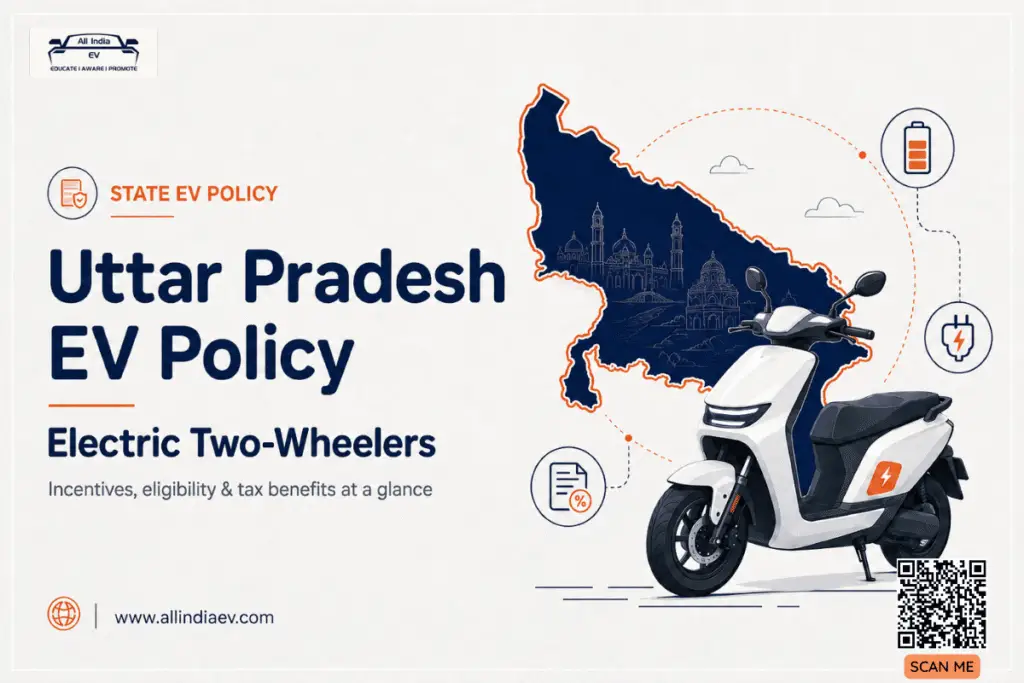


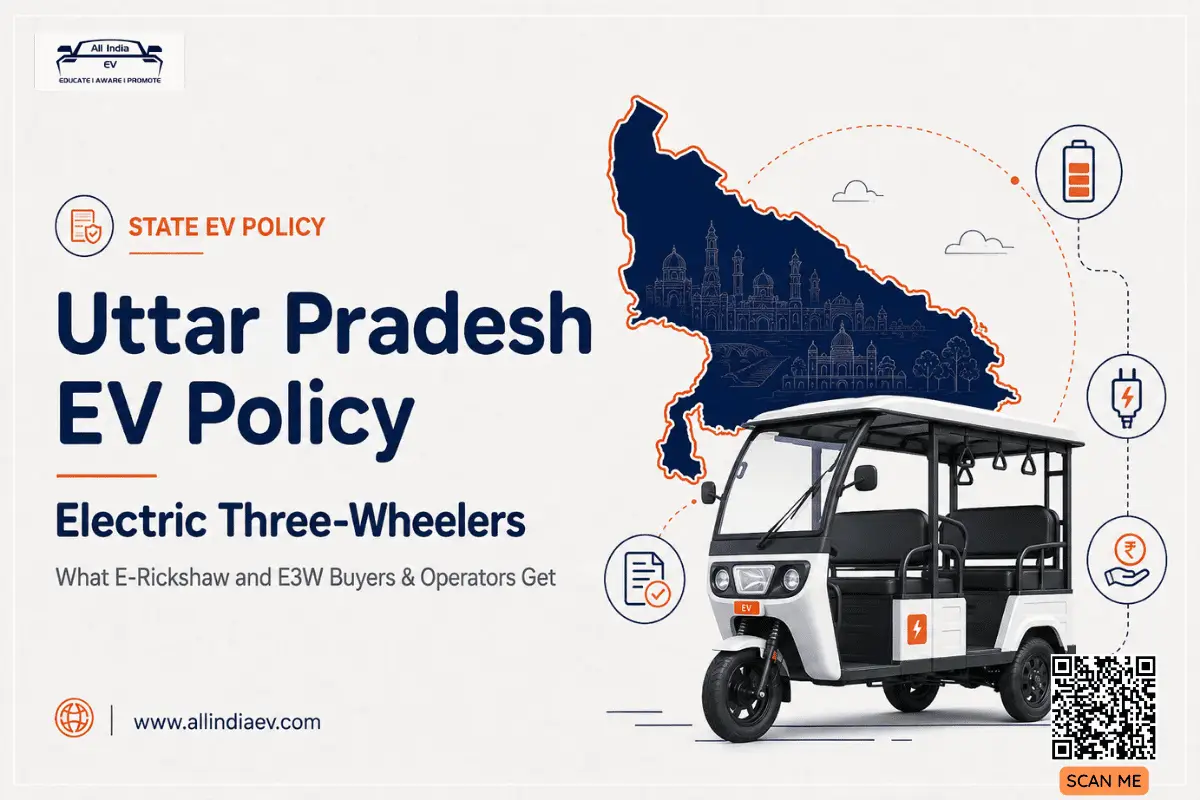
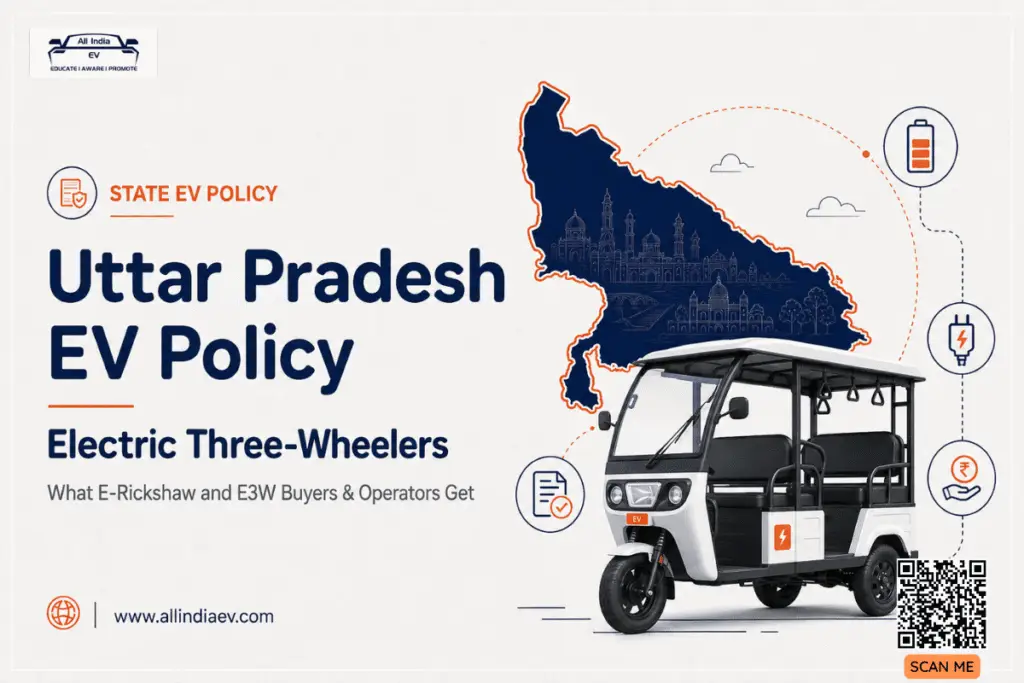
Electric three-wheelers need a little extra attention under the Uttar Pradesh EV Policy because passenger e3Ws and electric goods carriers are treated differently.
What does the policy offer?
| Benefit | Passenger e3W / E-Rickshaw | Electric Goods Carrier |
|---|---|---|
| Purchase subsidy in 2026 | ❌ Not available | ✅ Available |
| Purchase subsidy amount | — | 10% of ex-factory cost |
| Maximum subsidy | — | ₹1 lakh per vehicle |
| Original vehicle allocation | — | 1,000 vehicles |
| Original budget allocation | — | ₹10 crore |
| Road tax exemption | ✅ Subject to current conditions | ✅ Subject to current conditions |
| Registration fee exemption | ✅ Subject to current conditions | ✅ Subject to current conditions |
The original 2022 policy had offered passenger electric three-wheelers a subsidy of 15% of ex-factory cost, capped at ₹12,000 per vehicle, for up to 50,000 vehicles.
However, that is not the current position in 2026.
Is the ₹12,000 e3W subsidy available today?
No.
The November 2025 government order extending purchase incentives for pure EVs until 13 October 2027 specifically states that purchase subsidy for three-wheelers will continue to remain inadmissible.
So buyers of passenger e3Ws or e-rickshaws should not assume that the original ₹12,000 incentive is still available.
This is an important difference between the original policy document and the policy applicable today.
Electric cargo three-wheelers are different
An electric three-wheeler registered under the e-goods carrier category can fall under a separate incentive provision.
The policy provides electric goods carriers a subsidy of:
10% of ex-factory price, capped at ₹1 lakh per vehicle.
The original allocation covers up to 1,000 e-goods carriers, with a maximum budget of ₹10 crore.
The 2025 government order also permits aggregators and fleet operators to claim purchase subsidy for up to 25 e-buses or e-goods carriers, subject to the applicable conditions.
So the vehicle’s registration category matters considerably.
What about road tax and registration fees?
UP provides a 100% road-tax and registration-fee exemption for eligible EVs.
During the first three years of the policy, the exemption applied to EVs purchased and registered in Uttar Pradesh.
During the fourth and fifth years, the vehicle must be:
Manufactured in Uttar Pradesh + Purchased in Uttar Pradesh + Registered in Uttar Pradesh.
That localisation condition is particularly important for vehicles being purchased in 2026.
Quick takeaway
Passenger e3W / e-rickshaw purchase subsidy: ❌ Not available
Original ₹12,000 subsidy: ❌ Should not be treated as current
Electric goods carrier subsidy: ✅ Up to ₹1 lakh
Fleet limit for eligible e-goods carriers: Up to 25 vehicles
Road tax exemption: ✅ Subject to localisation conditions
Registration fee exemption: ✅ Subject to localisation conditions
All India EV takeaway
The biggest mistake while reading UP’s e3W policy is treating all electric three-wheelers as one category.
In 2026, the policy is considerably more attractive for an electric cargo three-wheeler registered as an e-goods carrier than for a passenger e-rickshaw, because the former can still access a dedicated purchase incentive while the normal three-wheeler purchase subsidy is not admissible
Follow us on 𝐈𝐧𝐬𝐭𝐚𝐠𝐫𝐚𝐦: https://lnkd.in/gv3WizBK
Follow us on 𝐘𝐨𝐮𝐓𝐮𝐛𝐞: https://lnkd.in/g6XgiqNA
Join our 𝐖𝐡𝐚𝐭𝐬𝐀𝐩𝐩 community: https://lnkd.in/gq-a2q5b