

India’s next phase of commercial EV adoption may not be decided in its biggest metropolitan markets.
- 1. What are the biggest differences businesses should expect when deploying EV fleets in Tier-II and emerging cities compared with metros?
- 2. You have previously said that “the route should dictate the vehicle and infrastructure.” What does this mean in practical terms?
- 3. How important is vehicle utilisation in determining whether an EV fleet makes economic sense?
- 4. What should businesses include when calculating the real-world TCO of an EV fleet?
- 5. Outside metros, how important are service readiness and vehicle uptime to fleet economics?
- 6. ARC follows a “commercial viability first” approach to fleet electrification. What does that mean in practice?
- 7. Conversely, are there routes or use cases where you would not recommend immediate electrification?
- 8. How can the micro-cluster approach help businesses expand EV fleets beyond metros, and what should they evaluate before scaling?
As electric fleets expand into Tier-II cities and emerging urban centres, fleet operators are confronting a very different operating environment—one where charging access, route patterns, utilisation, parking availability, service infrastructure and local demand can vary significantly from one city to another. ARC Electric’s experience suggests that simply replicating a metro deployment model in a smaller city is unlikely to produce the same economics.
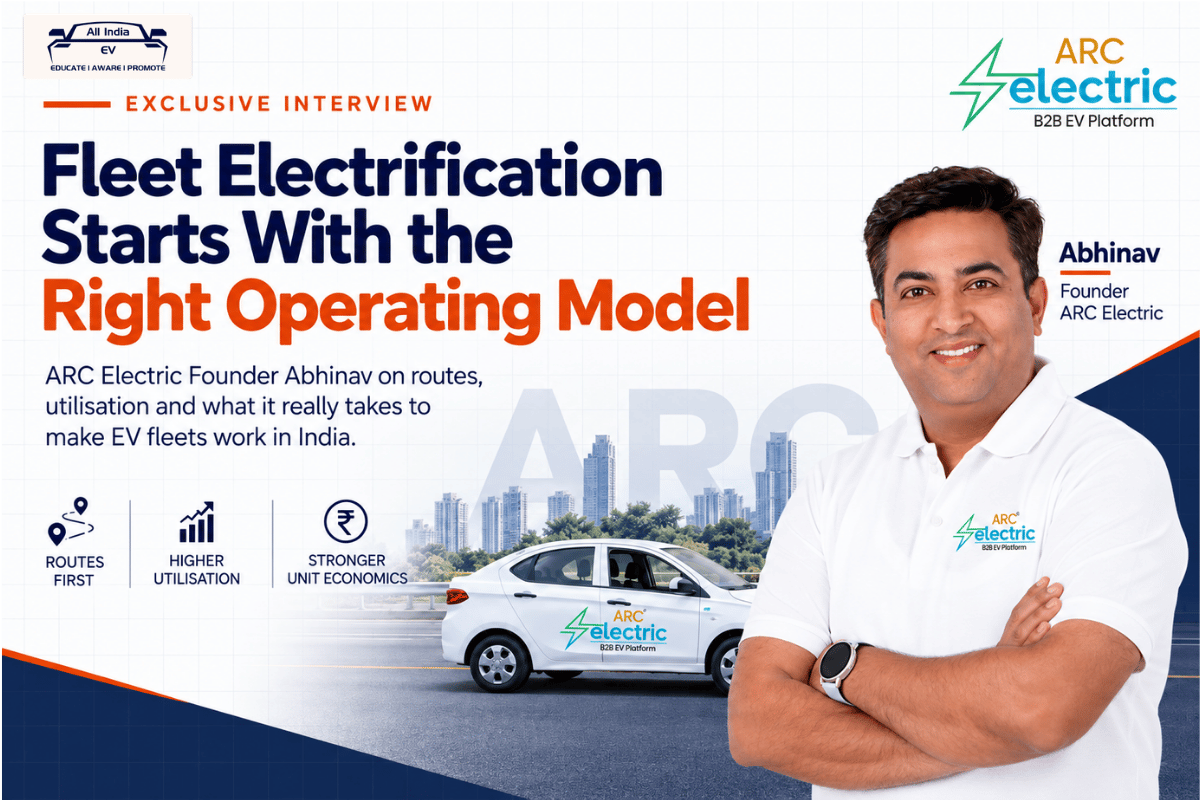
For ARC Electric Founder Mr. Abhinav, the starting point for fleet electrification is therefore not the vehicle.
It is the route.
Before deciding which EV to procure or how many chargers to install, operators need to understand daily kilometres, load requirements, operating shifts, turnaround time, dwell periods and the actual utilisation expected from each vehicle. The question is not whether an EV offers sufficient range on paper, but whether it can complete its duty cycle, recharge within the available window and return to operation without compromising fleet productivity.
In this conversation with All India EV, Abhinav explains why ARC Electric follows a “commercial viability first” approach to electrification, how fleet economics change outside metros, why micro-clusters can help operators scale more efficiently, and why businesses should evaluate routes individually rather than assuming every operation is immediately ready to go electric.
1. What are the biggest differences businesses should expect when deploying EV fleets in Tier-II and emerging cities compared with metros?
The biggest difference is that businesses cannot assume that an operating model that works in a metro will automatically work in a smaller city.
EV fleet deployment in Tier-II and emerging cities tends to be more cost-driven and operationally localised. Route lengths, traffic patterns, parking availability, charging access, service infrastructure and vehicle utilisation can vary significantly from one market to another.
From our experience of deploying EV fleets across multiple markets, the first step is to understand the operating environment of the city rather than start with a vehicle purchase.
One of our key learnings has been that emerging markets respond better when deployment starts with a focused operating cluster rather than a large fleet rollout.
The principle is simple:
Understand the route, utilisation and infrastructure first — and then determine where electrification makes commercial sense.
2. You have previously said that “the route should dictate the vehicle and infrastructure.” What does this mean in practical terms?
It means that vehicle selection should follow the duty cycle.
A business should first map:
- Daily kilometres
- Route length
- Passenger or payload requirements
- Operating hours
- Number of shifts
- Turnaround time
- Vehicle dwell time
A predictable 100–150 km duty cycle with several hours of dwell time is operationally very different from a vehicle expected to cover substantially longer distances across multiple shifts.
A short, predictable urban delivery route may be best served by a smaller EV with overnight charging, while longer intercity routes may require a higher-range vehicle and suitably located fast charging.
The question is therefore not simply whether a vehicle has enough range on paper.
The real question is:
Can it complete its duty cycle, recharge within the available window and return to service without affecting operations?
3. How important is vehicle utilisation in determining whether an EV fleet makes economic sense?
Utilisation is one of the most important variables because the economic advantage of an EV accumulates with kilometres operated.
In fleet operations, we typically look at actual operating kilometres rather than simply the number of hours a vehicle is available.
A vehicle that is consistently deployed throughout the day can absorb its fixed costs and infrastructure costs more effectively than one that remains idle for long periods.
The higher the daily kilometres and productive hours per vehicle, the faster the business can recover its initial investment through lower energy and maintenance costs.
This is why EVs can be especially attractive for high-utilisation applications such as:
- Delivery fleets
- Employee transportation
- Logistics
- Day-and-night shift operations
Utilisation should therefore be assessed before procurement.
The right question is not only:
“How much does the EV cost?”
It is:
“How intensively will we use it?”
4. What should businesses include when calculating the real-world TCO of an EV fleet?
Businesses should avoid relying only on vehicle purchase price or laboratory efficiency figures.
Real-world EV economics depend on actual energy consumption, which can vary with:
- Vehicle type
- Passenger or payload load
- Road conditions
- Traffic
- Air-conditioning usage
- Driving behaviour
- Weather
The more useful metric is therefore actual energy consumed per kilometre under the intended operating conditions, together with electricity tariffs and charging losses.
A proper Total Cost of Ownership (TCO) calculation should include:
- Energy or fuel cost
- Maintenance
- Financing
- Insurance
- Charging infrastructure
- Downtime
- Residual value
In our fleet operations, EV running costs can be around ₹2/km, compared with approximately ₹5–6/km for comparable diesel/CNG operations, although the actual figure varies by vehicle and operating conditions.
If the difference in operating cost is approximately ₹3–4 per kilometre and a vehicle travels 60,000 kilometres annually, that can translate into around ₹1.8–2.4 lakh in annual operating-cost savings, before accounting for financing, infrastructure, maintenance and resale value.
That is why the correct comparison is not simply:
EV purchase price vs ICE purchase price.
The real question is whether the complete operating model delivers a lower and more predictable cost over the intended ownership period.
5. Outside metros, how important are service readiness and vehicle uptime to fleet economics?
Service readiness becomes especially important outside major metropolitan markets because the problem is often not the vehicle itself but the surrounding support ecosystem.
Before deployment, businesses should assess access to:
- Trained technicians
- Spare parts
- Diagnostics
- Roadside support
- Battery-related services
In smaller and emerging cities, limited local support can increase service-response times and lead to longer periods of vehicle downtime.
This is why service capability should be planned before vehicles are deployed, rather than developed after the fleet is already operating.
Vehicle availability is equally important.
A commercial EV may have sufficient range, but if it remains unavailable because of charging constraints, maintenance delays or service issues, the economics of the deployment can deteriorate quickly.
Businesses should therefore establish an uptime or availability target before deployment and monitor the actual reasons for downtime rather than treating availability as a single headline number.
Preventive maintenance and telematics can also help identify battery, energy-use and maintenance issues before they become unexpected operational failures.
For commercial fleets, the real objective is not simply to maximise range.
It is to maximise productive vehicle availability.
6. ARC follows a “commercial viability first” approach to fleet electrification. What does that mean in practice?
At ARC, we deliberately follow a “commercial viability first” approach to EV fleet deployment.
We operate EVs in areas and on routes where the economics work well for us — where utilisation, route characteristics, charging availability and operating costs make the deployment commercially viable.
If the initial model does not work in a particular location, we do not simply abandon it.
We look at what can be changed.
That may involve:
- Modifying the operating model
- Changing the route structure
- Reworking charging requirements
- Selecting a different vehicle
- Adjusting the deployment strategy
The objective is to find a model that works commercially.
This route-by-route approach is important because EV fleet economics can vary significantly depending on utilisation, electricity cost, route length and charging infrastructure.
7. Conversely, are there routes or use cases where you would not recommend immediate electrification?
Yes.
Not every route is equally ready for electrification.
Some operating conditions can make an EV deployment difficult to operate economically, including:
- Highly unpredictable daily kilometres
- Continuous multi-shift operations
- Very limited charging windows
- Inadequate local charging access
- Weak service support
The important point is that this does not necessarily mean the route can never be electrified.
It may simply mean that the charging infrastructure, vehicle technology, operating pattern or local service ecosystem needs to evolve first.
The question should therefore not be:
“Can this entire fleet be electrified?”
A better question is:
“Which routes are ready to be electrified today?”
8. How can the micro-cluster approach help businesses expand EV fleets beyond metros, and what should they evaluate before scaling?
A micro-cluster brings demand, routes, vehicles, charging and operations together within a defined geography.
Instead of trying to deploy a large fleet across an entire city immediately, a business can first establish a concentrated operating base where:
Demand is visible → Routes are predictable → Charging can be managed → Utilisation can be improved
At ARC, this approach has helped reduce dry-run rates from around 30–40% to approximately 10–15% by improving the alignment between vehicle deployment and demand.
That is a significant operational improvement.
The broader principle is that Tier-II and emerging cities should not simply be treated as smaller versions of metros.
Mobility patterns, infrastructure, utilisation and charging requirements can differ substantially, so the operating model needs to be localised.
Before committing capital or scaling a cluster, businesses should evaluate seven things:
- Route predictability — Can the daily duty cycle be mapped reliably?
- Utilisation — Will the vehicle operate enough to justify the investment?
- Charging — Where and when can it charge without disrupting operations?
- Vehicle suitability — Does the vehicle match the route, load and shift pattern?
- Service readiness — Can technical support, diagnostics and parts be accessed locally?
- TCO — Do the economics work after financing, infrastructure and downtime are included?
- Scalability — Can the operating model be replicated as the fleet grows?
The central question should therefore be:
Which routes can be electrified reliably and economically today — and what needs to change before the remaining routes become viable?
Policy intervention can accelerate that transition.
But incentives should remain an enabler, not the foundation of the business case.
The real test is whether the operating model remains commercially sustainable without depending permanently on policy support.
The central message from this conversation is simple:
Successful fleet electrification begins with operational design, not vehicle procurement.
The industry often starts the EV conversation with battery capacity, claimed range, vehicle price or charging power. But commercial fleets ultimately operate on a different equation—utilisation, uptime, kilometres travelled, energy cost, charging availability and revenue-generating hours.
ARC Electric’s route-by-route approach illustrates why this distinction matters. Even within the same city, one duty cycle may already offer compelling EV economics while another may require better charging infrastructure, a different vehicle configuration or changes in operating patterns before electrification becomes viable.
The same principle becomes even more important as EV fleets move beyond metros.
Tier-II and emerging cities should not simply be treated as smaller versions of Delhi, Mumbai or Bengaluru. Their mobility patterns, charging environments, service ecosystems and demand density can be fundamentally different. ARC’s micro-cluster strategy—concentrating vehicles, routes, demand and charging within defined operating areas—has helped the company reduce dry-run rates from roughly 30–40% to around 10–15%, showing how operating design can materially influence fleet economics.
Perhaps the most important takeaway is that not every route needs to be electrified immediately.
The better question for fleet operators is:
Which routes can be electrified reliably and economically today—and what needs to change before the remaining routes become viable?
That distinction could become increasingly important as India moves from EV pilots to large-scale commercial deployment.
Policy incentives can accelerate that transition, but as Abhinav argues, they should remain an enabler rather than the foundation of the business case. Ultimately, a sustainable electric fleet is one whose economics continue to work after the incentives disappear.