

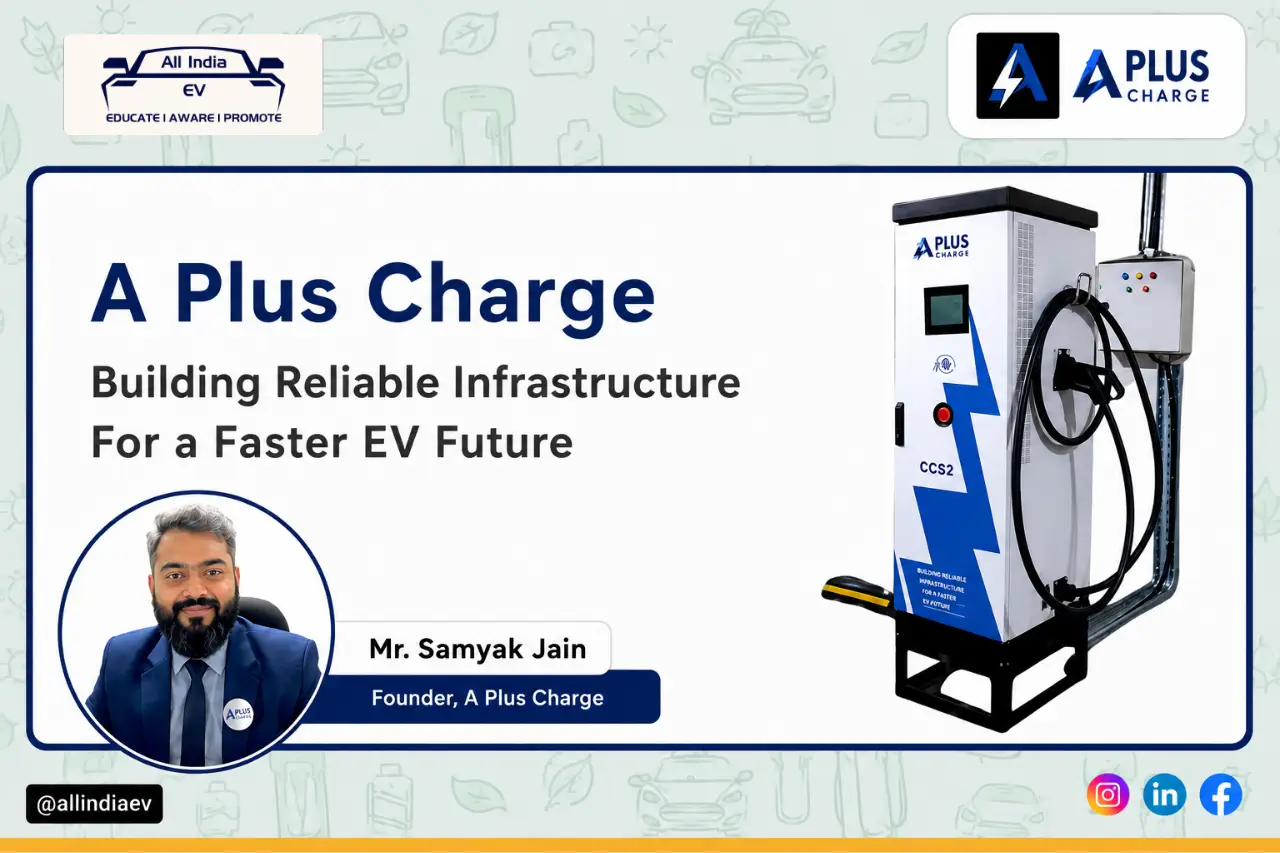
By Mr. Samyak Jain, Founder, A Plus Charge
India’s EV charging network is expanding, but the growth remains heavily concentrated in a handful of states. While Karnataka, Tamil Nadu, Maharashtra, Delhi and Telangana account for a significant share of the country’s public charging infrastructure, the North-East continues to face a very different reality.
The challenge is not simply a lack of demand. For charging operators, the region presents a difficult combination of long travel distances, challenging terrain, lower charging density and uncertain utilisation. Building a dependable network therefore requires more than installing chargers at individual locations; it requires connecting corridors and ensuring that drivers can rely on the network between cities.
This is where A Plus Charge has been focusing its efforts. During H1 2026, the company expanded its presence across the North-East while taking on a larger role in building charging infrastructure in regions where conventional commercial deployment has remained limited.
What Was Achieved in H1 2026
One of the key developments during the first half of 2026 was A Plus Charge’s selection as an empanelled Charge Point Operator for Assam and Tripura under the PM E-DRIVE scheme.
The designation gives the company a state-level role in developing public charging infrastructure supported by central government incentives.
On the ground, this has translated into charging deployments across Guwahati, Shillong, Dibrugarh and Agartala, covering important urban and industrial centres in the region.
A Plus Charge has also initiated Phase 1 of Project NEEV, with the objective of developing an intercity EV charging corridor across the North-East.
For the region, corridor development is particularly important. Unlike dense urban markets where drivers may have several charging options within a relatively short distance, North-Eastern routes can involve significantly longer distances between major centres. Network continuity therefore becomes a fundamental requirement for EV adoption.
Physical infrastructure is only one part of the equation. A Plus Charge has also worked on improving network visibility, with its charging network being made discoverable through platforms including Statiq’s EV Linga, Pulse and MapMyIndia.
A charger that exists physically but cannot be located through the platforms drivers use is of limited practical value. Discoverability, accurate location information and operational visibility are becoming increasingly important components of charging infrastructure.
What Comes Next
A Plus Charge’s next phase involves three commitments that increase progressively in scale.
The immediate priority is the completion of Project NEEV Phase 1, targeting 100 chargers across the region.
The larger objective is to reach 1,600 chargers across the North-Eastern states by March 2028. If achieved, this would represent a substantial increase in the region’s charging infrastructure and could help create the network continuity required for longer-distance EV travel.
The third element is economic sustainability.
In lower-density markets, government support can help bridge the initial capital gap, but subsidies alone cannot determine the long-term viability of a charging site. Charger utilisation ultimately has to increase enough for the infrastructure to remain commercially sustainable.
A Plus Charge’s strategy combines PM E-DRIVE support with higher charger utilisation, particularly through locations and use cases capable of generating stronger demand.
This distinction is important. The objective is not simply to maximise the number of installed chargers, but to build infrastructure that can remain operational and financially viable after the initial deployment phase.
H1 2026 Against H1 2025
A Plus Charge describes H1 2026 as a period of significant operational expansion compared with the previous year.
- Revenue Growth: The company reported substantial financial scaling, with combined revenue from April and May 2026 exceeding its total revenue for the entire 2025–26 financial year.
- Operational Evolution: The company moved from foundational planning toward large-scale physical deployment.
- Regional Expansion: Charging activity expanded across key North-Eastern locations, including Assam and Tripura.
- Ecosystem Integration: A Plus Charge increased its engagement with the wider EV ecosystem through participation in industry and sustainability forums.
- Policy Engagement: The company participated in high-level discussions, including the Delhi Climate Week and World Sustainable Development Summit.
The shift from planning to deployment is particularly significant for emerging EV markets. Infrastructure companies operating in these regions have to balance capital expenditure, demand development, site selection and network reliability at the same time.
Building a Charging Corridor, Not Just Individual Stations
The North-East requires a different infrastructure strategy from India’s established EV markets.
For an EV driver, a charging network is useful only when the next reliable charging point is within reach. This makes corridor planning critical, particularly on routes connecting cities and states.
A Plus Charge’s Project NEEV approach reflects this requirement by focusing on interconnected charging infrastructure rather than treating every station as an isolated asset.
The challenge will be maintaining sufficient utilisation across these corridors while EV adoption develops. Higher utilisation can improve project economics, but utilisation itself depends on vehicle adoption, route traffic, charger availability and consumer confidence.
This creates a cycle that charging operators must actively manage: infrastructure needs to arrive before demand reaches maturity, while the business model must remain sustainable as demand develops.
The Economics Behind the Expansion
The North-East charging opportunity also highlights a broader issue facing India’s EV infrastructure sector: capital efficiency.
Public charging requires significant upfront investment in chargers, electrical infrastructure, land and operations. In markets where EV density remains low, utilisation can take time to reach commercially attractive levels.
Government incentives can reduce part of the initial investment burden, but the long-term economics depend on actual charger usage.
For operators, this makes site selection particularly important. Locations with stronger traffic, commercial demand, fleet activity or intercity relevance can potentially achieve higher utilisation than isolated public charging sites.
A Plus Charge’s strategy is therefore built around combining policy support with commercially viable deployment rather than depending on subsidies as the sole source of project economics.
Why the North-East Matters for India’s EV Transition
The development of charging infrastructure in the North-East has implications beyond the number of chargers installed.
A stronger network can improve intercity EV travel, support commercial fleets and create greater confidence among consumers considering EVs in the region.
It can also help connect the North-Eastern states more effectively with the wider national EV ecosystem. As charging corridors develop, network continuity can become an important enabler for electric mobility across longer distances.
The target of 1,600 chargers across the North-Eastern states by March 2028 will therefore be an important milestone to watch. The more important measure, however, will be how many of those chargers are operational, discoverable and sufficiently utilised.
Looking Ahead
A Plus Charge’s H1 2026 expansion reflects a broader transition in India’s charging industry—from building isolated charging points to developing connected, reliable and commercially sustainable networks.
The North-East presents a difficult operating environment, but it also represents one of India’s most significant infrastructure gaps. Closing that gap will require coordination between government programmes, charging operators, utilities, vehicle manufacturers and local stakeholders.
For A Plus Charge, the next test will be execution: completing the first 100 chargers under Project NEEV, expanding toward the 1,600-charger target and ensuring that the infrastructure remains operational as the regional EV market develops.
The success of the North-East’s charging transition will ultimately not be measured only by how many chargers are installed. It will be measured by whether drivers can depend on them when they need them.