

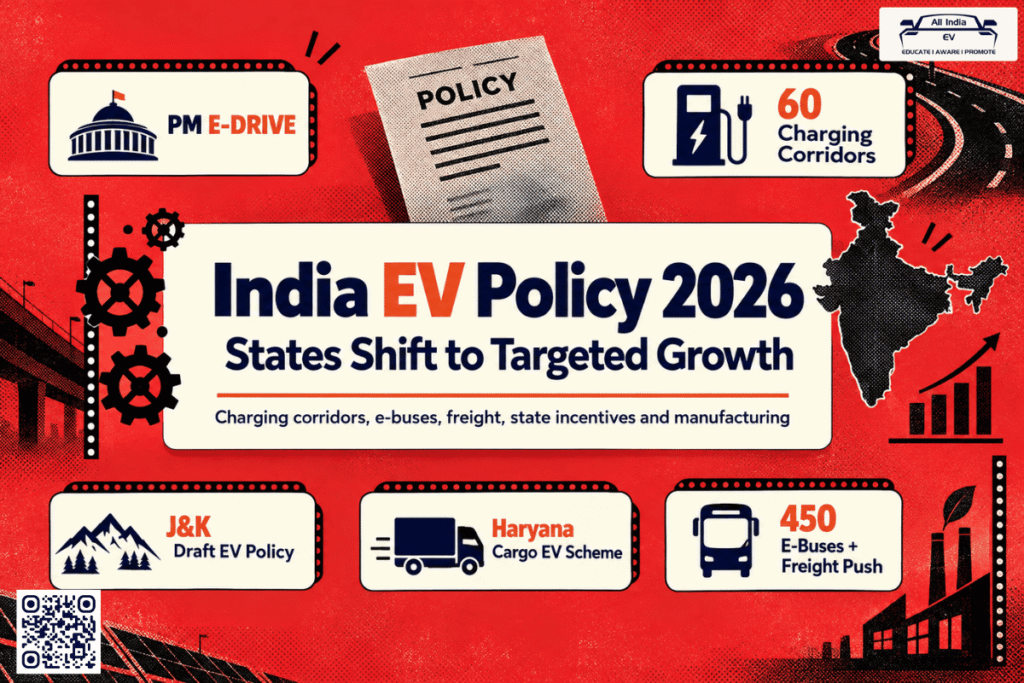
India’s electric mobility policy is entering a different phase.
- PM E-DRIVE Is Becoming the Central Policy Backbone
- NITI Aayog Is Preparing for a State EV Policy Reset
- Charging Policy Is Moving From Numbers to Reliability
- Jammu & Kashmir Is Building Reliability Into Policy Design
- Electric Freight Is Becoming a Dedicated Policy Segment
- Haryana Is Targeting MSME Cargo Electrification
- Electric Bus Policy Is Moving Toward Scale — and Bankability
- States Are Competing for the EV Manufacturing Layer Too
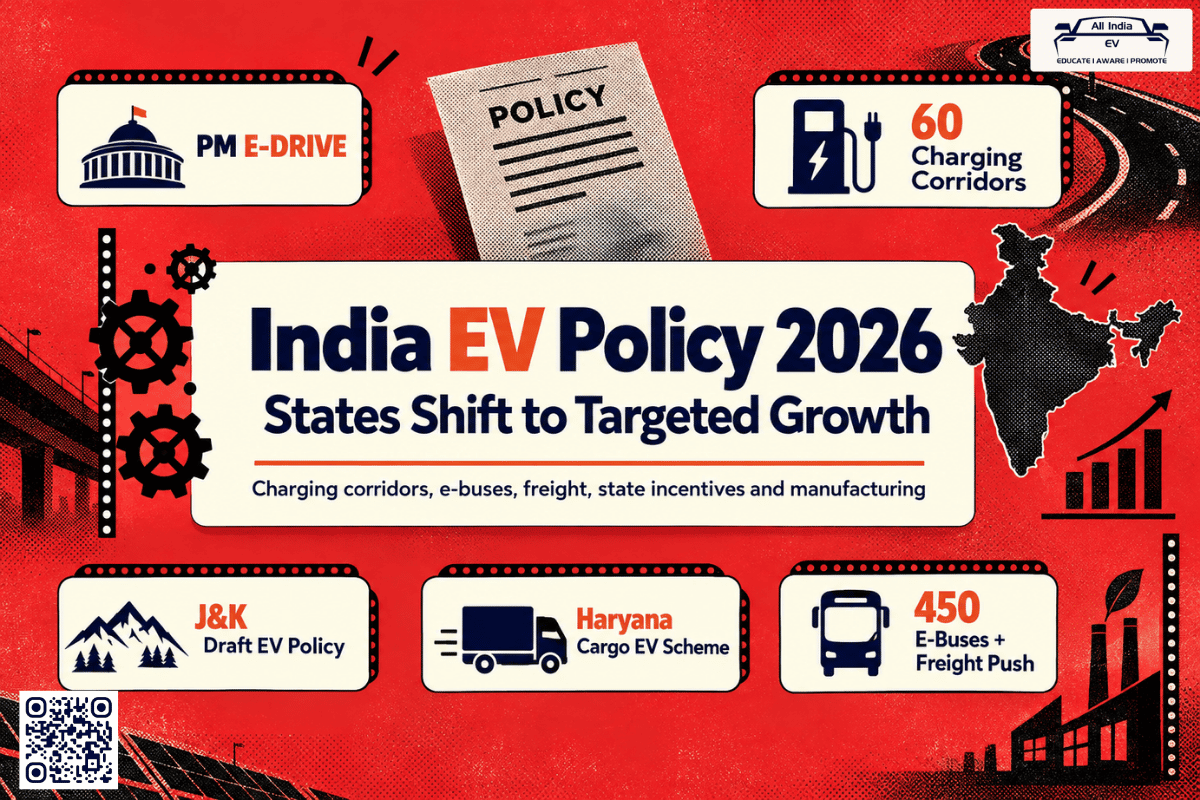
The first phase of the EV transition was dominated by purchase incentives, early charging infrastructure and efforts to create demand. By September 2026, policy activity increasingly points toward a more specialised model: freight corridors for electric trucks, targeted incentives for MSME cargo vehicles, state-specific EV frameworks, high-uptime charging networks, large electric-bus contracts and competition between states for EV manufacturing investment.
The India EV policy 2026 landscape is therefore becoming less about one national incentive programme and more about how central schemes, states, cities, courts and industry work together to solve different parts of the transition.
That shift is visible across a series of developments unfolding almost simultaneously.
PM E-DRIVE Is Becoming the Central Policy Backbone
The Centre’s PM E-DRIVE scheme remains the broadest fiscal framework supporting electric mobility, but its structure continues to evolve.
The Ministry of Heavy Industries’ notification tracker shows that the scheme has already been extended until 31 March 2028. During 2026, the government has issued fresh amendments covering electric two-wheelers, electric buses and N2/N3 electric trucks, while also introducing support for electric ambulances. Further amendments to localisation requirements for e-trucks and e-buses were issued on 3 September 2026.
That pattern matters.
Rather than treating electric mobility as a single vehicle category, the government is increasingly adjusting policy separately for two-wheelers, three-wheelers, buses, trucks, ambulances and charging infrastructure.
At the same time, state policy is becoming more important.
NITI Aayog Is Preparing for a State EV Policy Reset
At least 10 state EV policies are due to expire in 2027, including those of Tamil Nadu, Telangana, Uttar Pradesh, Rajasthan, Chhattisgarh, Himachal Pradesh, Jharkhand, Punjab and Haryana. NITI Aayog has consequently begun work on a next-generation framework that could help states reassess incentives, manufacturing policies and adoption strategies.
This comes as EV penetration continues to rise. India registered around 2.45 million EV sales in FY26, up 25% year-on-year, while EVs represented 8.5% of new vehicle sales, according to Vahan data cited by Mint.
But the most important policy question is increasingly not whether every state should offer the same subsidy.
States are pursuing very different strategies.
Some are prioritising manufacturing incentives. Others are supporting vehicle adoption, charging networks, hybrids, fleet electrification or commercial vehicles.
The newly released India Electric Mobility Index 2025, prepared by WRI India in partnership with NITI Aayog, shows how uneven this development has become. Delhi recorded the highest overall score at 84, followed by Maharashtra at 78, Karnataka at 73, Chandigarh at 71 and Goa at 65. Among large states, Maharashtra and Karnataka were the top performers.
The index also demonstrates why one policy template may not work everywhere. Haryana, for example, scored strongly on charging-infrastructure readiness but much more weakly on transport electrification, showing that infrastructure availability and vehicle adoption do not necessarily progress at the same pace.
Charging Policy Is Moving From Numbers to Reliability
Charging infrastructure is becoming one of the clearest examples of this second policy phase.
The Ministry of Heavy Industries has identified 60 priority highway corridors where it wants assured charging availability. Heavy Industries Secretary Kamran Rizvi has suggested that SIAM and automobile manufacturers could potentially divide responsibility for those corridors among OEMs, although this remains an industry proposal rather than a formally announced allocation policy.
The government has a ₹2,000 crore corpus available for charging infrastructure, but officials are increasingly emphasising reliability rather than simply the number of installed chargers.
Rizvi highlighted complaints from motorists who could see dozens of chargers digitally but discovered that many were unavailable when required. Government adviser Tarun Kapoor similarly linked low utilisation with poor maintenance and argued that professional network operators will become increasingly important.
State governments are moving in the same direction.
Uttar Pradesh plans to add 1,000 EV charging stations across highways, expressways and districts including Lucknow, Noida, Varanasi, Meerut and Ayodhya. The state currently has around 238 charging stations across roughly a dozen districts, according to Uttar Pradesh Power Corporation chairman Ashish Goyal.
In Himachal Pradesh, charging expansion has even become a judicial issue.
The Himachal Pradesh High Court has directed the state government to establish at least two charging stations at every district headquarters, initially at circuit houses, while also seeking charging facilities at Himachal Bhawans in Chandigarh and Delhi. The court observed that charging infrastructure had failed to keep pace with EV deployment and asked the state to explain its implementation framework.
The common theme is clear: public charging policy is moving toward coverage, uptime and accessibility, not installation counts alone.
Jammu & Kashmir Is Building Reliability Into Policy Design
The draft Jammu & Kashmir EV Policy 2026 provides one of the clearest examples of how state-specific policy could evolve.
The draft proposes targets including EVs reaching 40% of new personal four-wheeler registrations, 35% of two-wheelers, 30% of buses and 25% of taxis and shared mobility during the first six years.
But the charging targets are arguably more interesting.
J&K proposes expanding from around 180 charging stations today to 450 by year three and 900 by year six, including 140 priority fast-charging hubs targeted to maintain at least 98% monthly uptime.
The policy also acknowledges something national EV policies rarely address directly: climate.
A proposed Winter Validation Protocol would evaluate battery thermal behaviour, low-temperature charging and the effect of cabin heating under J&K’s sub-zero conditions.
This is what state-specific EV policy increasingly looks like: adapting national electrification objectives to local terrain, climate, power systems and transport use cases.
Electric Freight Is Becoming a Dedicated Policy Segment
Commercial freight is emerging as another major policy focus.
On 7 September, NITI Aayog’s e-FAST India platform launched the Platform for Aggregating Clean Transport (PACT) along with a ZET Marketplace.
PACT is designed to aggregate demand from shippers and logistics service providers and convert that demand into deployment opportunities on specific freight corridors. The platform brings together OEMs, financiers, charge point operators and fleet customers in an attempt to solve one of electric trucking’s biggest problems: individual fleet demand can be too fragmented to justify vehicles and infrastructure at scale.
The timing is significant. Official figures cited by PIB show electric medium- and heavy-duty freight deployments increasing from 201 vehicles in FY25 to 826 in FY26, while more than 3,000 e-MHD trucks are now operating nationally.
Policy is therefore beginning to move from simply subsidising the electric truck toward creating the freight demand, financing and charging ecosystem around it.
Haryana Is Targeting MSME Cargo Electrification
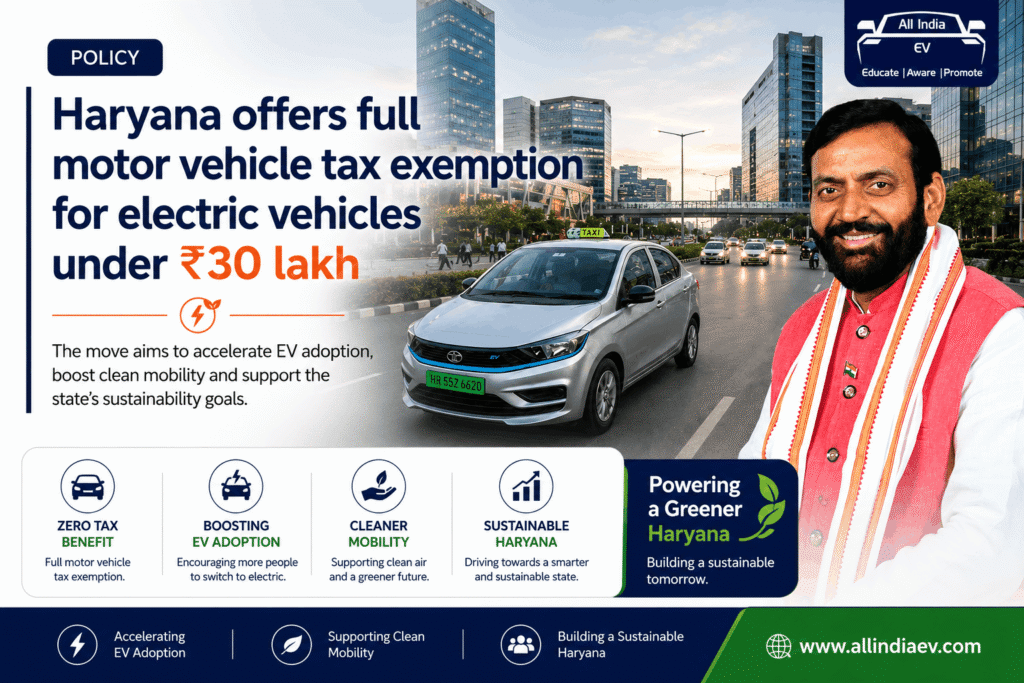
Haryana has taken a particularly targeted approach with its new EV for Cargo Logistic Scheme for MSMEs.
Under the state notification, eligible micro, small and medium enterprises can receive financial assistance equal to 15% of the ex-showroom cost, capped at ₹5 lakh, toward a new cargo EV. The scheme covers qualifying electric cargo trucks and commercial three- and four-wheelers with load capacities between 700 kg and 10,000 kg.
Assistance is limited to one vehicle per MSME and the first 250 eligible applicants, subject to budget availability. Vehicles purchased on or after 1 April 2026 can qualify.
Interestingly, the scheme is intended specifically for MSMEs electrifying their own logistics operations; businesses whose primary activity is logistics or transportation are excluded.
That makes the Haryana programme different from a broad consumer EV subsidy. It is an industrial-productivity policy using commercial EVs as a tool to reduce logistics operating costs for smaller businesses.
Electric Bus Policy Is Moving Toward Scale — and Bankability
Public transport is following another path.
Haryana has added demand for 450 electric buses to CESL’s third tender under the PM E-Bus Sewa scheme, lifting the tender size to 4,054 buses.
But the tender changes reveal a policy challenge beyond vehicle procurement.
CESL has increased the maximum number of buses a single bidder can bid for from 2,400 to 2,717 and is allowing equity raised during FY27 to count toward bidders’ net-worth requirements.
The government has also created a ₹3,433 crore payment security fund intended to reduce the risk of delayed payments by public transport authorities. Concession agreements for 4,470 e-buses across 56 cities have already been signed under PM E-Bus Sewa, with the larger programme targeting 10,000 urban e-buses across 116 cities.
The policy lesson is that electric-bus deployment depends as much on financing, payment security and contract design as it does on vehicle technology.
States Are Competing for the EV Manufacturing Layer Too
The final piece of the policy shift is manufacturing.
At SEMICON India 2026, Karnataka held discussions with several investors, including Euler Motors. The electric commercial vehicle manufacturer has proposed a facility for electric three- and four-wheelers in Karnataka, with the state suggesting Vijayapura as a possible location.
No final investment commitment has been announced, so this remains a proposal rather than a confirmed plant.
But it demonstrates how EV policy competition is expanding from buyer subsidies into land, industrial ecosystems, skills, manufacturing incentives and supply-chain localisation.