


Clean Electric’s packs and SONIC chargers run across most of India, which means they run across most of India’s climates too. A charging system tuned around lab conditions does not survive that spread. 0Kelvin™ is Clean Electric’s answer: an immersion cooling EV battery architecture paired with a predictive temperature and current control layer. Together, they determine whether “20-minute charge” is a number shown once in a lab, or a number a fleet operator can plan a route around.
- Why Temperature, Not the Charger, Limits EV Fast Charging
- How Immersion Cooling EV Battery Design Enables Faster, Safer Charging
- Predictive Temperature and Current Control: The 0Kelvin Control Layer
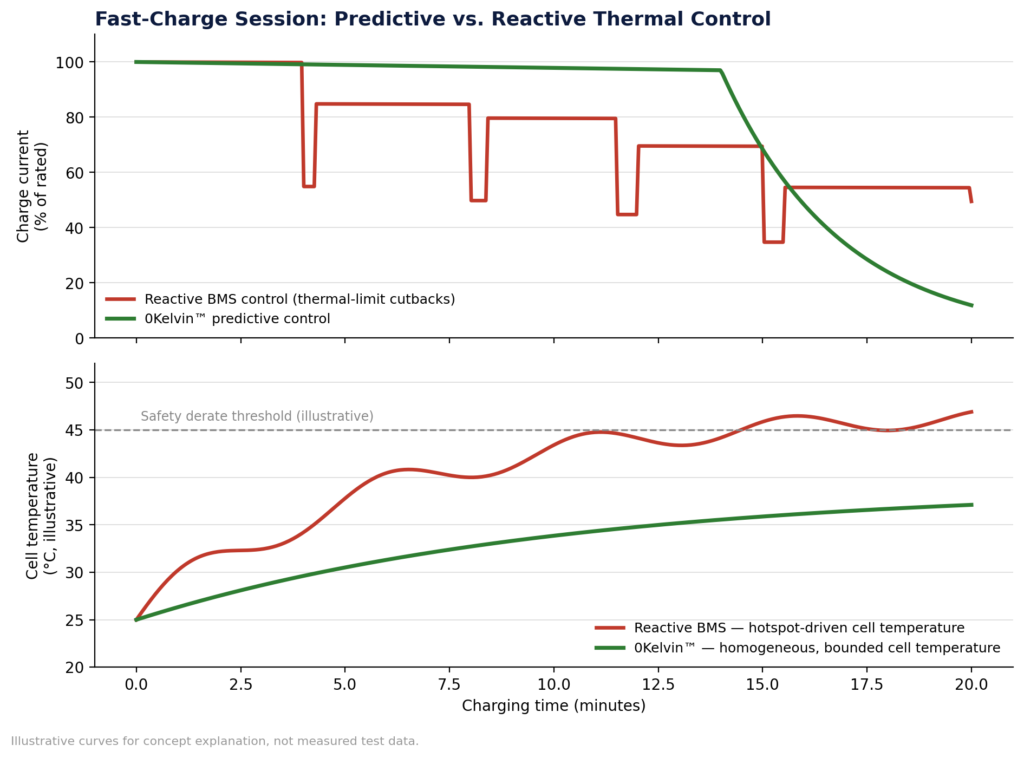
- Reactive Control vs. 0Kelvin Predictive Control
- SONIC20: The DC Fast Charger Built to Match Predictive Control
- Why Fleet Scale Matters for EV Fast Charging Claims
- Frequently Asked Questions
- Key Takeaways
Why Temperature, Not the Charger, Limits EV Fast Charging
Charge acceptance in a lithium-ion cell depends heavily on how warm that cell already is. Push current into a hot cell, or into a pack where some cells run hotter than others, and the result is lithium plating, faster SEI growth, and local hotspots, early steps toward capacity fade and, in bad cases, thermal runaway.
- Most battery systems handle heat reactively: monitor temperature, and once a cell crosses its limit, cut current.
- This approach works, but it is blunt, and the cost shows up directly in charge time.
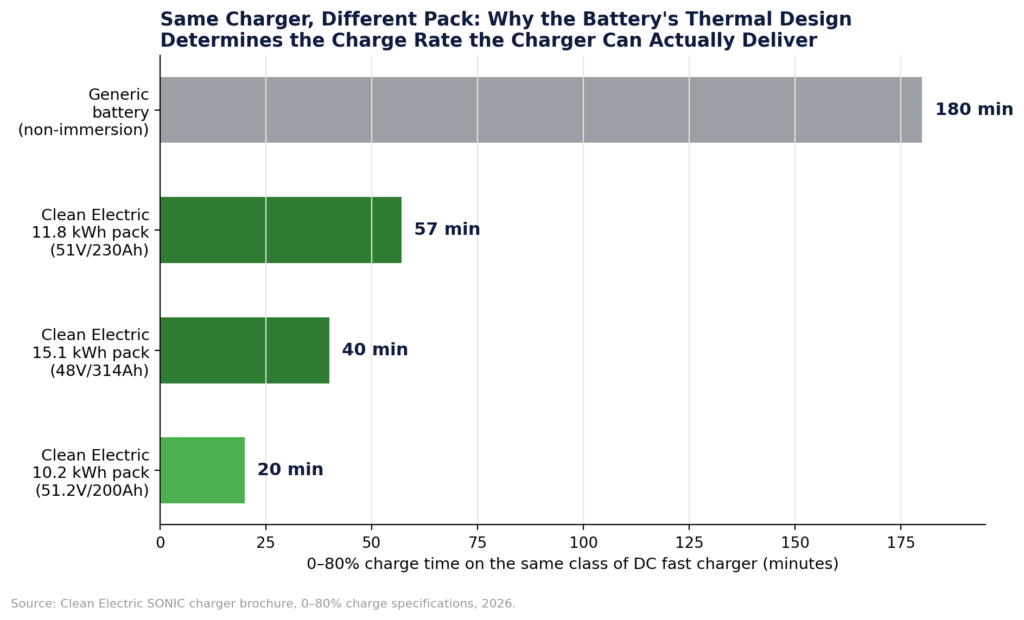
- A conventional, non-immersion-cooled EV battery pack charging 0-80% on a comparable DC fast charger takes roughly 180 minutes, even when the charger itself is rated to deliver far more power.
Key takeaway: A charger’s rated output and a pack’s real-world charge rate are two different numbers. Thermal management is what sits between them, making it the real bottleneck in EV fast charging, not the charger hardware.
How Immersion Cooling EV Battery Design Enables Faster, Safer Charging
In a 0Kelvin™ pack, every cell sits directly in circulating, non-flammable dielectric coolant rather than being cooled only at the edges through a cold plate. Three effects follow, and all three are central to fast charging performance:
- Higher contact area: roughly 7-10x more than plate cooling, so heat leaves the cell close to where it is generated, exactly what’s needed at high C-rates.
- Narrower cell-to-cell temperature spread: the battery management system (BMS) tracks one thermal picture instead of sixteen or twenty diverging ones.
- Uniform degradation across the pack: this is what allows an aggressive charge rate to hold out to 3,000-4,000 cycles, instead of derating early to protect a handful of outlier cells.
Charge Time Comparison: Immersion Cooling vs. Conventional Packs
Three Clean Electric immersion-cooled packs, charged 0-80% on the same class of DC fast charger used for a generic (non-immersion-cooled) pack, show the practical difference in charge time.
Chart: Same class of charger, different pack, 0-80% charge time by pack thermal design. Source: Clean Electric SONIC charger brochure, 2026.
Important distinction: Immersion cooling is what makes it safe to request a high charge rate in the first place. On its own, it does not make charge time repeatable session after session, climate after climate. That is the control system’s job, covered next.
Predictive Temperature and Current Control: The 0Kelvin Control Layer
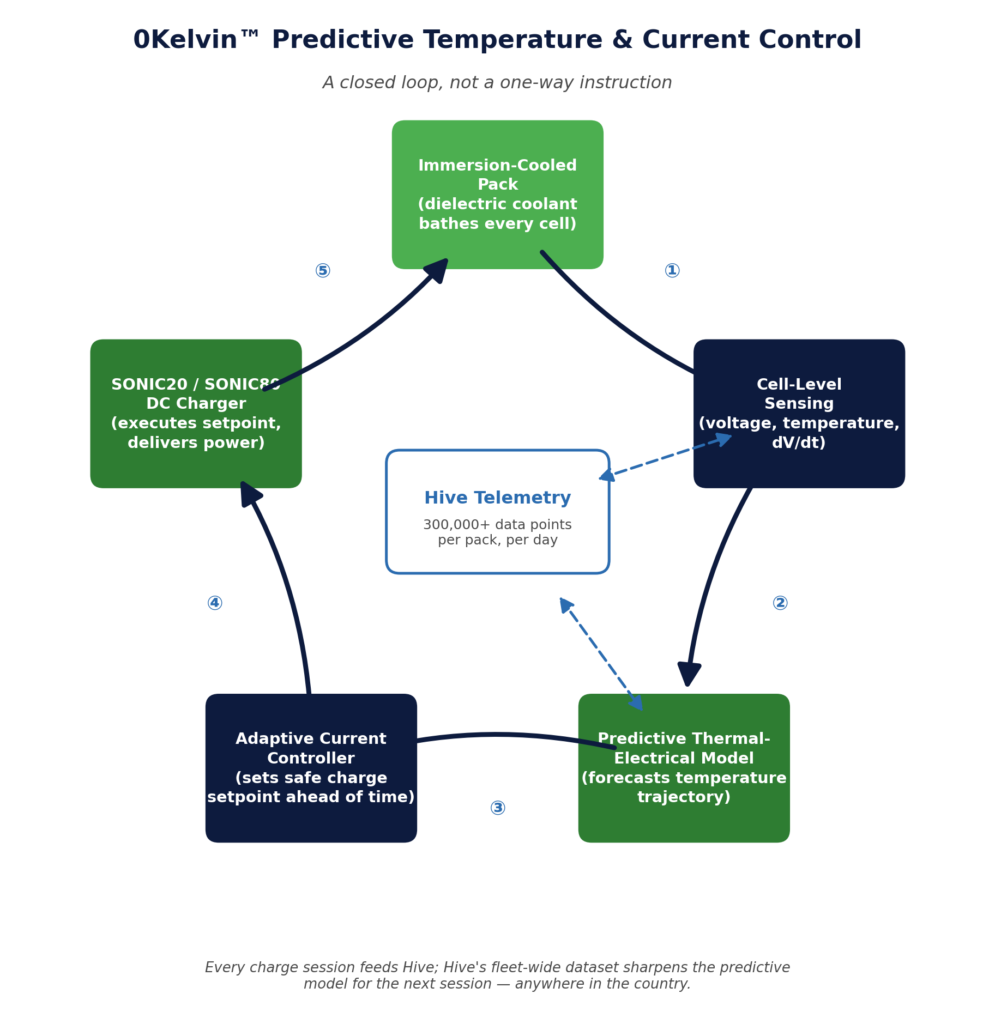
Rather than waiting for a temperature limit to be crossed and then cutting current, 0Kelvin™ continuously models where each cell’s temperature is heading. Live cell voltage, current, and temperature telemetry feed that model, moving the current setpoint ahead of the thermal event instead of reacting after it.
This telemetry comes from Hive, Clean Electric’s battery intelligence platform, which logs roughly 3 lakh (300,000+) data points per pack per day. Inside a single charging session, this data drives real-time control. Across the fleet, it builds the training dataset for the predictive model, so charge sessions in one part of the country improve charging behaviour in another.
Diagram: The 0Kelvin™ control loop. Sensing, prediction, and control run continuously, with Hive telemetry feeding the model in both directions.
Reactive Control vs. 0Kelvin Predictive Control
| Reactive Control | 0Kelvin™ Predictive Control | |
|---|---|---|
| Trigger | Temperature limit already crossed | Temperature trajectory forecast in advance |
| Current profile | Sharp cutbacks and step derates | Smooth, near-continuous taper |
| Cell spread | Driven by hotspots, uneven | Homogeneous and bounded |
| Charge time consistency | Drifts with age, ambient temperature, and geography | Holds across cycles and climate |
Chart: Illustrative session comparison, the step-cutback pattern of reactive control against the smooth predictive taper of 0Kelvin™.
SONIC20: The DC Fast Charger Built to Match Predictive Control
Predictive control on the battery pack is only as good as the charger’s ability to follow it, on a Delhi rooftop in June and in a Manali charging bay in January alike. That requirement shaped the design of the SONIC20, Clean Electric’s 20 kW Type-6 DC fast charger.
- Wide operating envelope: rated for -20°C to 75°C ambient, IP55-rated, and specified for outdoor installation up to 5,500 m with derating.
- 200 A output at up to 120 V: delivers the full 20 kW when the pack’s controller requests it, rather than holding to a conservative fixed profile.
- Auto-start charging: charger and pack handshake and begin the session on connection, so the control loop runs from the first second.
- 94%+ conversion efficiency: less grid power is lost as heat the cooling system then has to remove.
- OCPP over 4G connectivity: keeps every session’s telemetry inside the same fleet-wide dataset the predictive model learns from.
The 80 kW SONIC80 extends the same architecture to dual-gun simultaneous charging for larger packs. The underlying principle is unchanged: the charger is an active participant in the control loop, not a power source sitting outside it.
Why Fleet Scale Matters for EV Fast Charging Claims
Clean Electric has approximately 6,000 immersion-cooled batteries deployed in the field, spread across India rather than concentrated in one city or climate zone. At that scale, a fast-charging claim is only meaningful if it holds up in three directions:
- Across geography: the same model must work in coastal humidity, desert heat, and Himalayan cold, which is why both the pack’s thermal system and the charger’s operating envelope are specified for climate extremes rather than average conditions.
- Across pack lifetime: because degradation is even, the charge time a fleet plans around in year one does not quietly stretch out by year two.
- Across the pack-charger boundary: prediction is wasted if the charger cannot deliver what the model requests, which is why SONIC20 and SONIC80 were engineered alongside the packs rather than sourced as generic accessories.
Frequently Asked Questions
What is immersion cooling in an EV battery? Immersion cooling submerges each battery cell directly in circulating, non-flammable dielectric coolant, rather than cooling only at the pack’s edges through a cold plate. This increases heat-transfer contact area by roughly 7-10x and keeps cell-to-cell temperatures closely matched.
How does predictive temperature control differ from standard BMS thermal management? Standard (reactive) battery management systems cut current only after a temperature limit is crossed. Predictive control, as used in 0Kelvin™, continuously forecasts each cell’s temperature trajectory using live voltage, current, and temperature telemetry, adjusting the current setpoint before a thermal limit is reached.
How fast can an immersion-cooled EV battery charge compared to a conventional pack? In Clean Electric’s comparison, a conventional non-immersion-cooled pack takes roughly 180 minutes for a 0-80% DC fast charge on a comparable charger, while 0Kelvin™ immersion-cooled packs charge substantially faster on the same class of charger, while holding that charge rate over 3,000-4,000 cycles.
Key Takeaways
- Immersion cooling EV battery design is what makes high fast-charging current safe to request in the first place.
- Predictive temperature and current control, not immersion cooling alone, is what makes the charge time repeatable across sessions, seasons, and geography.
- Charger hardware (SONIC20, SONIC80) has to be engineered to execute that prediction accurately, with a wide climate rating and real-time telemetry, or the pack-side gains are capped.
- Claims about EV fast-charging speed are only credible at fleet scale: across geography, across pack lifetime, and across the full pack-charger system.


