

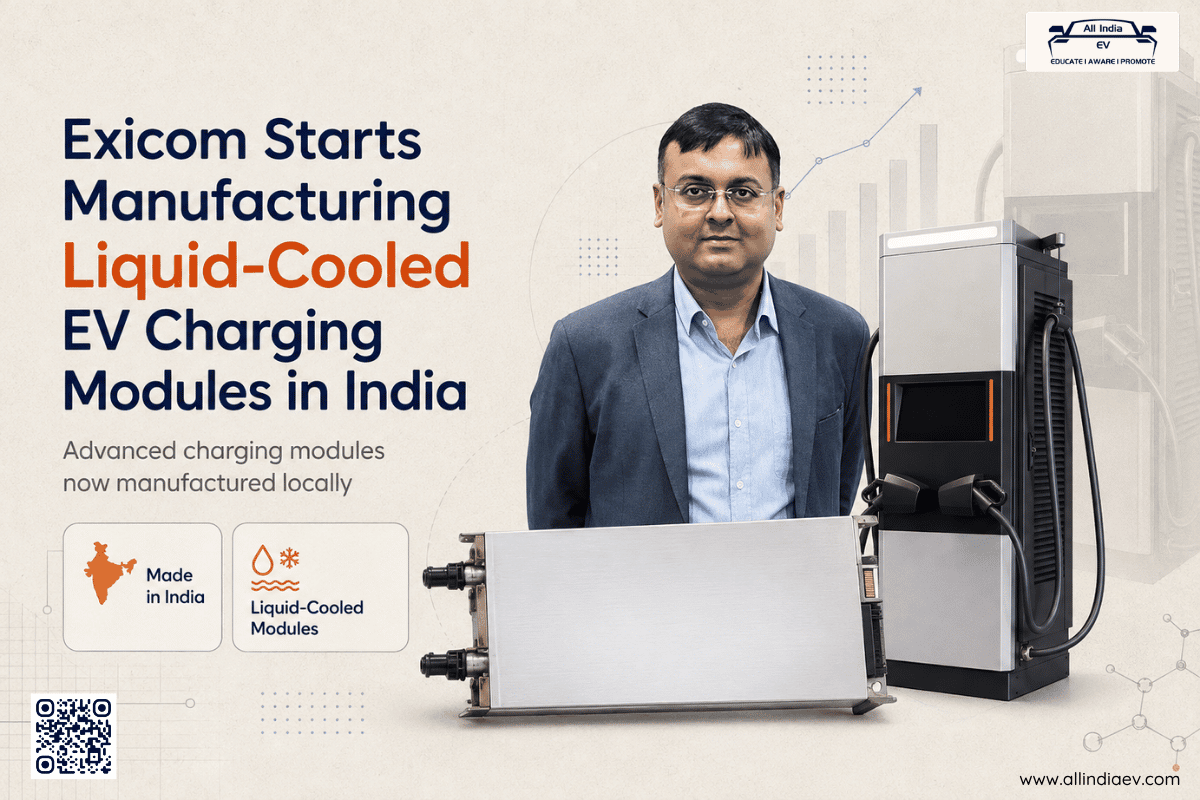
Exicom Tele-Systems has started manufacturing advanced liquid-cooled AC-DC and DC-DC power modules for EV chargers at its Hyderabad facility and has begun exporting the India-made modules to the United States.
Exicom says it is the first Indian company to manufacture this class of liquid-cooled power electronics domestically. The development follows nearly two years of engineering and validation work and an investment of approximately $3.5 million in technology development and manufacturing capability.
The modules will initially support Exicom’s international charging business, including next-generation chargers developed under the Tritium portfolio.
Why Liquid Cooling Matters for Fast Chargers
As DC chargers move towards higher power outputs, thermal management becomes increasingly important.
Power electronics convert grid electricity into the controlled DC power required by an EV battery. That conversion generates heat, particularly when chargers operate continuously at high power.
Traditional chargers commonly use air cooling, where fans move air across electronic components.
Liquid-cooled systems instead move coolant closer to heat-generating components, allowing heat to be removed more effectively.
Exicom says its liquid-cooled architecture can maintain internal temperatures around 10°C lower than comparable air-cooled systems during demanding operation. The company also cites thermal stress as a major contributor to power electronics failures.
The technology therefore becomes increasingly relevant as the market moves toward ultra-fast charging for electric cars, buses and heavy commercial vehicles.
Exicom Claims Efficiency of Up to 99%
Another important number is efficiency.
According to Exicom EVSE CEO Anshuman Divyanshu, the new modules can achieve efficiency of up to 99%, compared with roughly 95-96% for conventional modules.
The modules also use silicon carbide-based power electronics, a technology increasingly being adopted in high-power EV charging because of its ability to operate efficiently at higher voltages and temperatures.
Even a small improvement in conversion efficiency can matter when a charger repeatedly handles hundreds of kilowatts.
Less energy lost during conversion means lower heat generation and potentially better operating economics over the charger’s lifetime.
Tritium Acquisition Begins Showing Technology Benefits
The development also provides a clearer picture of why Exicom acquired the business and assets of Australian DC fast-charging company Tritium in 2024.
Tritium had already developed expertise around liquid-cooled fast chargers. Exicom subsequently worked on next-generation liquid-cooled modules that could be manufactured in India.
The Hyderabad-made modules are now being shipped to Exicom’s US facility and will power rectifiers used in next-generation Tritium chargers.
Initial production is primarily aimed at North American and European markets, including Tritium’s TRI-FLEX and DC-FLEX charging systems. Exicom also plans to integrate the architecture into its Harmony charger portfolio.
India Moves Deeper Into EV Charger Manufacturing
The larger story is not simply that another charger component is being produced locally.
India’s charging industry has historically depended on imported power electronics and specialised components even where final charger assembly happened domestically.
Exicom is attempting to move further upstream by developing and manufacturing one of the more technically demanding parts of the charger in India.
And importantly, these modules are not being developed only for domestic deployment. They are already entering the global supply chain through exports.
That makes this development worth watching.
India’s EV charging opportunity is gradually moving from installing chargers to engineering the technology inside them.