

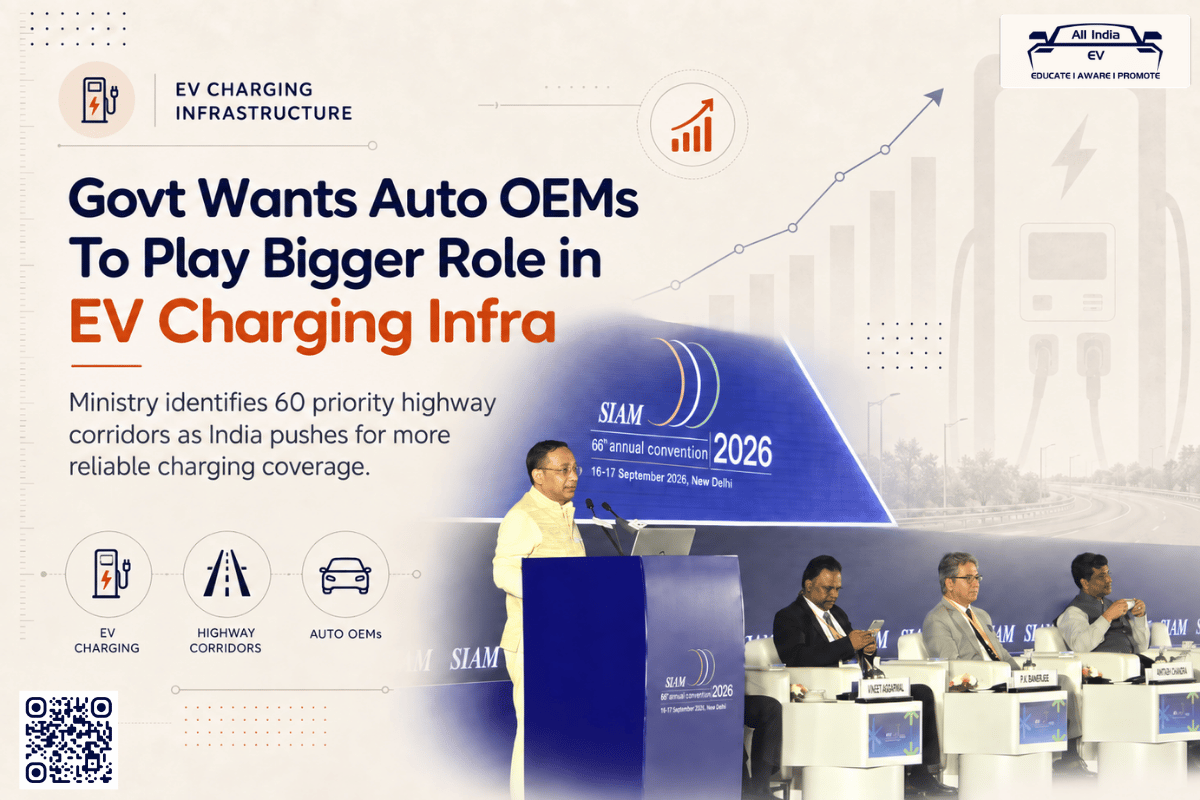
India’s automobile manufacturers may need to become more directly involved in building the charging networks required to support the vehicles they sell.
The Ministry of Heavy Industries has identified 60 high-priority highway corridors where it wants assured EV charging coverage and has shared the list with the Society of Indian Automobile Manufacturers (SIAM). Heavy Industries Secretary Kamran Rizvi has suggested that the industry body could coordinate with automakers to divide these corridors among manufacturers and develop reliable charging infrastructure for electric cars, buses and trucks.
For EV charging infrastructure in India, this could represent an important change in approach: moving some responsibility for infrastructure closer to vehicle manufacturers rather than relying primarily on independent charge point operators and public-sector companies.
Government Identifies 60 Priority EV Charging Corridors
The proposal would potentially assign individual highway corridors to automakers, allowing companies to ensure adequate charging coverage along specific routes.
However, this is not yet a formal corridor-allocation programme. Rizvi presented the idea as a proposal for SIAM and the automotive industry rather than announcing a final government policy.
The objective is to create dependable highway charging coverage over the next two to three years, particularly as electric passenger vehicles and commercial EVs begin travelling longer intercity routes.
Rizvi argued that automakers cannot assume charging infrastructure will develop in the same way as petrol stations did for internal-combustion vehicles. Unlike the mature petroleum distribution ecosystem, EV infrastructure is still being built and requires closer coordination between vehicles, locations, power availability and operators.
₹2,000 Crore Already Allocated for EV Charging
The government has allocated ₹2,000 crore under the PM E-DRIVE scheme for public EV charging infrastructure across India.
Official Ministry of Heavy Industries documents confirm that the allocation covers EV public charging stations, battery swapping stations and battery charging stations.
Rizvi indicated that government support could potentially be structured to encourage automakers to participate in corridor development. The exact mechanism, however, has not yet been announced.
The government’s concern is also shifting from simply counting chargers to ensuring that chargers actually work.
Rizvi cited user feedback in which multiple charging stations appeared along a route digitally, but many were unavailable or non-functional when drivers arrived.
Charger Reliability Is Becoming the Bigger Question
Advisor to the Prime Minister Tarun Kapoor also highlighted the relationship between utilisation and reliability.
Low-utilisation charging stations can become difficult to maintain commercially. Poor maintenance then reduces reliability, which in turn discourages EV drivers from using those stations — creating a cycle that weakens utilisation further.
This suggests that the next phase of EV charging infrastructure in India may require more emphasis on uptime, utilisation and professional network operations, rather than installation numbers alone.
Highway Charging Could Change Electric Truck Economics
The government’s corridor strategy becomes particularly important for electric trucks.
Reliable chargers positioned at shorter intervals could allow truck manufacturers and fleet operators to potentially use smaller battery packs, reducing vehicle weight and upfront cost. Heavy-duty EVs are especially sensitive to charging availability because downtime directly affects commercial vehicle utilisation.
Electric bus depots could eventually contribute additional charging capacity as well. Rizvi said around 160 cities are expected to have electric buses over the next two to three years, creating depot infrastructure that could potentially support a broader commercial EV ecosystem.