

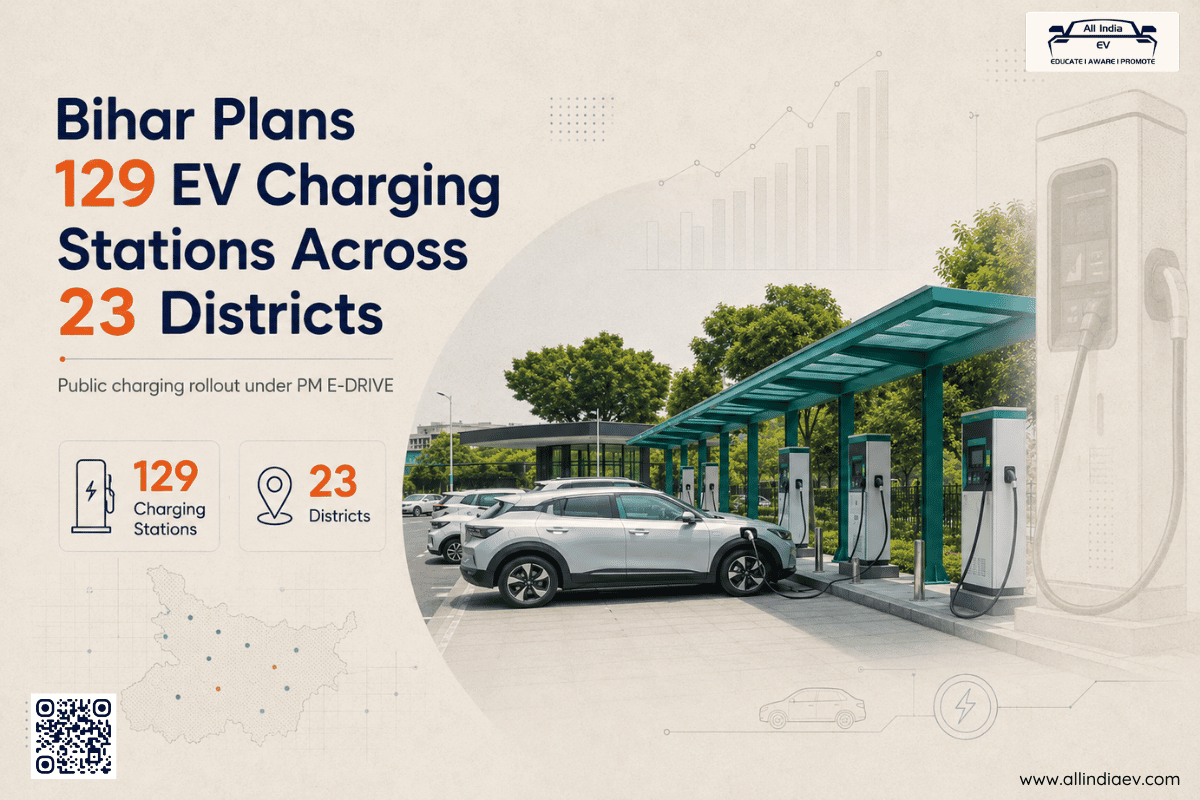
Bihar has started groundwork for a major expansion of its public electric vehicle charging network, with 129 EV charging stations proposed across 23 districts in the first phase.
The rollout is being developed under the central government’s PM E-DRIVE scheme, with Bharat Heavy Electricals Limited (BHEL) working alongside the Ministry of Heavy Industries and Bihar authorities to identify technically viable charging locations.
The development comes as Bihar’s registered electric vehicle population has crossed 5.1 lakh vehicles, increasing the need for charging infrastructure beyond major urban centres.
BHEL Begins Site Surveys
BHEL began technical surveys on August 17 at 72 identified locations across Patna, Gaya, Vaishali, Purnia, Nalanda and Chhapra.
The surveys are evaluating several factors before charging stations can move towards installation, including:
- Land availability
- Grid and power connectivity
- Site accessibility
- Technical suitability
- Space required for charging infrastructure
The findings will determine which proposed sites are suitable for actual deployment.
This distinction is important.
Announcing a charging location does not automatically mean a charger is ready for installation. Power availability, transformer capacity, land ownership and vehicle accessibility can all affect whether a proposed site eventually becomes operational.
Bihar’s decision to conduct technical surveys before installation could therefore help reduce execution problems later in the project.
₹2,000 Crore Allocated for Charging Under PM E-DRIVE
The charging network is being supported through PM E-DRIVE, which was launched with an overall outlay of ₹10,900 crore.
Of this, approximately ₹2,000 crore has been earmarked for public EV charging infrastructure across India.
Bihar intends to deploy its charging network in phases, with highways and important urban areas receiving priority.
For the state, the requirement is becoming increasingly visible.
As of July 2026, Bihar had more than 5.1 lakh registered EVs, including approximately:
- 3.37 lakh e-rickshaws
- 92,895 electric motorcycles and scooters
- 61,983 passenger electric three-wheelers
- 4,093 electric goods three-wheelers
- 3,847 electric cars
- 50 electric buses
This vehicle mix also means Bihar’s charging strategy cannot be designed around electric cars alone.
Bihar’s Charging Opportunity Is Different
Bihar is one of India’s largest electric three-wheeler markets, meaning much of its EV adoption has historically depended on locally charged commercial vehicles.
A wider public charging network could gradually support a different layer of demand, including electric cars, commercial vehicles and intercity EV travel.
The proposed 129 stations can therefore serve two purposes.
Within cities, they can improve access to dependable public charging.
Along major roads, they can help reduce the infrastructure gaps that still make longer electric journeys difficult.
However, the key number to track will not remain 129 proposed stations.
For All India EV, the more important metric will be how many locations successfully move through survey, approval, power connection, installation and finally operational status.
That conversion from proposal to operational charger will determine whether Bihar’s latest charging push becomes meaningful infrastructure rather than another announcement on paper.