

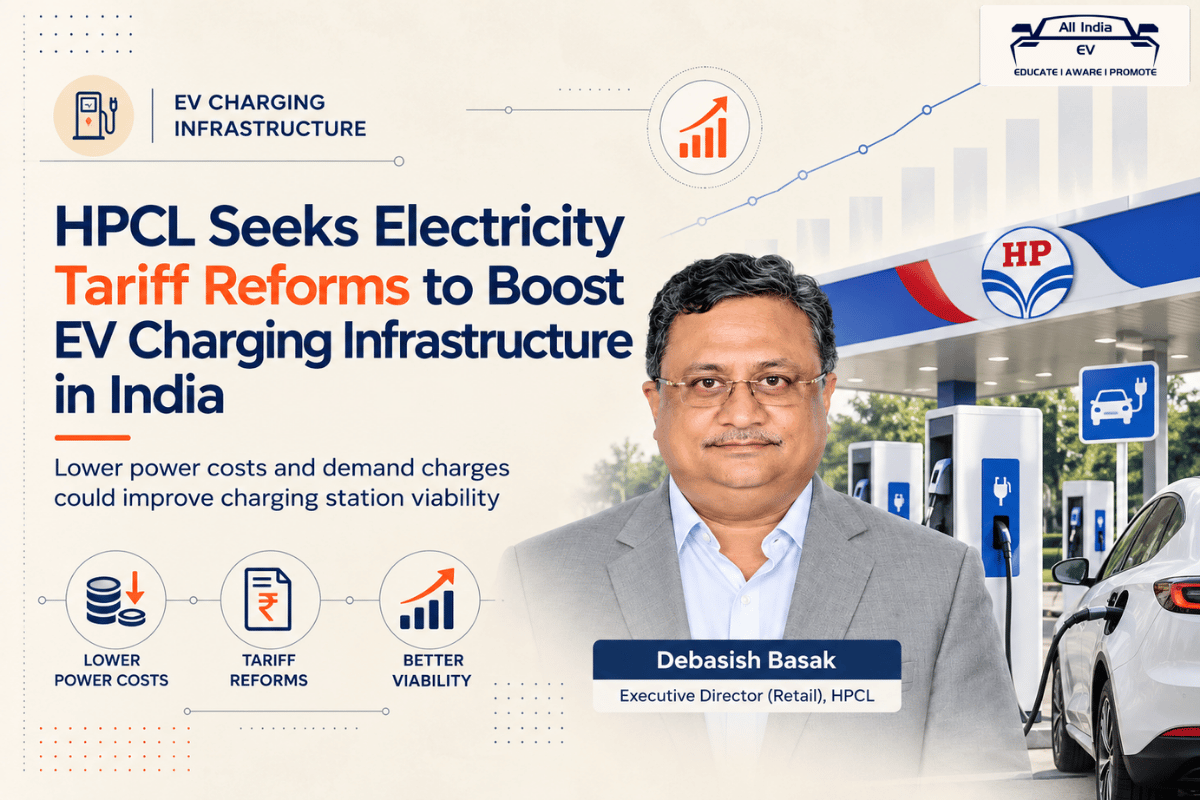
Hindustan Petroleum Corporation Limited (HPCL) has called for electricity tariff reforms, lower demand charges and faster power connections to improve the commercial viability of electric vehicle (EV) charging stations in India. The company believes that reducing operating costs and simplifying electricity-related procedures will encourage investment in public charging infrastructure and support the country’s transition to electric mobility.
According to HPCL Executive Director (Retail) Debasish Basak, a more supportive electricity tariff framework is essential to make EV charging projects financially sustainable. The company has recommended a coordinated review of electricity tariffs, demand charges, grid connection costs and applicable service-charge ceilings to improve returns for charging station operators.
High Costs Continue to Challenge EV Charging Operators
Despite the expansion of electric mobility in India, public charging infrastructure continues to face financial challenges. High initial investment requirements, electricity costs and relatively low charger utilisation can make it difficult for operators to generate consistent returns.
HPCL noted that the economics of charging stations depend on several factors, including charger capacity, location, electricity tariffs and operating expenses. According to Basak, DC fast chargers may require utilisation levels of around 15–25% to achieve attractive economics, depending on the project’s cost structure.
Lower demand charges and transparent electricity pricing could help operators manage expenses, particularly during the early stages of deployment when charging demand is still developing.
HPCL Targets 6,000 EV Chargers by FY27
HPCL is continuing to expand its electric vehicle charging network across the country. The company has grown its network by approximately 8% to 5,826 charging facilities, comprising 2,180 AC slow chargers and 3,656 DC fast chargers.
After adding 640 chargers in the previous financial year, HPCL installed another 541 charging facilities between April and September 2026. It aims to increase its network to approximately 6,000 chargers by the end of the 2026–27 financial year.
The company is also planning to deploy around 100 high-power chargers rated at 240 kW along strategic highway corridors. These installations are expected to support faster charging and improve the convenience of long-distance electric vehicle travel.
HPCL is targeting electric trucks and buses across 50 highway corridors, reflecting the growing importance of charging infrastructure for commercial and heavy-duty electric vehicles.
Expansion Beyond Traditional Fuel Stations
Alongside its highway network, HPCL is expanding into residential complexes, offices, shopping malls, commercial centres and fleet depots. The company is exploring partnerships and asset-light business models to control investment costs while increasing charger availability.
HPCL has already installed charging stations at eight residential welfare associations in Mumbai and Bengaluru, with energy dispensation exceeding 5 MWh. It is also exploring partnerships with housing societies, real estate developers and charging operators to expand residential charging facilities.
Battery swapping is another area of interest, particularly for electric two-wheelers, three-wheelers and commercial fleets that require quick turnaround times.
Profitability Becomes a Key Priority
HPCL aims to transform EV charging from a customer-retention initiative into a sustainable, revenue-generating business by March 2030. Achieving this goal will depend on higher charger utilisation, reliable operations, competitive electricity procurement and disciplined investment.
The proposed tariff reforms could help reduce financial pressure on charging operators and encourage wider infrastructure development. For India’s EV ecosystem, a commercially sustainable charging network will be essential to improving accessibility, supporting fleet electrification and strengthening consumer confidence in electric mobility.