

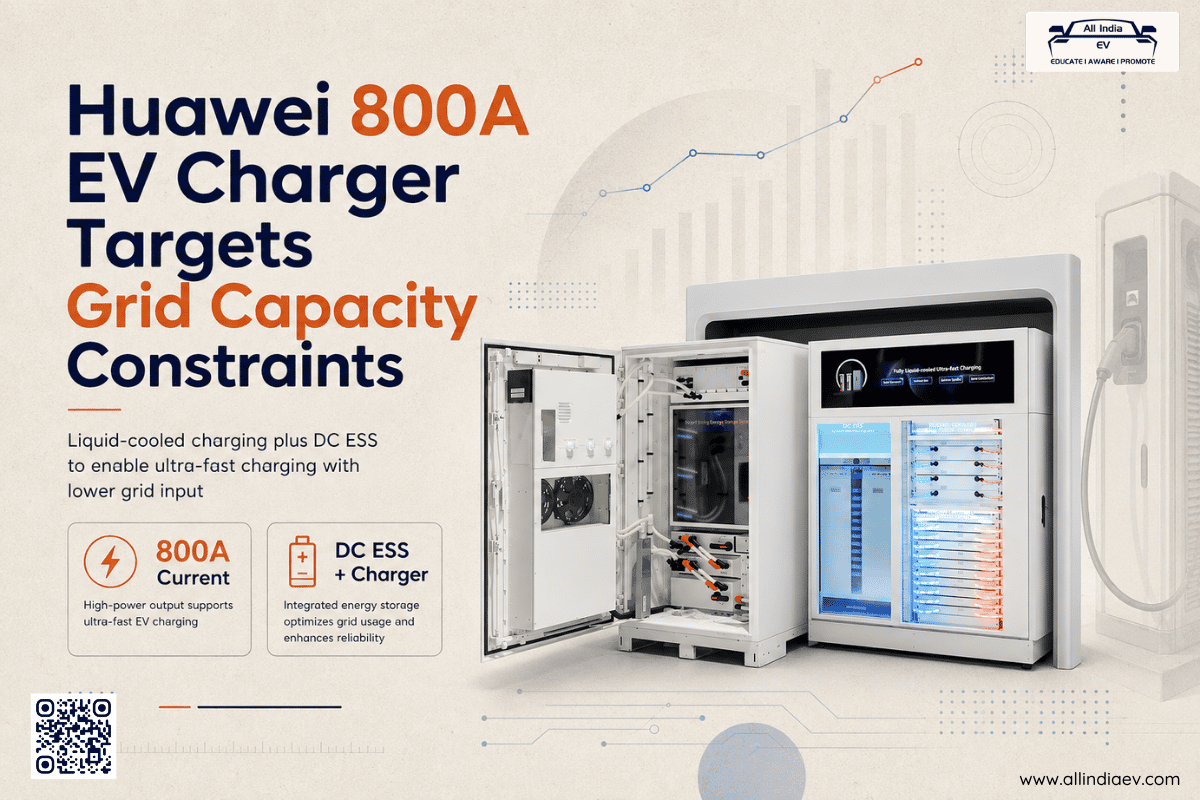
Huawei Digital Power has introduced an upgraded 800A liquid-cooled EV charging dispenser alongside a new DC energy storage and charger solution designed to tackle one of the biggest constraints facing ultra-fast charging stations: insufficient grid capacity.
The technology was showcased at Power2Drive Europe 2026 in Munich as part of Huawei’s FusionCharge portfolio.
The upgraded charging dispenser supports up to 800A current across a 150V-1,000V operating range, while Huawei’s liquid-cooled charging architecture can deliver up to 720 kW of total power.
Huawei claims the system can add more than 200 km of driving range in approximately five minutes, depending on the vehicle’s charging capability.
From 500A to 800A Charging
The new dispenser represents a substantial current upgrade over Huawei’s earlier generation.
Huawei’s 2025 liquid-cooled charging solution supported up to 500A per charging connector. The latest generation increases that figure to 800A.
Higher current becomes particularly relevant for high-voltage electric vehicles and commercial fleets where reducing charging time can directly improve asset utilisation.
Huawei has retained full liquid cooling across the system, which helps manage the thermal load created during high-power charging.
The company also states that operating noise can remain below 55 dB, while liquid cooling is intended to improve charger durability and reduce maintenance requirements.
But the more interesting technology may sit behind the charger.
DC ESS + Charger Needs Just 50 kW Grid Input
Huawei has paired the charging platform with a new DC-based Battery Energy Storage System + Charger solution.
The objective is simple: allow ultra-fast charging stations to operate even where the electricity grid cannot immediately provide hundreds of kilowatts of additional capacity.
According to Huawei, the system can operate with grid input starting from only 50 kW by using battery storage to supplement grid power when vehicles require much higher charging output.
This could significantly change charging station deployment economics.
A charging operator may have access to an excellent highway or urban location but discover that obtaining a 500 kW or 1 MW grid connection requires expensive transformer upgrades, utility approvals and months of construction.
Battery storage provides another option.
Electricity can be accumulated gradually when demand is low and discharged quickly when an EV arrives for ultra-fast charging.
Huawei says its DC architecture can enable deployment of an ultra-fast charging station in as little as one week in suitable situations where grid capacity is constrained.
Storage Could Become Part of EV Charging Infrastructure
Huawei reports a 92.1% round-trip efficiency for the DC ESS architecture, partly because direct DC coupling reduces unnecessary power conversions between the storage system and charger.
The architecture can also integrate solar generation, storage and charging infrastructure.
This development points toward a wider shift in the EV charging market.
The next generation of high-power charging stations may no longer consist simply of grid connection + charger.
Increasingly, the architecture could become:
Grid + solar + battery storage + ultra-fast charger + intelligent power management.
That matters especially for highway charging, electric truck depots and fleet hubs where charging demand may grow faster than local grid infrastructure.
Huawei’s 800A charger therefore represents more than a race for higher charging power.
The bigger innovation is creating a charging station capable of delivering ultra-fast charging without requiring the grid itself to provide all that power at the exact moment the vehicle plugs in.