

Bajaj and Hero Gain Ground as TVS Retains the Lead
- The September Scorecard
- TVS Leads, but Bajaj Narrows the Gap
- Hero Delivers the Strongest Growth Among the Leading Six
- Ather Expands, but Loses Relative Share
- Ola Declines as the Wider Dataset Expands
- Greaves and River Grow; BGauss Holds Near 5,000 Units
- Smaller Manufacturers Produce Some of the Sharpest Movements
- What September Means for the Competition
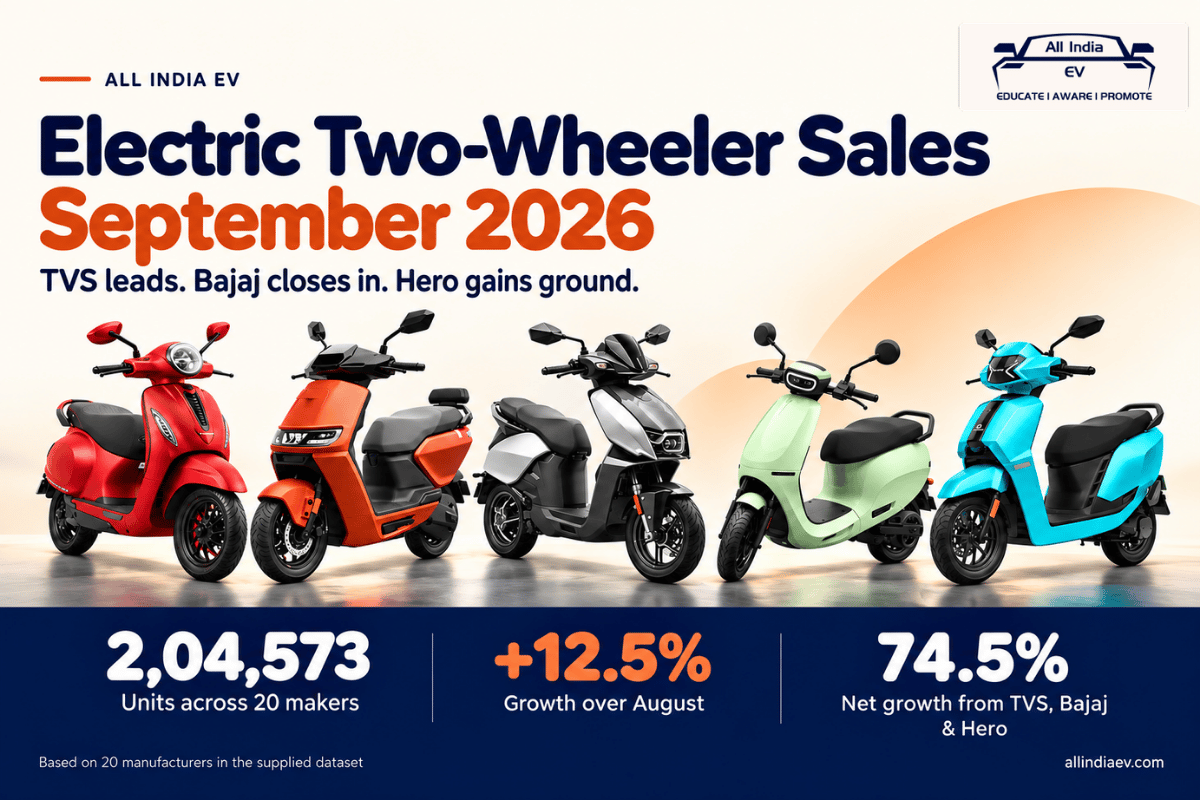
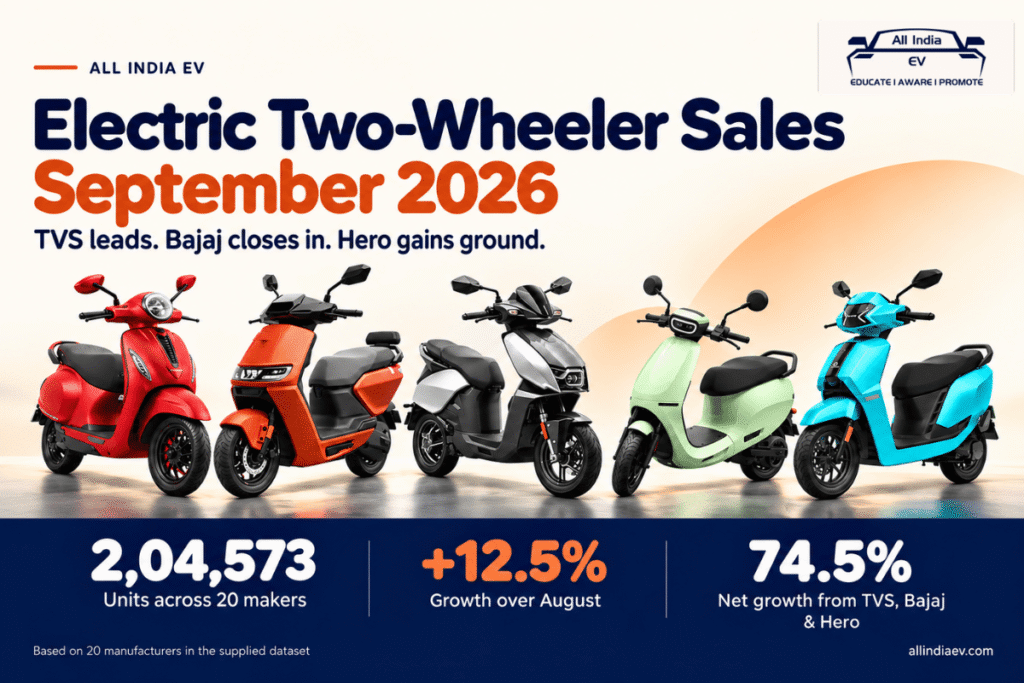
India’s electric two-wheeler sales strengthened in September, but the growth was unevenly distributed. TVS retained its leadership, Bajaj delivered the largest increase in volumes, and Hero MotoCorp recorded the fastest growth among the six largest manufacturers in the supplied dataset.
Across the 20 manufacturers covered, sales rose from 181,864 units in August to 204,573 units in September, an increase of 12.5%. This added 22,709 units in a month.
The competitive signal lies in who delivered those additional units. TVS, Bajaj and Hero together accounted for 74.5% of the net increase, while Ather expanded more slowly and Ola declined.
Data note: This analysis uses the figures supplied to All India EV. Aggregate volumes and shares refer to these 20 manufacturers, rather than a verified total for the entire Indian electric two-wheeler market. The figures do not establish wholesale dispatches, registration timing or the causes of individual manufacturers’ performance.
The September Scorecard
| Manufacturer | August sales | September sales | Monthly change | September share* |
|---|---|---|---|---|
| TVS | 49,286 | 53,990 | +9.5% | 26.39% |
| Bajaj | 41,339 | 48,383 | +17.0% | 23.65% |
| Ather | 29,068 | 30,477 | +4.8% | 14.90% |
| Hero MotoCorp | 19,142 | 24,306 | +27.0% | 11.88% |
| Ola Electric | 13,941 | 13,449 | −3.5% | 6.57% |
| Greaves Electric Mobility | 8,623 | 9,316 | +8.0% | 4.55% |
| River | 5,216 | 5,549 | +6.4% | 2.71% |
| BGauss | 5,045 | 5,023 | −0.4% | 2.46% |
Share within the supplied 20-manufacturer dataset.
TVS Leads, but Bajaj Narrows the Gap
TVS recorded 53,990 units, adding 4,704 units over August. Its position at the top remained intact, although its 9.5% growth was below the dataset’s overall expansion.
Consequently, TVS’s share slipped from 27.10% to 26.39%. This illustrates an important distinction: a manufacturer can sell more vehicles while losing relative ground when competitors grow faster.
Bajaj recorded 48,383 units, increasing volumes by 7,044 units, or 17.0%. It contributed 31.0% of the entire dataset’s net monthly increase, the largest contribution from any manufacturer.
The gap between TVS and Bajaj narrowed from 7,947 units in August to 5,607 units in September. Bajaj’s share increased from 22.73% to 23.65%.
Together, the two manufacturers crossed 102,000 units, representing approximately half of the covered sales. September therefore strengthened their combined importance while making the competition between them closer.
One month does not establish that leadership will change. It does, however, make the pace of Bajaj’s growth a key variable to watch.
Hero Delivers the Strongest Growth Among the Leading Six
Hero MotoCorp’s sales increased from 19,142 to 24,306 units, a rise of 27.0%.
Its addition of 5,164 units exceeded TVS’s monthly increase and represented 22.7% of the dataset’s net growth. Hero’s share rose from 10.53% to 11.88%, a gain of approximately 1.36 percentage points—the largest share improvement among the manufacturers listed.
Hero also narrowed its distance from Ather. The gap fell from 9,926 units in August to 6,171 units in September.
This makes Hero’s September performance significant beyond its fourth-place ranking. If sustained, the growth could increase competitive pressure on the third position.
The next test is consistency. A strong month establishes momentum; repeated gains would provide firmer evidence of a lasting shift in competitive standing.
Ather Expands, but Loses Relative Share
Ather crossed 30,000 units, reaching 30,477 sales in September. Volumes increased by 1,409 units, or 4.8%.
However, its growth was substantially below the dataset’s 12.5% expansion. Its share consequently declined from 15.98% to 14.90%.
Ather remained comfortably ahead of Hero in absolute volumes, but September compressed that lead. The result suggests that protecting third position will require attention to competitors’ growth rates as well as Ather’s own sales trajectory.
The data does not explain whether the difference reflects product availability, geographic exposure, delivery schedules or customer demand. It establishes the outcome: Ather grew, while Bajaj and Hero gained ground more quickly.
Ola Declines as the Wider Dataset Expands
Ola Electric’s sales fell from 13,941 to 13,449 units, a decline of 3.5%.
The absolute reduction was 492 units. Its competitive impact was greater because it occurred during an expanding month: Ola’s share fell from 7.67% to 6.57%.
The gap between Hero and Ola widened from 5,201 to 10,857 units, more than doubling in one month.
September therefore placed Ola under pressure on two fronts: declining volumes and a widening distance from the manufacturer immediately above it.
The figures alone cannot attribute this performance to pricing, service, product execution or supply constraints. Those explanations require separate evidence. What the dataset shows clearly is that Ola did not participate in September’s overall growth.
Greaves and River Grow; BGauss Holds Near 5,000 Units
Greaves Electric Mobility increased sales to 9,316 units, up 8.0%, while River reached 5,549 units, growing 6.4%.
Both added volume, but neither matched the overall growth rate. Their shares therefore declined modestly, to 4.55% and 2.71%, respectively.
BGauss recorded 5,023 units, down just 22 units from August. Its volumes were broadly stable, although its share fell from 2.77% to 2.46%.
These results underline the pace of competition. Maintaining volumes—or even delivering moderate growth—was insufficient to preserve share in September.
Smaller Manufacturers Produce Some of the Sharpest Movements
Outside the leading eight, Bounce, e-Sprinto and Oben delivered substantial increases.
| Manufacturer | August sales | September sales | Monthly change |
|---|---|---|---|
| Bounce | 1,049 | 3,069 | +192.6% |
| e-Sprinto | 120 | 1,997 | +1,564.2% |
| Oben | 642 | 1,417 | +120.7% |
| Lectrix | 851 | 1,153 | +35.5% |
| Honda | 882 | 1,100 | +24.7% |
| Revolt | 917 | 1,027 | +12.0% |
Bounce, e-Sprinto and Oben together added 4,672 units, accounting for 20.6% of the dataset’s net increase. Their combined share rose from approximately 1.00% to 3.17%.
These gains deserve attention, but percentage growth needs context. e-Sprinto’s exceptional increase started from only 120 units. Its absolute addition of 1,877 units is a more useful measure of September’s contribution than the percentage alone.
The movements also changed rankings. Oben overtook Simple Energy, whose sales declined 18.8% to 1,351 units.
Elsewhere, Motovolt fell 53.5% to 635 units, Quantum declined 36.4% to 576, and Ultraviolette dropped 12.3% to 536. Suzuki slipped 3.3% to 652 units, while Kinetic increased 8.4% to 567.
Overall, 13 manufacturers grew and seven declined. September’s expansion was broad, but it did not lift every participant.
What September Means for the Competition
September points to two simultaneous developments.
First, growth remained concentrated among the largest manufacturers. TVS, Bajaj, Ather and Hero represented 76.82% of covered sales, up from 76.34% in August. These four delivered 80.7% of the net monthly increase.
Second, selected smaller manufacturers gained enough volume to modestly reduce the top six’s combined share, from 88.75% to 87.95%. Competition below the leading group remained active.
For All India EV, the central takeaway is that September rewarded manufacturers growing faster than the category’s covered average. Bajaj and Hero strengthened their positions, TVS retained leadership, and Ather faced a narrower cushion over fourth place.
October will test whether those changes persist. The most useful indicators will be the TVS–Bajaj gap, Hero’s distance from Ather, Ola’s ability to recover volumes, and whether the sharp gains at Bounce, e-Sprinto and Oben translate into sustained monthly scale.