

Mahindra Last Mile Mobility and Bajaj Auto controlled nearly 69% of the top-ten market, while Mini Metro delivered July’s fastest growth
India’s electric L5 three-wheeler market recorded another strong month in July 2026, supported by rising commercial fleet demand, improving product availability and the growing economic case for electric passenger and cargo vehicles.
- Mahindra Last Mile Mobility and Bajaj Auto controlled nearly 69% of the top-ten market, while Mini Metro delivered July’s fastest growth
- June versus July 2026 electric L5 sales
- Mahindra Last Mile Mobility crosses 13,000 units
- Bajaj adds the largest number of vehicles in July
- TVS consolidates third position
- Piaggio remains stable around 1,500 units
- Saera Electric Auto crosses 1,200 units
- YC Electric records 23.5% monthly growth
- Mini Metro delivers July’s fastest growth
- Dilli Electric Auto approaches 1,000 units
- Omega Seiki returns to growth
- Euler Motors reaches 584 units
- Top-ten L5 sales have risen nearly 79% since January
- What is driving electric L5 growth in India?
- Commercial economics are becoming harder to ignore
- Formal commercial fleets are expanding
- Vehicle range and capability have improved
- Financing is becoming a competitive weapon
- Buyers are shifting toward registered and compliant vehicles
- A market led by two giants, but not closed to challengers
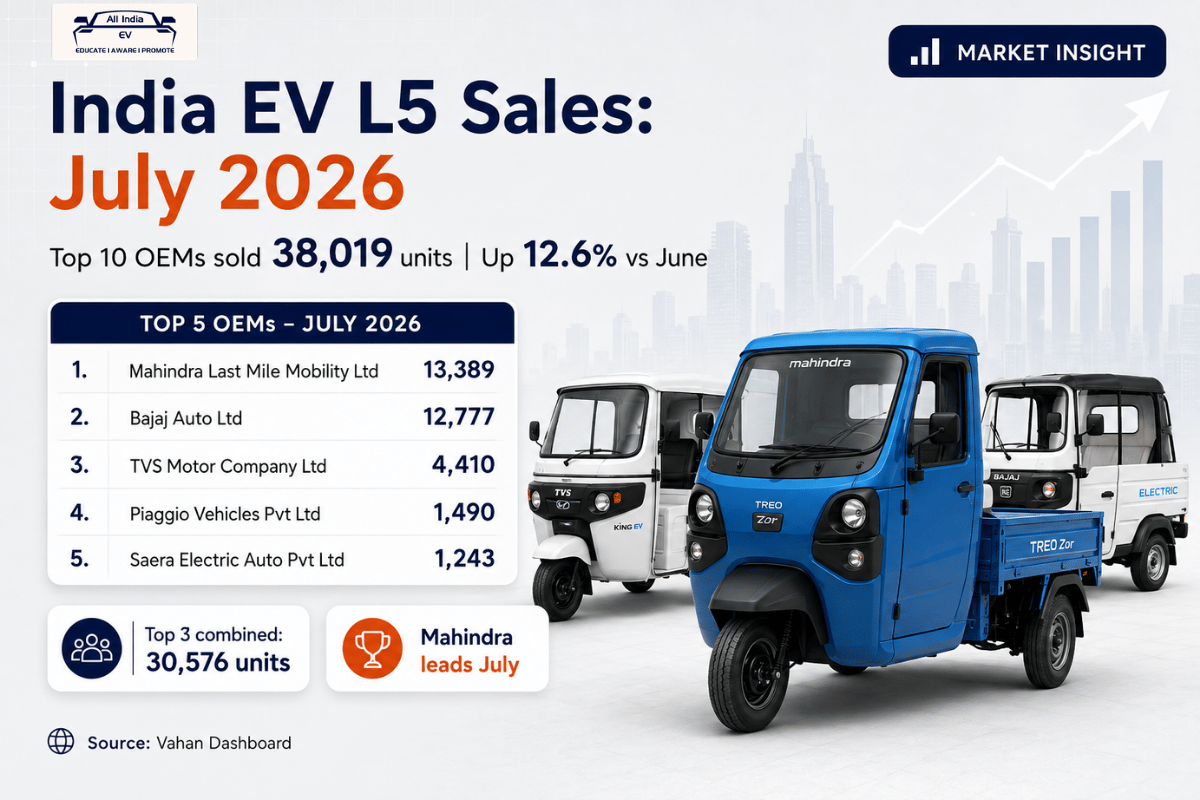
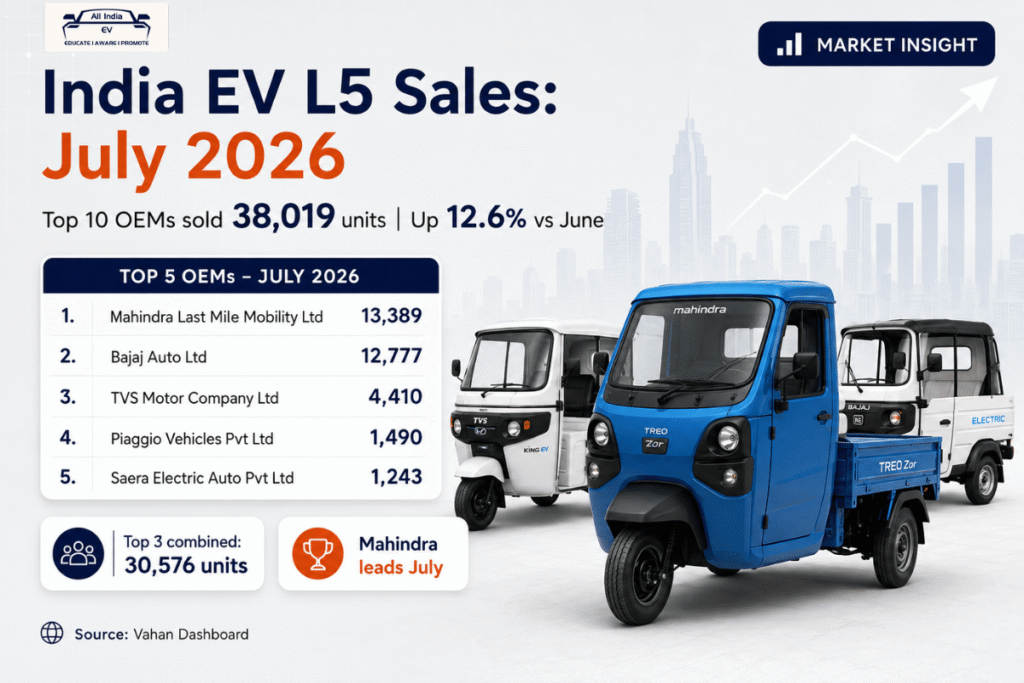
The ten manufacturers covered in this analysis collectively sold 38,019 vehicles in July, compared with 33,752 units in June. This represents month-on-month growth of 12.6%.
Mahindra Last Mile Mobility led the market with 13,389 units, narrowly ahead of Bajaj Auto at 12,777 units. TVS Motor Company ranked third with 4,410 units.
Together, Mahindra and Bajaj accounted for approximately 68.8% of the top-ten July volume. Including TVS, the top three manufacturers controlled 80.4% of the market covered in this analysis.
The concentration shows that electric L5 three-wheelers are rapidly shifting from a fragmented early-stage segment into a scale-driven commercial vehicle market.
Source: Vahan Dashboard
Calculations: All India EV analysis based on January–July 2026 sales data.
June versus July 2026 electric L5 sales
| Rank | Manufacturer | June 2026 | July 2026 | Monthly change |
|---|---|---|---|---|
| 1 | Mahindra Last Mile Mobility | 12,275 | 13,389 | +9.1% |
| 2 | Bajaj Auto | 11,218 | 12,777 | +13.9% |
| 3 | TVS Motor Company | 4,007 | 4,410 | +10.1% |
| 4 | Piaggio Vehicles | 1,498 | 1,490 | -0.5% |
| 5 | Saera Electric Auto | 993 | 1,243 | +25.2% |
| 6 | YC Electric Vehicle | 941 | 1,162 | +23.5% |
| 7 | Mini Metro EV | 714 | 1,118 | +56.6% |
| 8 | Dilli Electric Auto | 839 | 982 | +17.0% |
| 9 | Omega Seiki | 743 | 864 | +16.3% |
| 10 | Euler Motors | 524 | 584 | +11.5% |
| Total | 33,752 | 38,019 | +12.6% |
Nine of the ten manufacturers increased their sales in July. Piaggio was the only company to record a decline, and even that reduction was limited to eight vehicles.
The broad-based rise suggests that July’s expansion was not dependent on one manufacturer or a single fleet order.
Mahindra Last Mile Mobility crosses 13,000 units
Mahindra Last Mile Mobility sold 13,389 vehicles in July, up from 12,275 units in June.
The company added 1,114 units, representing monthly growth of 9.1%, and captured approximately 35.2% of the top-ten July market.
Mahindra’s sales have more than doubled since January, increasing from 6,629 to 13,389 units. This represents six-month growth of approximately 102%.
The company’s rise reflects the strength of its passenger and cargo electric three-wheeler portfolio, supported by a large commercial vehicle network and established relationships with fleet operators, financiers and dealerships.
For commercial buyers, the decision is rarely based on specifications alone. Vehicle uptime, finance availability, local service access and spare-parts supply are equally important.
Mahindra’s advantage lies in offering an EV product through an ecosystem that many drivers and fleet owners already understand.
Bajaj adds the largest number of vehicles in July
Bajaj Auto recorded 12,777 units in July, compared with 11,218 units in June.
Its sales increased by 1,559 vehicles, the largest absolute gain among the top ten manufacturers. This translated into month-on-month growth of 13.9%.
Bajaj remained only 612 units behind Mahindra, leaving the market leadership contest wide open.
Compared with January, Bajaj’s sales increased by 52.7%, from 8,369 to 12,777 units.
The company’s established three-wheeler brand, broad dealer reach and familiarity among commercial operators give it a major advantage as the market shifts from internal-combustion vehicles to electric alternatives.
Bajaj also benefits from buyers who already operate conventional three-wheelers and prefer moving to an electric vehicle from a familiar manufacturer.
The July numbers indicate that the battle for leadership will likely be shaped by production scale, fleet relationships and regional dealer execution rather than product announcements alone.
TVS consolidates third position
TVS Motor Company sold 4,410 vehicles in July, up from 4,007 units in June.
The monthly increase of 10.1% helped TVS strengthen its position as the third-largest manufacturer in the dataset.
Its sales rose from 2,732 units in January to 4,410 units in July, representing growth of approximately 61.4%.
TVS remains well behind Mahindra and Bajaj in absolute volume, but its consistent monthly expansion indicates growing acceptance of its electric three-wheeler portfolio.
The company’s existing two- and three-wheeler distribution ecosystem may become increasingly valuable as commercial EV buyers look for dependable local service.
TVS’s challenge will be closing the scale gap with the top two while defending its position against a rapidly growing second tier of specialised manufacturers.
Piaggio remains stable around 1,500 units
Piaggio Vehicles recorded 1,490 units in July, marginally lower than the 1,498 units sold in June.
The decline of 0.5% made Piaggio the only top-ten manufacturer to report lower monthly sales.
However, July volume remained 63.6% higher than January, when the company recorded 911 units.
Piaggio has a long-standing presence in India’s three-wheeler market, particularly in passenger and goods applications. That legacy provides strong product familiarity, although competition is now intensifying as Mahindra, Bajaj and TVS scale aggressively.
Its stable July performance suggests an established demand base, but a flat market position could become a concern if smaller competitors continue growing at double-digit rates.
Saera Electric Auto crosses 1,200 units
Saera Electric Auto recorded 1,243 units in July, compared with 993 units in June.
The company delivered monthly growth of 25.2%, adding 250 vehicles.
Its July volume was approximately 186% higher than the 435 units recorded in January, making Saera one of the fastest-growing manufacturers during the first seven months of the year.
The growth illustrates how specialised EV manufacturers can still build meaningful positions, even as larger automotive companies dominate the top of the market.
However, scaling from around 1,000 units to a sustainable national operation will require dependable production, dealer expansion, battery support and access to commercial vehicle financing.
YC Electric records 23.5% monthly growth
YC Electric Vehicle sold 1,162 L5 vehicles in July, up from 941 units in June.
The company’s monthly volume increased by 23.5%, while July sales were approximately 158% higher than January.
YC Electric has traditionally been associated with the broader electric three-wheeler ecosystem. Its growing L5 volumes suggest that manufacturers previously focused on lower-speed products are moving toward more formal, higher-performance vehicle categories.
This transition matters because the L5 segment offers better speed, payload and commercial utility, but also requires stronger engineering, homologation and service capabilities.
Mini Metro delivers July’s fastest growth
Mini Metro EV recorded the strongest percentage growth among the top ten manufacturers.
Sales increased from 714 units in June to 1,118 units in July, representing growth of 56.6%.
The company added 404 vehicles, nearly matching TVS’s absolute monthly increase despite operating at a much smaller scale.
Mini Metro’s sales have expanded from only 120 units in January, meaning July volume was more than nine times the January level.
That translates into growth of approximately 832% over six months.
The percentage is amplified by the small starting base, but the direction remains significant. Mini Metro has moved from a marginal position to more than 1,100 monthly vehicles in a relatively short period.
The next test will be whether this rise represents sustainable retail demand or a temporary spike driven by dealer dispatches or fleet orders.
Dilli Electric Auto approaches 1,000 units
Dilli Electric Auto sold 982 vehicles in July, up from 839 units in June.
The company reported month-on-month growth of 17% and was only 18 vehicles short of crossing the 1,000-unit threshold.
July sales were more than three times its January volume of 325 units, representing growth of approximately 202%.
Dilli Electric’s expansion highlights the importance of regional distribution in India’s commercial electric vehicle market.
A manufacturer does not always need a national footprint to build substantial volume. Strong dealer presence across a few high-demand urban and semi-urban clusters can create a viable business base.
Omega Seiki returns to growth
Omega Seiki recorded 864 units in July, compared with 743 units in June.
The monthly increase of 16.3% marked a recovery from the company’s low point in April, when sales had fallen to 474 units.
However, July remained slightly below the 880 units recorded in January.
Omega Seiki’s performance was therefore different from most competitors. While the wider market expanded significantly over six months, the company largely returned to its starting level.
The recovery is positive, but the manufacturer will need stronger and more consistent growth to defend its position as larger OEMs enter more electric cargo and last-mile mobility applications.
Euler Motors reaches 584 units
Euler Motors recorded 584 units in July, up from 524 units in June.
The monthly increase of 11.5% took its July sales approximately 46% above January.
Euler operates primarily in the electric cargo vehicle market, where fleet economics, payload capacity and daily uptime have a direct impact on purchase decisions.
The company’s moderate growth suggests steady adoption, but its current scale remains far below Mahindra, Bajaj and TVS.
Cargo-focused manufacturers also face a demanding customer base. Fleet operators evaluate vehicles through route-level economics, charging downtime, payload, maintenance and the ability to secure fast replacement support.
Top-ten L5 sales have risen nearly 79% since January
The ten manufacturers collectively sold 21,251 vehicles in January.
By July, that total had increased to 38,019 units, representing growth of approximately 78.9%.
| Manufacturer | January | July | Jan–July growth |
|---|---|---|---|
| Mahindra Last Mile Mobility | 6,629 | 13,389 | +102.0% |
| Bajaj Auto | 8,369 | 12,777 | +52.7% |
| TVS Motor Company | 2,732 | 4,410 | +61.4% |
| Piaggio Vehicles | 911 | 1,490 | +63.6% |
| Saera Electric Auto | 435 | 1,243 | +185.7% |
| YC Electric Vehicle | 450 | 1,162 | +158.2% |
| Mini Metro EV | 120 | 1,118 | +831.7% |
| Dilli Electric Auto | 325 | 982 | +202.2% |
| Omega Seiki | 880 | 864 | -1.8% |
| Euler Motors | 400 | 584 | +46.0% |
Nine manufacturers sold more vehicles in July than in January. Omega Seiki was the only company whose July volume remained slightly below its January level.
The growth is especially notable because PM E-DRIVE support for the electric L5 category had already closed on 26 December 2025, according to the scheme’s official portal. The later extension applies to registered e-rickshaws and e-carts, not L5 vehicles.
This means the January-to-July rise cannot be explained by continuing direct demand incentives for L5 vehicles alone.
What is driving electric L5 growth in India?
Commercial economics are becoming harder to ignore
L5 three-wheelers are income-generating assets.
Passenger operators, delivery fleets and small businesses compare electric and internal-combustion vehicles through daily operating economics rather than environmental messaging alone.
The key considerations include:
- Energy cost per kilometre
- Daily kilometres travelled
- Vehicle loan instalment
- Maintenance expenditure
- Battery warranty
- Payload or passenger capacity
- Charging downtime
- Vehicle resale value
For high-utilisation operators, the lower energy and maintenance requirements of an electric drivetrain can create meaningful savings across the ownership period.
The stronger the daily utilisation, the more visible the operating-cost difference becomes.
Formal commercial fleets are expanding
Electric L5 vehicles are increasingly being considered for organised last-mile logistics, urban deliveries, institutional mobility and passenger transport.
Fleet operators require predictable vehicles that can be financed, monitored and maintained across multiple locations.
This favours manufacturers with telematics, fleet dashboards, service-level commitments and established financing relationships.
It also explains why large OEMs are gaining market share. Product reliability matters, but the ability to support dozens or hundreds of vehicles matters even more.
Vehicle range and capability have improved
The market is no longer limited to low-speed electric vehicles designed for short neighbourhood routes.
The official PM E-DRIVE model database shows approved electric L5 vehicles with ranges extending beyond 150 km and, in some cases, above 200 km, depending on configuration and test conditions. The database also lists models from manufacturers including Piaggio, Bajaj and Euler.
These improvements make electric three-wheelers suitable for longer routes and heavier daily utilisation.
Claimed range is not the same as real-world range, particularly under full payload, high temperatures or congested conditions. Nevertheless, the widening capability has increased the number of commercially viable applications.
Financing is becoming a competitive weapon
Commercial vehicle buyers are highly sensitive to down payment and monthly instalments.
A manufacturer may offer a technically strong product, but it can lose a sale if buyers cannot access affordable financing.
Large OEMs benefit from established lending relationships, while specialised EV manufacturers are increasingly partnering with banks, NBFCs and digital financing platforms.
The next wave of growth will depend on reducing perceived lender risk through reliable battery warranties, telematics data and stronger resale markets.
Buyers are shifting toward registered and compliant vehicles
Government incentive frameworks have consistently linked support to registered vehicles and approved models. PM E-DRIVE’s official FAQ specifies that electric three-wheelers supported under the scheme are eligible only for commercial use and must be manufactured and registered within the applicable validity period.
Even though L5 demand incentives are now closed, this policy direction continues pushing the market toward homologated vehicles, traceable manufacturers and formal registrations.
That shift benefits companies capable of meeting regulatory, battery and manufacturing requirements at scale.
A market led by two giants, but not closed to challengers
Mahindra and Bajaj together sold 26,166 vehicles in July.
Their combined share reached nearly 69% of the sales covered in this analysis. Add TVS, and more than four out of every five vehicles came from the top three manufacturers.
This is a strongly concentrated market.
However, the lower half of the ranking is moving quickly. Saera, YC Electric, Mini Metro and Dilli Electric all recorded monthly growth above 17%.
Mini Metro’s 56.6% rise shows that smaller manufacturers can still move through the rankings rapidly, particularly when they strengthen distribution or secure fleet demand.
The question is whether these companies can convert rapid percentage growth into durable scale.
That will require:
- Production consistency
- Reliable batteries
- Strong local service
- Accessible spare parts
- Financing availability
- Fleet partnerships
- Transparent warranties
- Predictable resale value
The bigger story
July 2026 was a strong month for India’s electric L5 industry.
Top-ten sales rose 12.6% from June and nearly 79% from January, despite the closure of direct PM E-DRIVE demand support for the category in December 2025.
Mahindra Last Mile Mobility has emerged as the leader, but Bajaj remains close enough to challenge it every month. TVS has established a clear third position, while a group of smaller manufacturers is scaling rapidly behind the leaders.
The market is entering a new phase where incentives matter less and commercial performance matters more.
Manufacturers will increasingly compete on cost per kilometre, vehicle uptime, battery life, financing and service response.
For a passenger driver or delivery operator, an electric L5 vehicle is not merely a mobility product.
It is a machine expected to earn money every day.