

Tata Passenger Electric Mobility crossed 12,700 units, while Mahindra, JSW MG, Maruti Suzuki and BYD recorded month-on-month declines
India’s electric passenger vehicle market recorded a mild correction in July 2026 after posting strong growth during the preceding months.
- June versus July 2026 electric car sales
- Tata crosses 12,700 units and widens its leadership
- Mahindra declines from June but remains firmly in second place
- JSW MG falls 10.1% but retains third position
- Maruti Suzuki falls after a rapid first-half ramp-up
- VinFast moves into the top five
- BYD records a 20.9% monthly decline
- Mahindra & Mahindra records steady growth
- Hyundai records July’s fastest percentage growth
- Kia and BMW record monthly declines
- India’s EV car market grew sharply over six months despite July’s decline
- What changed in India’s electric car market during the last six months?
- More credible electric SUVs entered the market
- The market now offers multiple ownership models
- Established manufacturers are scaling production
- Charging infrastructure is becoming part of the product strategy
- Competition has moved beyond Tata versus MG
- A concentrated market entering its next competitive phase
- The bigger story
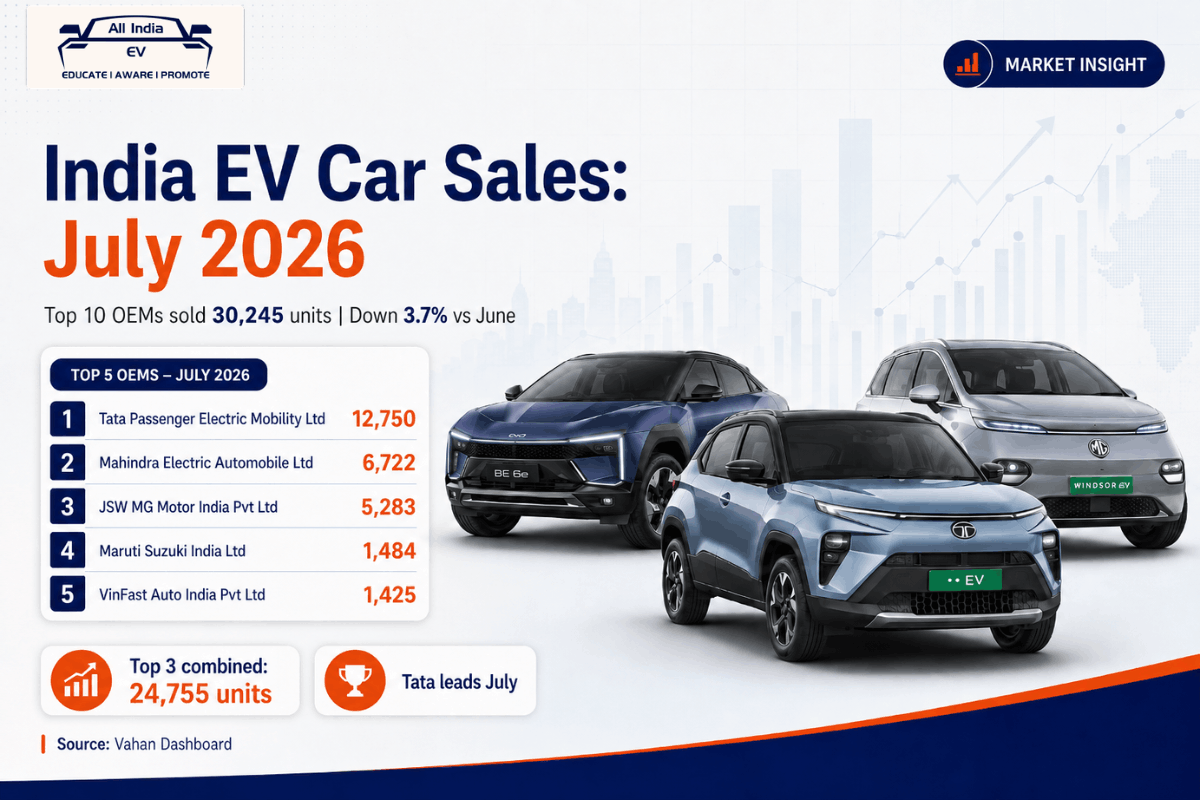
The ten manufacturers covered in this analysis collectively recorded 30,245 electric car sales in July, compared with 31,393 units in June. This represents a month-on-month decline of 3.7%.
The decline, however, was not uniform across the industry. Tata Passenger Electric Mobility, VinFast, Hyundai and Mahindra & Mahindra recorded growth, while six manufacturers reported lower July volumes.
Tata remained the clear market leader with 12,750 units, followed by Mahindra Electric Automobile with 6,722 units and JSW MG Motor India with 5,283 units.
Together, the top three manufacturers accounted for 24,755 units, or approximately 81.8% of the top-ten July volume. This shows that India’s electric passenger vehicle market remains highly concentrated despite the arrival of several new manufacturers and models.
Source: Vahan Dashboard
Calculations: All India EV analysis based on January–July 2026 data supplied for the ten manufacturers.
June versus July 2026 electric car sales
| Rank | Manufacturer | June 2026 | July 2026 | Monthly change |
|---|---|---|---|---|
| 1 | Tata Passenger Electric Mobility | 12,167 | 12,750 | +4.8% |
| 2 | Mahindra Electric Automobile | 7,307 | 6,722 | -8.0% |
| 3 | JSW MG Motor India | 5,874 | 5,283 | -10.1% |
| 4 | Maruti Suzuki India | 1,869 | 1,484 | -20.6% |
| 5 | VinFast Auto India | 1,390 | 1,425 | +2.5% |
| 6 | BYD India | 885 | 700 | -20.9% |
| 7 | Mahindra & Mahindra | 517 | 552 | +6.8% |
| 8 | Hyundai Motor India | 363 | 539 | +48.5% |
| 9 | Kia India | 517 | 440 | -14.9% |
| 10 | BMW India | 504 | 350 | -30.6% |
| Total | 31,393 | 30,245 | -3.7% |
Only four companies recorded month-on-month growth. Tata added the largest number of vehicles, while Hyundai delivered the strongest percentage increase.
BMW reported the steepest percentage decline, although its smaller base means monthly variations can appear more dramatic.
Tata crosses 12,700 units and widens its leadership
Tata Passenger Electric Mobility recorded 12,750 units in July, compared with 12,167 units in June.
The company added 583 units, representing growth of 4.8%, and accounted for approximately 42.2% of the top-ten July volume.
Tata’s sales increased from 8,855 units in January to 12,750 units in July, translating into growth of approximately 44% over the period.
Its performance is supported by one of the broadest electric passenger vehicle portfolios in India, covering compact cars, SUVs and multiple price points. Tata has also continued updating its EV range, including the introduction of a new Punch.ev as part of its effort to accelerate mainstream adoption.
The company entered July after announcing a price revision across its passenger vehicle portfolio from 1 July 2026. Despite that change, its electric vehicle volume continued to grow, suggesting that product range and brand familiarity remained stronger demand drivers than the price adjustment during the month.
Tata’s market position is increasingly built around ecosystem depth rather than a single model. The company has previously outlined plans to support a substantially larger charging network by 2027, an important factor for customers still evaluating the practicality of EV ownership.
Mahindra declines from June but remains firmly in second place
Mahindra Electric Automobile recorded 6,722 units in July, down from 7,307 units in June.
The month-on-month decline of 8% followed several months of strong growth. Despite the fall, Mahindra retained a substantial lead over JSW MG and remained India’s second-largest electric passenger vehicle manufacturer in the dataset.
Its July sales were approximately 95.2% higher than the 3,443 units recorded in January.
Mahindra’s recent expansion has been driven by its purpose-built electric SUV portfolio, particularly the BE 6 and XEV 9e. These products allowed Mahindra to move beyond converted internal-combustion platforms and compete in higher-value electric SUV segments.
The company generated considerable initial demand for the two models, reporting more than 30,000 bookings on the first day, with a booking value of approximately ₹8,472 crore.
Mahindra’s July correction should therefore be viewed against a much larger six-month expansion. Deliveries of new models often fluctuate with production schedules, variant availability and the conversion of earlier bookings.
The bigger strategic shift is that Mahindra has established itself as a volume EV manufacturer rather than a peripheral participant in the passenger EV market.
JSW MG falls 10.1% but retains third position
JSW MG Motor India recorded 5,283 units in July, compared with 5,874 units in June, representing a decline of 10.1%.
Its July volume was almost unchanged from January, when the company recorded 5,290 units.
The Windsor remains the centrepiece of MG’s electric vehicle strategy. The company announced in July that the model had crossed 75,000 cumulative sales in less than two years, with more than 19,000 units sold during the first half of 2026.
MG has also used Battery-as-a-Service pricing to lower the apparent upfront acquisition cost, separating part of the battery expense from the vehicle purchase. Its official platform currently positions the Windsor from ₹9.99 lakh under the BaaS structure.
The company’s EV business had already expanded significantly before July. JSW MG reported 62,591 EV sales in FY2026, compared with 37,730 units in FY2025, representing annual growth of 66%.
The July decline therefore looks more like a monthly slowdown within an established EV franchise than a collapse in the Windsor’s market acceptance.
Maruti Suzuki falls after a rapid first-half ramp-up
Maruti Suzuki India recorded 1,484 units in July, down from 1,869 units in June.
The decline of 20.6% was among the sharpest in the top ten. Yet the broader trajectory remains notable: Maruti’s recorded volume increased from only 201 units in January to 1,484 units in July.
That represents growth of more than 638%, although the percentage is amplified by the extremely small January base.
Maruti’s entry is strategically important because the company operates India’s largest passenger vehicle distribution and service ecosystem. Even modest EV penetration across that network can materially alter the competitive structure of the market.
However, the July data also demonstrates that dealer reach alone does not guarantee linear monthly growth. Product supply, customer education, charging confidence and model-specific demand all influence adoption during the early stages of an EV launch.
Maruti’s longer-term position will depend on whether it can convert its conventional vehicle customer base into repeatable electric volumes rather than relying on an initial launch cycle.
VinFast moves into the top five
VinFast Auto India recorded 1,425 units in July, up from 1,390 units in June.
The increase of 2.5% was modest, but enough for the company to move ahead of several established global manufacturers.
VinFast’s July sales were more than three times its January volume of 445 units, representing growth of approximately 220%.
This makes VinFast one of the fastest-scaling manufacturers in the dataset.
The company’s early performance indicates that India’s electric car market is becoming receptive to new brands when they enter with dedicated EV products rather than treating electric mobility as a secondary powertrain option.
The next test will be consistency. VinFast must support its initial sales with service centres, spare-parts availability, charging support, finance partnerships and confidence around long-term resale value.
For a new automotive brand, the product opens the door. The ownership ecosystem decides whether buyers keep walking through it.
BYD records a 20.9% monthly decline
BYD India sold 700 vehicles in July, compared with 885 units in June.
This represents a decline of 20.9%.
Despite the monthly correction, July sales were nearly three times the January volume of 236 units. BYD’s January-to-July growth stood at approximately 196.6%.
BYD operates in relatively premium electric segments, where volumes are naturally lower and monthly fluctuations can be influenced by shipments, inventory and delivery schedules.
Its position is also distinct from mass-market manufacturers. The company competes through battery technology, longer-range products and globally developed EV platforms rather than entry-level pricing.
For BYD, the strategic question is whether it can expand beyond premium urban customers and build a broader retail and service footprint in India.
Mahindra & Mahindra records steady growth
The separate Mahindra & Mahindra entry in the Vahan data recorded 552 units in July, up from 517 units in June.
The increase of 6.8% took its July volume approximately 73% above January.
The separate reporting of Mahindra Electric Automobile and Mahindra & Mahindra likely reflects different legal entities or vehicle registrations within the wider Mahindra portfolio. These volumes should therefore not automatically be combined without examining the underlying Vahan manufacturer classifications.
Nevertheless, both entries together demonstrate Mahindra’s widening presence across India’s electric passenger vehicle market.
The company is now participating through both newer purpose-built electric SUVs and vehicles recorded under its established automotive entity.
Hyundai records July’s fastest percentage growth
Hyundai Motor India delivered the strongest percentage gain among the ten manufacturers.
Its sales increased from 363 units in June to 539 units in July, representing growth of 48.5%.
Hyundai’s July volume was also 45.7% higher than in January.
The company remains a relatively small participant in India’s EV market by volume, but the July increase shows that demand is not limited only to the three largest manufacturers.
Hyundai possesses strong conventional passenger vehicle brand recognition, service infrastructure and supplier relationships. Its ability to expand EV sales will depend on product pricing and whether it can introduce electric models across more accessible market segments.
One strong month does not establish a permanent trajectory, but the July jump makes Hyundai an important manufacturer to track during the second half of 2026.
Kia and BMW record monthly declines
Kia India sold 440 electric vehicles in July, down from 517 units in June, representing a decline of 14.9%.
Despite the fall, July remained approximately 13.1% above January.
BMW India recorded 350 units, down from 504 in June. The 30.6% decline was the steepest among the top ten, while July sales were also slightly below the company’s January volume.
Both manufacturers largely operate in higher-priced EV segments, where monthly registrations can vary substantially because of imports, allocation cycles and smaller overall volumes.
Their position is different from Tata, Mahindra or MG, which are competing for broader-market scale. For premium manufacturers, revenue, model mix and brand penetration can matter as much as total unit volume.
India’s EV car market grew sharply over six months despite July’s decline
Although July sales were lower than June, the wider January-to-July trajectory remained strongly positive.
The combined sales of the ten manufacturers increased from 19,921 units in January to 30,245 units in July, representing growth of approximately 51.8%.
| Manufacturer | January | July | Jan–July change |
|---|---|---|---|
| Tata Passenger Electric Mobility | 8,855 | 12,750 | +44.0% |
| Mahindra Electric Automobile | 3,443 | 6,722 | +95.2% |
| JSW MG Motor India | 5,290 | 5,283 | -0.1% |
| Maruti Suzuki India | 201 | 1,484 | +638.3% |
| VinFast Auto India | 445 | 1,425 | +220.2% |
| BYD India | 236 | 700 | +196.6% |
| Mahindra & Mahindra | 319 | 552 | +73.0% |
| Hyundai Motor India | 370 | 539 | +45.7% |
| Kia India | 389 | 440 | +13.1% |
| BMW India | 373 | 350 | -6.2% |
The combined market crossed 30,000 units in both June and July, compared with fewer than 20,000 units at the beginning of the year.
That is the more important signal. July delivered a correction, but it occurred at a significantly higher market base.
What changed in India’s electric car market during the last six months?
More credible electric SUVs entered the market
Electric cars in India were previously concentrated around compact vehicles and a small number of premium imports.
The arrival and scaling of models such as the Mahindra BE 6 and XEV 9e expanded consumer choice in the purpose-built electric SUV category. Mahindra positioned these vehicles on its INGLO architecture with dedicated EV technology rather than merely converting an existing petrol platform.
This helped electric vehicles attract customers who wanted design, performance and technology, not only lower operating costs.
The market now offers multiple ownership models
The EV purchase equation is no longer limited to a conventional ex-showroom price.
MG’s Battery-as-a-Service model separates part of the battery cost from the vehicle price, while manufacturers increasingly use assured buyback, battery warranties, connected charging support and finance packages to reduce customer hesitation.
These models do not eliminate the cost of the battery. They redistribute it across the ownership period, making monthly affordability an increasingly important sales tool.
Established manufacturers are scaling production
Mahindra’s rapid expansion and Tata’s continued growth show that the electric passenger vehicle market is moving beyond limited production runs.
Manufacturing scale improves availability, reduces waiting periods and gives suppliers greater confidence to localise EV components.
As supply becomes more consistent, monthly sales depend less on whether vehicles are available and more on which manufacturer offers the strongest overall value proposition.
Charging infrastructure is becoming part of the product strategy
The central government continues to support EV charging infrastructure through PM E-DRIVE. The scheme carries an overall outlay of ₹10,900 crore, with ₹2,000 crore earmarked for public charging infrastructure.
Passenger electric cars do not receive the same direct demand incentives available to selected two- and three-wheelers under PM E-DRIVE, but they benefit indirectly from the expansion of the charging ecosystem.
For car buyers, charger visibility on highways, in apartment complexes, offices and commercial destinations reduces one of the largest psychological barriers to EV adoption.
Competition has moved beyond Tata versus MG
At the beginning of India’s passenger EV journey, the market was largely interpreted through Tata’s dominance and MG’s presence in selected segments.
That picture has changed.
Mahindra has become a high-volume competitor. Maruti and VinFast are scaling from smaller bases. BYD is expanding in premium segments, while Hyundai and Kia are building their electric portfolios.
More manufacturers mean more pricing pressure, faster product updates and greater investment in charging and service infrastructure.
It also means market share will become harder to defend.
A concentrated market entering its next competitive phase
The top three manufacturers controlled almost 82% of the July sales recorded by the ten companies.
Tata alone held more than 42%, while Tata and Mahindra Electric Automobile together accounted for nearly two-thirds of the total.
This concentration shows that having an EV model on sale is not enough. To generate consistent volume, manufacturers require:
- Multiple product and battery options
- Reliable production capacity
- Accessible financing
- Urban and highway charging support
- Extensive service coverage
- Clear battery warranties
- Strong residual-value confidence
- Predictable software and after-sales support
The bigger story
July 2026 was a month of consolidation rather than uninterrupted growth.
The top-ten market declined by 3.7%, but Tata strengthened its leadership and Hyundai delivered a sharp increase. Mahindra and MG retained their positions despite monthly declines, while Maruti and VinFast continued building scale from relatively new market bases.
The most important change is structural.
India’s electric car market is no longer dependent on one or two models. It is developing into a broader contest involving compact EVs, family crossovers, premium electric SUVs and global electric-only brands.
The next phase will not be won through claimed range alone.
It will be won by manufacturers that combine a credible electric vehicle with charging access, finance, service, battery confidence and resale support.
July’s dip does not reverse the growth story. It simply shows that India’s electric car market is maturing, and mature markets rarely move upward in a perfectly straight line.