

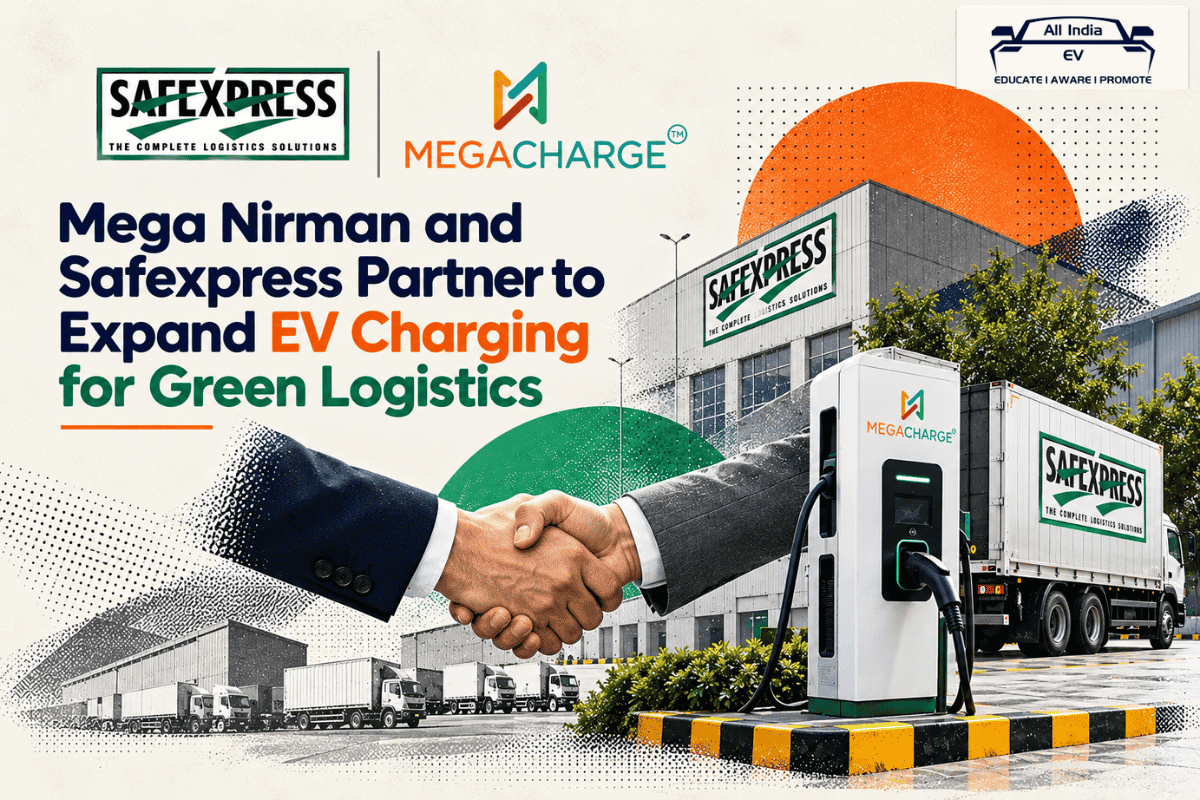
India’s electric vehicle (EV) infrastructure sector is set for a boost as Mega Nirman & Industries Ltd. and Safexpress Private Limited have entered into a long-term partnership to support the electrification of commercial transportation. The collaboration aims to establish high-power EV charging infrastructure at designated logistics hubs and transit facilities, helping accelerate the adoption of electric commercial vehicles across India.
The agreement, announced on October 12, 2026, brings together Mega Nirman’s MegaCharge EV charging division and Safexpress’s established logistics network. The partnership is intended to create a structured framework for deploying, operating and maintaining charging stations to meet the evolving requirements of electric freight and logistics operations.
10-Year Agreement to Support EV Charging Infrastructure
Under the master agreement, MegaCharge will develop and operate charging facilities at mutually agreed locations, subject to individual site assessments and technical, operational and commercial arrangements. Each facility deployed under the framework will have a 10-year operational term.
The agreement also outlines provisions for minimum charging utilisation, service-level commitments and a digital Charging Management System (CMS). These measures are intended to improve operational visibility, monitor charging activity and support the long-term performance of the infrastructure.
For Mega Nirman & Industries, the partnership represents an opportunity to expand its presence in the commercial EV charging market. For Safexpress, it creates a pathway to integrate charging infrastructure into its logistics network as the company and the wider freight industry explore electric mobility solutions.
Agra to Get an Initial 180 kW DC Fast-Charging Station
The initial deployment includes a proposed 180 kW DC fast-charging station in Agra, Uttar Pradesh. The facility is designed to support the charging requirements of medium- and heavy-duty electric commercial vehicles.
High-power DC charging can play an important role in commercial logistics, where vehicles need dependable charging facilities to maintain delivery schedules and minimise operational downtime. Strategically located chargers can help fleet operators plan routes, manage charging breaks and evaluate the feasibility of switching from conventional fuel-powered vehicles to electric alternatives.
The Agra installation is expected to serve as an important starting point for the partnership. However, the commissioning schedule and final technical specifications will depend on the relevant site-specific arrangements.
Scope for Future Charging Network Expansion
Beyond Agra, the master agreement provides a framework for expanding charging infrastructure to additional Safexpress logistics hubs and transit locations. Each proposed site will be evaluated separately before deployment, allowing the companies to assess technical feasibility and operational requirements.
The site-based approach is particularly relevant for commercial fleets because charging demand depends on vehicle movement, delivery schedules, distance travelled and the availability of suitable electrical infrastructure. Future deployments will therefore depend on the companies’ rollout plans and the arrangements finalised for individual locations.
The partnership does not, by itself, establish a confirmed nationwide station count. Its broader significance lies in creating a long-term structure for adding charging facilities as requirements evolve.
Why EV Charging Matters for India’s Logistics Sector
India’s logistics industry connects manufacturing centres, warehouses, distribution hubs and consumer markets across extensive road networks. Electrifying freight transportation could help businesses reduce tailpipe emissions and dependence on conventional fuels, while potentially improving operating economics under suitable conditions.
However, the transition to electric commercial vehicles requires more than vehicle availability. Logistics operators also need reliable charging facilities, adequate power capacity, compatible charging equipment and efficient fleet management. High-power charging infrastructure at logistics hubs can help address some of these challenges.
The MegaCharge–Safexpress partnership reflects the growing importance of integrating charging infrastructure directly into commercial transport operations rather than relying exclusively on public charging stations.
Outlook for Commercial EV Adoption
The agreement marks a strategic development for Mega Nirman & Industries as it expands its EV charging business and strengthens its position in the institutional charging segment. For Safexpress, the collaboration offers a structured way to prepare selected logistics facilities for the gradual adoption of electric commercial vehicles.
As India’s EV ecosystem develops, partnerships between infrastructure providers and logistics companies are likely to play an important role in supporting fleet electrification. The progress of the Agra installation and the announcement of additional sites will be important indicators of how the initiative develops.
Overall, the partnership establishes a foundation for supporting greener freight movement through dedicated charging infrastructure, with future results depending on site deployment, charging utilisation and the pace of electric commercial vehicle adoption.