

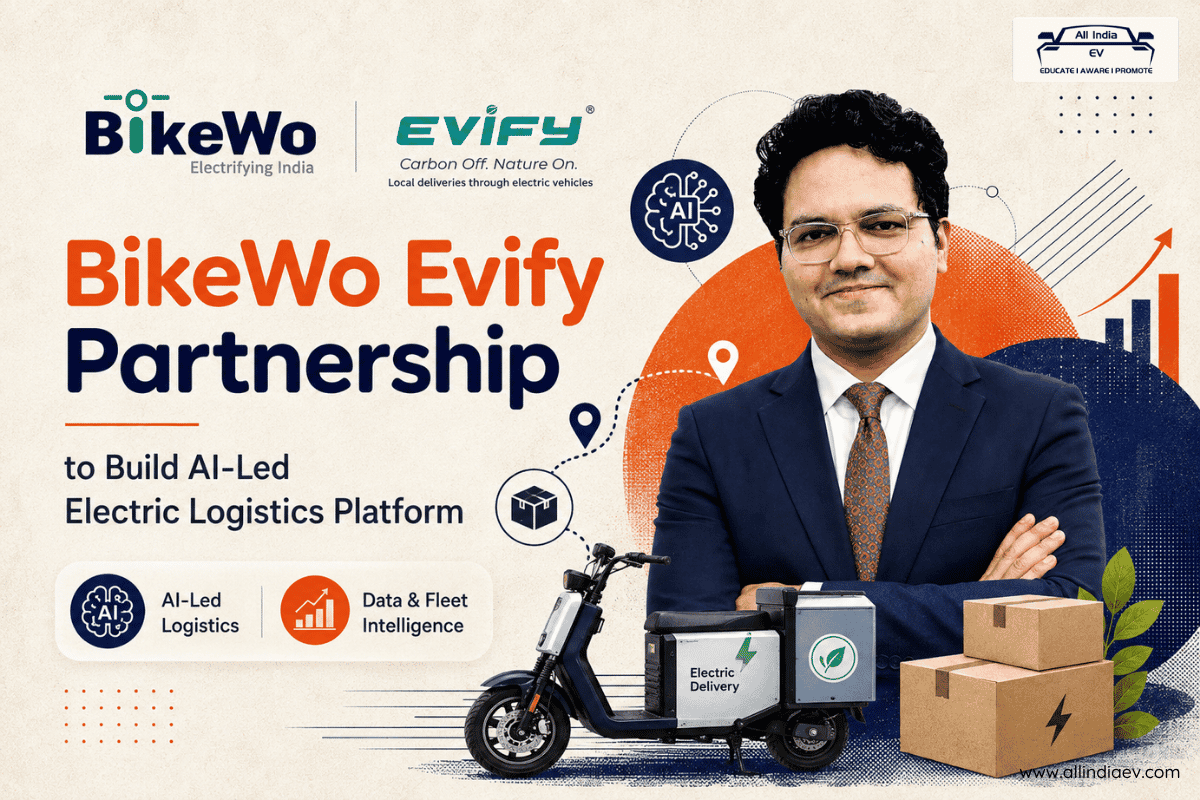
BikeWo Green Tech Limited and Evify Logitech Private Limited have signed a Memorandum of Understanding to explore the development of a technology and data platform for electric logistics.
The proposed platform will combine hardware-enabled data acquisition, artificial intelligence and data generated from real-world electric fleet operations.
The companies plan to use this data layer for applications including fleet management, route optimisation, rider performance, asset monitoring, predictive analytics and wider logistics intelligence.
The partnership represents an increasingly important development in electric mobility: EV fleets are becoming not only transportation businesses, but also significant generators of operational data.
BikeWo to Bring Hardware, Evify to Bring Fleet Data
Under the proposed collaboration, Evify will contribute its existing app-based logistics platform and rider-data capabilities.
BikeWo, meanwhile, plans to develop and deploy hardware systems capable of acquiring additional information from vehicles and fleet operations.
Combining the two could create a richer dataset covering how vehicles, riders and routes perform under actual delivery conditions.
The companies intend to first conduct technology pilots to assess data quality, hardware performance, potential applications and commercial viability.
Depending on the outcome, the collaboration could eventually lead to the development of datasets, algorithms, AI models and other technology solutions for electric mobility and logistics.
Why EV Fleets Need Better Data
Electric logistics fleets produce information that can directly influence operating economics.
A fleet operator can potentially track vehicle utilisation, route efficiency, battery behaviour, charging patterns, rider performance and asset downtime.
The challenge is converting that raw information into decisions.
For example, fleet intelligence could help identify which routes consistently consume more energy than expected, which vehicles are being underutilised or when an asset may require maintenance.
Route optimisation can also become particularly relevant for EVs because energy consumption and charging availability have to be considered alongside conventional logistics factors such as distance and delivery time.
Predictive analytics adds another layer by allowing operators to potentially identify abnormal patterns before they result in vehicle downtime.
AI Could Improve Electric Fleet Economics
Electric last-mile delivery is a high-utilisation business.
Small improvements in energy consumption, rider productivity or vehicle availability may appear insignificant at the level of a single trip, but the impact becomes much larger when repeated across hundreds of vehicles and thousands of deliveries.
This is where the BikeWo Evify partnership could become commercially relevant.
Instead of treating the electric vehicle merely as an asset travelling between two locations, the proposed platform aims to use operating data to continuously understand how efficiently that asset is performing.
The bigger opportunity may eventually extend beyond BikeWo and Evify’s own operations.
If the companies can generate reliable datasets and algorithms from electric fleet activity, those capabilities could potentially support other mobility and logistics applications.
India’s EV market is steadily moving from a hardware-first phase toward a more software-driven ecosystem.
Vehicles, batteries and chargers remain the physical foundation, but the intelligence layer connecting them is becoming increasingly valuable.
The BikeWo Evify partnership is an early example of that shift in electric logistics, where competitive advantage may increasingly depend not just on how many EVs a fleet operates, but on how effectively it understands every kilometre those vehicles travel.