

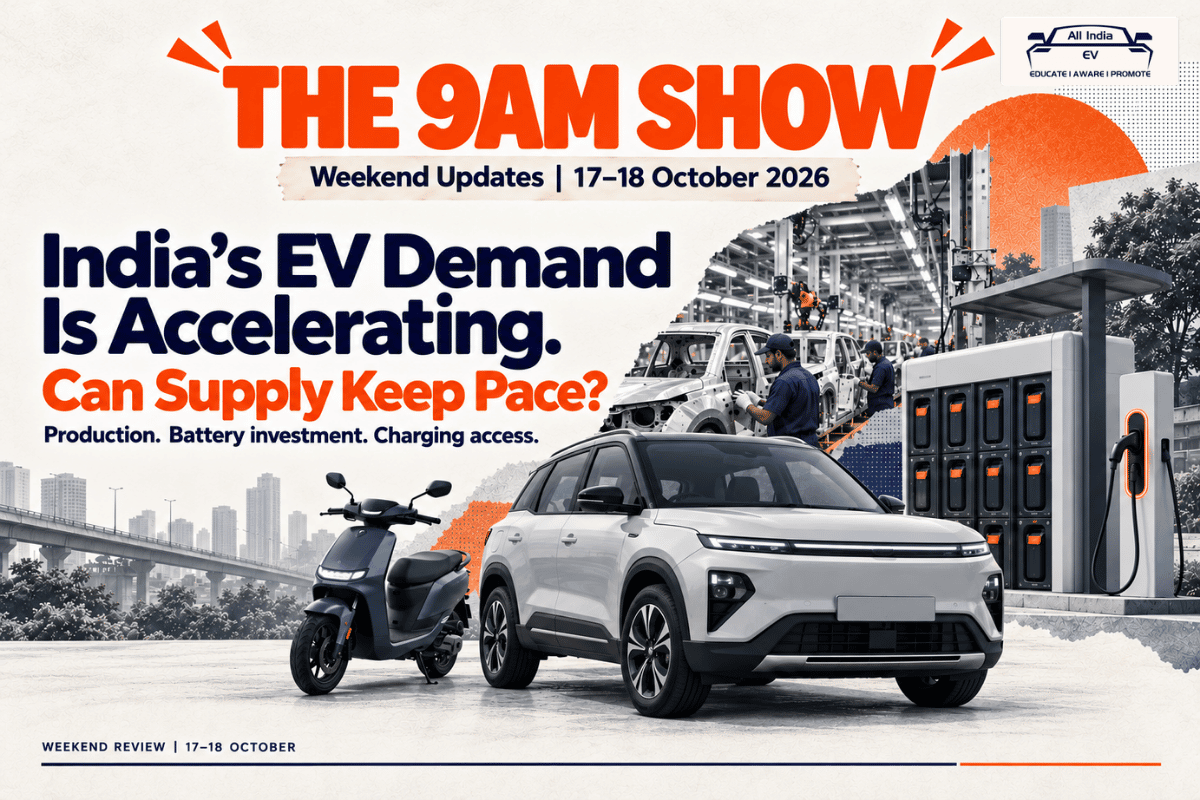
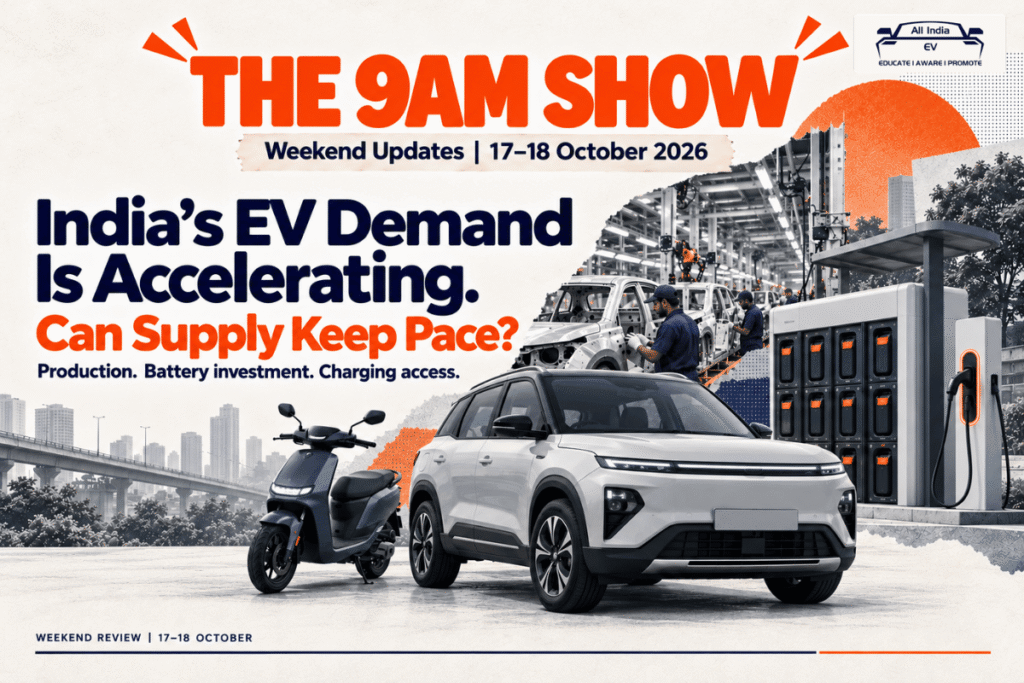
The 9AM Show | Monday, 19 October 2026
Weekend Review: 17–18 October
- EV demand puts production and suppliers under pressure
- Battery Smart’s reported ₹98 crore funding keeps swapping in focus
- India’s electric-car adoption gains international attention
- India’s electric-car adoption gains international attention
- Ferrari brings its electric future to New Delhi
- Tesla opens Roadster reservations; updates Model Y L
- Stellantis sets out a broader India growth roadmap
- Friday carryovers: charging integration and battery localisation
- What we are watching this week
India’s electric vehicle market is entering a more demanding phase of growth. Manufacturers are expanding capacity, investors are backing battery infrastructure, and global brands are widening their electric ambitions for the country.
But the weekend’s coverage also highlighted a challenge: rising demand needs a supply chain, charging network and ownership experience capable of supporting it.
From production constraints and Battery Smart’s latest funding to Ferrari’s electric debut, here are the developments shaping this Monday’s edition of All India EV’s The 9AM Show.
EV demand puts production and suppliers under pressure
The most consequential story of the weekend came from the manufacturing side.
Financial Express reported that growing EV demand is putting pressure on production capacity and component availability. Tata Motors has increased monthly EV production capacity to more than 16,000 units, while Ather plans to expand annual capacity from 4.2 lakh to 9.2 lakh units through its upcoming Maharashtra facility.
Hero MotoCorp and Bajaj Auto are also working to increase electric two-wheeler output. Yet supplier constraints and tighter inventories remain challenges, with waiting periods stretching in some markets.
The All India EV view: Capacity announcements are only one part of the growth equation. Suppliers must expand alongside vehicle manufacturers, and critical components must reach assembly lines consistently.
For buyers, this determines delivery times. For manufacturers, it determines how much demand becomes actual sales.
Battery Smart’s reported ₹98 crore funding keeps swapping in focus
Battery Smart reportedly raised approximately ₹98 crore from existing investor Ecosystem Integrity Fund, adding capital to its battery-swapping business for electric two- and three-wheelers. Reports published on Saturday cited regulatory filings describing the investment as a Series C top-up.
The development brings attention back to a crucial part of commercial electrification: keeping vehicles available for work.
For delivery riders and three-wheeler operators, charging downtime affects daily earning potential. Swapping offers a different operating model, although its usefulness depends on station access, battery availability, reliability and pricing.
The All India EV view: The next measure of progress will be how effectively additional capital improves service availability and operating economics for drivers.
India’s electric-car adoption gains international attention
Business Today cited regulatory filings describing the investment as a Series C top-up.
The development brings attention back to a crucial part of commercial electrification: keeping vehicles available for work.
For delivery riders and three-wheeler operators, charging downtime affects daily earning potential. Swapping offers a different operating model, although its usefulness depends on station access, battery availability, reliability and pricing.
The All India EV view: The next measure of progress will be how effectively additional capital improves service availability and operating economics for drivers.
India’s electric-car adoption gains international attention
Business Today reported on Sunday that India’s battery electric vehicle share of new-car sales exceeded that of the United States for six consecutive months from April 2026, citing energy think tank Ember.
The distinction matters: India’s lead concerns the proportion of new cars sold that are electric. The US continues to sell more electric cars in absolute numbers.
For India, the comparison offers another indication that electric cars are securing a larger place in the passenger vehicle market.
The All India EV view: International comparisons are useful, but India’s more important test is whether adoption spreads across price points, cities and buyer groups—and whether ownership support keeps pace.
Ferrari brings its electric future to New Delhi
Ferrari’s first all-electric car, the Luce, made its India debut at the Universo Ferrari exhibition in New Delhi on Saturday.
The appearance brings Ferrari’s electric programme directly to Indian audiences. It should be understood as an India showcase; the reports reviewed did not establish an Indian retail price or customer delivery schedule.
The All India EV view: Performance brands face a particular challenge with electrification: translating their identity into a different powertrain experience. Ferrari’s India showcase makes that transition part of the conversation in the country’s luxury car market.
Tesla opens Roadster reservations; updates Model Y L
Tesla opened reservations for its next-generation Roadster in India, according to a Saturday report by Economic Times. Production is planned for 2028, with initial availability intended in left-hand-drive configuration and subject to applicable regional requirements.
The company also announced a complimentary Acceleration Boost for the Model Y L, delivering a claimed 0–100 km/h time of 4.5 seconds.
The reservation announcement gives Indian buyers access to Tesla’s future product pipeline, but reservations and confirmed Indian deliveries remain separate milestones.
The All India EV view: Tesla’s near-term progress in India will be judged through its available vehicles, charging access, service coverage and customer experience.
Stellantis sets out a broader India growth roadmap
Sunday’s ETAuto coverage outlined Stellantis’ ambitions to revive its Indian business through an additional ₹4,000 crore investment, stronger localisation and a larger export footprint.
The company plans 12 product introductions—seven new products and five refreshes—and aims to triple domestic business and increase exports sixfold by 2029. The programme covers multiple powertrains; these figures should not be read as an exclusively electric vehicle commitment.
The All India EV view: For Jeep and Citroën, the significance will emerge through the products, pricing and ownership proposition delivered under this roadmap. India’s engineering and manufacturing role is central to that execution.
Friday carryovers: charging integration and battery localisation
Two announcements from 16 October, which continued receiving weekend coverage, deserve a brief mention.
Jio-bp and Kia India are integrating their charging platforms, taking the public charging points accessible through K-Charge in MyKia above 23,500. Kia’s dealership fast chargers will progressively join Jio-bp’s app. The figure represents access across integrated networks, rather than newly installed charging points.
Varroc and Forsee Power announced plans for an Indian battery-pack joint venture. Varroc will acquire a 45% stake in Forsee Power India and take management and operational control, with an initial focus on electric three-wheelers.
Together, these developments address two practical requirements for EV growth: easier charging access and a stronger domestic battery supply base.
What we are watching this week
Our focus now turns to delivery: whether production increases reduce waiting periods, whether infrastructure investment improves vehicle availability, and whether broader product strategies translate into clearer choices for Indian buyers.
The weekend’s developments point to an EV market with growing ambition. The next stage will be shaped by how consistently the industry delivers on it.
This is All India EV’s The 9AM Show—tracking the developments behind India’s electric mobility transition.