

India’s EV market did not spend the weekend chasing one blockbuster product launch.
- Electric Buses Are Moving From Sanctions to Actual Operations
- Kolkata Police Adds 183 High-Performance Electric Motorcycles
- Ahmedabad Shows That E-Bus Digitisation Still Needs Operational Discipline
- Chhattisgarh EV Sales Jump 67% — A Signal Beyond the Usual EV Markets
- India’s EV State Race Is Becoming Two Different Races
- Ashok Leyland Could Bring a ₹10,000–₹15,000 Crore EV Battery Project to Bhandara — But It Is Not Confirmed Yet
- India’s Lithium Strategy Is Starting to Move Beyond Simply Importing Cells
- Renault Gives India’s EV Market a Late-2027 Timeline
- The Bigger Picture
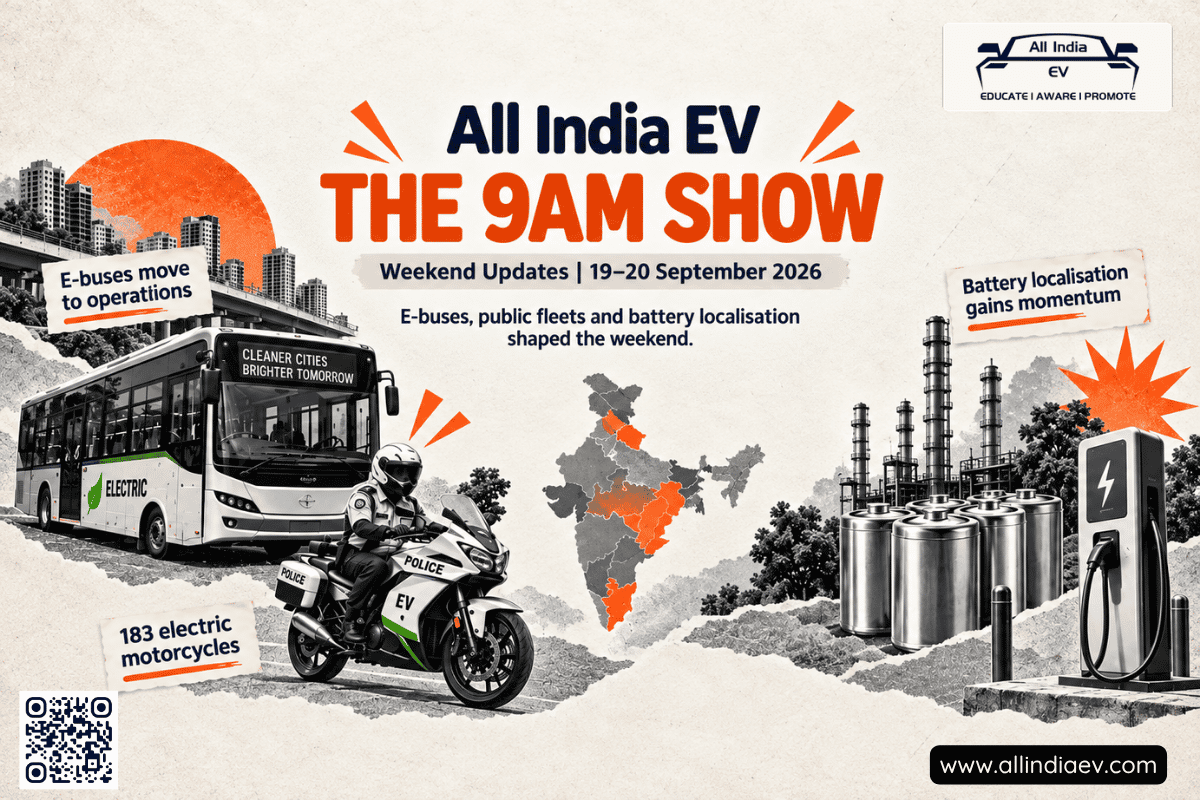
Instead, some of the more important developments happened further down the stack: electric buses moved closer to daily operations, public fleets added EVs, battery and lithium localisation plans became more concrete, and state-level data showed just how uneven India’s EV transition still is.
There was also an important reminder from Ahmedabad: deploying electric vehicles is only one part of the transition. Operating them efficiently, transparently and at scale is the harder part.
Here’s what actually happened over the weekend — and why it matters more than the headlines suggest.
Electric Buses Are Moving From Sanctions to Actual Operations
Three different cities produced three different signals about India’s electric-bus transition.
In Chamba, Himachal Pradesh, Deputy Chief Minister Mukesh Agnihotri flagged off 10 electric buses. The state says 297 electric buses are already operating and has announced plans to induct another 1,000 e-buses into the HRTC fleet.
In Visakhapatnam, the first Green Metro electric bus reached the Gajuwaka depot as part of the 100 e-buses allocated to the city under PM e-Bus Sewa. Passenger operations are scheduled to begin on 1 October, subject to registration and necessary approvals.
And in Bhopal, the electric-bus fleet is set to increase from 10 buses to 45, with reported daily ridership already approaching 10,000 passengers. Bhopal City Link Limited puts the operating cost at roughly ₹56 per kilometre.
The bigger point is not simply that more e-buses are being purchased.
India’s electric-bus story is increasingly moving from tender → allocation → depot → route → passenger operations.
That changes what the industry should start measuring. Fleet size alone will matter less. Bus availability, kilometres operated per day, charger uptime, ridership, energy cost and payment discipline will increasingly determine whether these projects become commercially sustainable public-transport systems.
Kolkata Police Adds 183 High-Performance Electric Motorcycles
One of the biggest electric two-wheeler fleet stories entering the weekend was Kolkata Police’s induction of 183 Ultraviolette X-47 Skyforce electric motorcycles.
The purpose-built police version is based on Ultraviolette’s X-47 platform and integrates equipment including sirens, hooters, a public-address system, warning lights and communication hardware. The motorcycles will support Kolkata Police’s emergency-response operations.
An important timing note: the formal handover took place on 18 September, with substantial coverage continuing into Saturday.
Why does this matter?
This is very different from handing over a few EVs for demonstration.
A 183-vehicle operational fleet creates a real-world test of electric motorcycles under police duty cycles — irregular routes, repeated acceleration, idle periods with electronics running, multiple riders and high vehicle availability requirements.
The most interesting numbers therefore won’t be the claimed range or top speed.
They will be kilometres per shift, charging behaviour, energy cost, uptime, maintenance requirements and vehicle availability after six or twelve months.
If those economics work, police departments and other government fleets could become a meaningful institutional market for electric motorcycles.
Ahmedabad Shows That E-Bus Digitisation Still Needs Operational Discipline
Not every weekend EV story was about expansion.
In Ahmedabad, two separate AMTS electric buses were found operating with the same displayed registration number. Officials subsequently said the vehicles had different actual RTO registrations but that the number plates had been tampered with. The operator was fined ₹5 lakh, and the matter triggered questions around fleet monitoring and control-room oversight.
The incident itself was reported on 18 September, while the enforcement action and wider scrutiny became part of the weekend news cycle.
The interesting part here is the digital layer.
These buses operate within a system where vehicles are monitored through GPS, and operator payments are linked to kilometres operated.
If two buses can display the same registration identity while operating on the same route without immediately triggering an operational alarm, the problem is bigger than a number plate.
As India’s electric-bus fleets grow into the thousands, fleet software, vehicle identity, GPS validation, payment reconciliation and operational auditing will become almost as important as the buses and chargers themselves.
Chhattisgarh EV Sales Jump 67% — A Signal Beyond the Usual EV Markets
A Sunday report citing Federation of Automobile Dealers Associations figures showed 5,943 EVs were sold in Chhattisgarh during August, compared with 3,550 units a year earlier.
That represents reported year-on-year growth of 67.41%. One month should not be treated as a structural trend by itself. But the number is still worth watching.
Much of India’s EV narrative has historically centred on Maharashtra, Karnataka, Delhi, Tamil Nadu and a handful of large urban markets.
Growth in states such as Chhattisgarh matters because the next phase of EV adoption will increasingly depend on whether electrification spreads beyond India’s first-wave EV cities.
The question now is whether this momentum continues for several months — and which segments are driving it: electric two-wheelers, three-wheelers, cars or commercial vehicles.
India’s EV State Race Is Becoming Two Different Races
Weekend coverage also brought renewed attention to NITI Aayog’s India Electric Mobility Index 2025.
The report itself was released before the weekend, but the state-by-state findings generated substantial discussion on Saturday and Sunday.
The headline numbers are useful:
Delhi scored 84, the highest overall score in the country. Among large states, Maharashtra led with 78, followed by Karnataka at 73.
But the more interesting finding sits underneath the overall rankings. Karnataka scored 97 for Charging Infrastructure Readiness, while Maharashtra and Haryana each scored 91.
Yet Haryana’s Transport Electrification Progress score was just 19 — the lowest among large states.
Uttar Pradesh showed almost the opposite pattern: a Transport Electrification Progress score of 58, but only 36 for Charging Infrastructure Readiness.
That tells us something important.
Installing chargers does not automatically create EV adoption. And strong EV adoption can develop faster than the charging network supporting it.
India therefore does not have one EV-transition problem.
Some states need vehicles and demand. Others need charging infrastructure. Others need policy execution, financing, research capacity or commercial fleet adoption.
The next generation of state EV policy may have to become much more targeted than simply offering another purchase subsidy.
Ashok Leyland Could Bring a ₹10,000–₹15,000 Crore EV Battery Project to Bhandara — But It Is Not Confirmed Yet
One of the largest numbers to emerge on Sunday came from Union Minister Nitin Gadkari.
Gadkari said Ashok Leyland is considering an EV battery project in Bhandara, Maharashtra, as part of its expansion plans.
According to him, if the company proceeds, the project could involve investment of around ₹10,000 crore to ₹15,000 crore. That status distinction is important.
This is not yet a confirmed ₹15,000 crore Ashok Leyland battery investment.
It is a potential project described publicly by the minister, and the company has not yet announced a final investment of that size in the reporting reviewed for this edition.
Still, the possibility is strategically important.
Commercial vehicles represent one of the battery industry’s most demanding applications because economics depend heavily on battery durability, usable energy, cycle life, charging speed and cost per kilometre.
If Ashok Leyland eventually moves into battery manufacturing at significant scale, it could bring vehicle manufacturing and one of the industry’s most important cost components closer together.
The next thing to watch is therefore not another investment estimate.
It is a formal company announcement, project scope, cell-versus-pack strategy, technology partner and commissioning timeline.
India’s Lithium Strategy Is Starting to Move Beyond Simply Importing Cells
A Sunday Business Standard report provided another important upstream signal.
Altmin plans to invest $200 million in a lithium refinery at Kakinada in Andhra Pradesh. The proposed plant is designed to process 300,000 tonnes per annum of spodumene into 30,000 tonnes of lithium carbonate, according to the company’s founder.
Meanwhile, Lohum has begun mining from 10 lithium blocks in Zimbabwe and plans to establish a larger refinery in India to process material from those assets.
Battery recycler Attero is also expanding lithium-ion battery recycling capacity, while NavPrakriti is preparing to source battery scrap internationally.
This is a more important shift than it may first appear.
India’s battery localisation debate has often focused on cell manufacturing. But a domestic cell plant still depends on imported materials if lithium, cathode materials and other upstream inputs remain externally sourced.
The emerging model is therefore becoming broader:
Overseas resources → Indian refining → battery materials → cells → packs → recycling.
If that chain develops, battery localisation becomes less about assembling cells in India and more about controlling a meaningful portion of the underlying material economics.
Renault Gives India’s EV Market a Late-2027 Timeline
Renault India also provided a clearer window into its electrification strategy over the weekend.
Francisco Hidalgo Marques, Renault India’s Vice President of Sales and Marketing, said the company is preparing new battery-electric vehicles from late 2027, while simultaneously expanding hybrid powertrains across its SUV portfolio.
Renault is pursuing a multi-powertrain strategy spanning petrol, CNG, hybrids and EVs, rather than betting exclusively on battery-electric vehicles in the immediate term.
That positioning is worth watching.
India’s passenger-vehicle market is increasingly dividing manufacturers into different transition strategies.
Some are moving aggressively toward dedicated EV platforms. Others are using hybrids, CNG and EVs simultaneously. Renault appears to be choosing the second route.
The key question will be what kind of EV arrives in late 2027: an adapted global product, a heavily localised India-focused model, or something positioned against the rapidly expanding ₹10–20 lakh electric-SUV market.
The Bigger Picture
Put these stories together and the weekend reveals a more mature phase of India’s EV transition.
It was not dominated by another concept vehicle or another headline-grabbing launch.
Instead:
- Public fleets are beginning to create real operational EV demand.
- Electric buses are moving from tenders into depots and routes.
- Cities are discovering that fleet management matters as much as vehicle procurement.
- Second-wave EV markets are beginning to show meaningful sales growth.
- States are learning that charging infrastructure and EV adoption do not automatically grow together.
And upstream, the conversation is shifting from importing batteries to controlling lithium, refining, recycling and potentially large-scale domestic battery manufacturing.
That is what an EV market starts to look like when it moves beyond the first phase of adoption.
The next phase will not be decided only by how many EVs India sells.
It will be decided by how reliably they operate, how cheaply they can be financed and charged, how much of their supply chain India controls, and whether EV economics continue to work after the subsidies and headlines disappear.
This is The 9AM Show by All India EV — Weekend Updates.