

10–16 August 2026 | All India EV Charging Infrastructure Weekly
- The Week at a Glance
- 1. Pulse Energy Connected 10,000+ Chargers to Unified Bharat eCharge
- 2. Gentari’s Possible Exit Raises a Bigger Question About Charging Economics
- 3. Indofast and GLIDA Are Combining Charging and Battery Swapping
- 4. Maharashtra Wants Charging Stations at Depots, RTOs and Under Flyovers
- 5. Himachal Pradesh Is Building Charging Around Tourism Demand
- 6. Plugzmart Commits ₹100 Crore to Charger Manufacturing in Tamil Nadu
- 7. Bolt.Earth Targets the 2W/3W Fast-Charging Problem
- 8. ChargeZone Is Bringing Charging Into the Vehicle-Sales Funnel
- 9. PM E-DRIVE’s Policy Runway Gets Longer
India’s EV charging sector had an unusually eventful week.
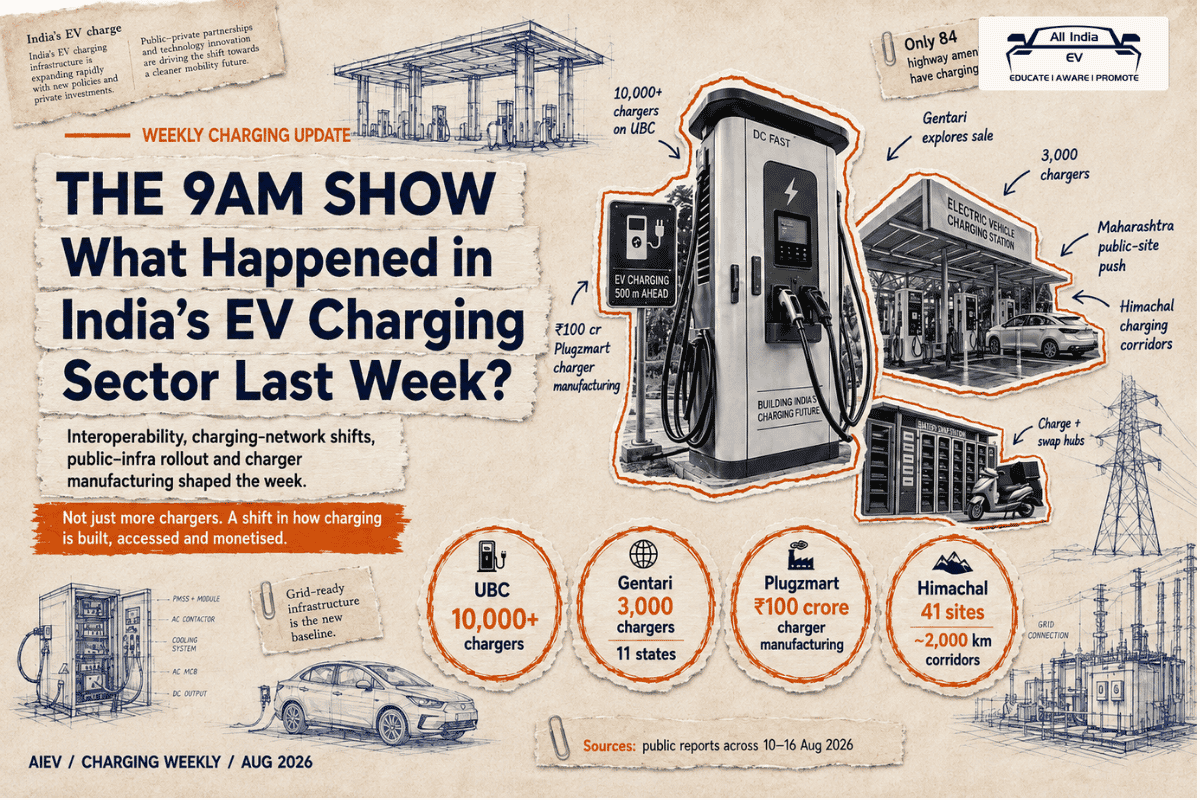
A network of more than 10,000 chargers moved closer to interoperable discovery and payments through Unified Bharat eCharge. At almost the same time, Petronas-backed Gentari reportedly began exploring the sale of an Indian charging business comprising roughly 3,000 charging points across 11 states.
Elsewhere, Maharashtra and Himachal Pradesh pushed charging infrastructure deeper into public locations and highway corridors, Indofast and GLIDA started combining charging with battery swapping, Plugzmart committed ₹100 crore toward charger manufacturing, and Bolt.Earth received ARAI certification for a charger aimed specifically at electric two- and three-wheelers.
Put together, the week’s developments point toward an EV charging market becoming more specialised, interoperable and infrastructure-heavy, while the economics of owning and operating networks remain an open question.
The Week at a Glance
| Development | Key Number | What It Signals |
|---|---|---|
| Pulse Energy joins Unified Bharat eCharge | 10,000+ chargers | Interoperability |
| Gentari explores India charging exit | ~3,000 points, 11 states | CPO economics / consolidation |
| Indofast + GLIDA | 50 sites, 100+ swap stations planned | Integrated energy hubs |
| Plugzmart Tamil Nadu MoU | ₹100 crore | Domestic charger manufacturing |
| Himachal Green Corridors | 41 sites across ~2,000 km | Highway/tourism charging |
| Maharashtra charging proposal | MSRTC depots, RTOs & flyovers | Public-land deployment |
| ChargeZone + Landmark Cars | 15,000+ charging-point network | Charging bundled with EV sales |
| Bolt.Earth Blaze | 3 kW dual-gun DC | Dedicated 2W/3W charging |
1. Pulse Energy Connected 10,000+ Chargers to Unified Bharat eCharge
The biggest structural development of the week came from Pulse Energy, which became one of the first certified technology enablers for Unified Bharat eCharge, or UBC.
Pulse says it works with more than 100 charge point operators and has a connected network exceeding 10,000 EV chargers. Those chargers can now be integrated into UBC while operators retain their existing hardware and brands.
The important part isn’t just the charger count.
UBC, backed by the Ministry of Heavy Industries, BHEL and NPCI, is designed as interoperable digital infrastructure. An EV driver can discover a participating charging station through the BHIM app, scan a QR code and make the payment directly through UPI, without maintaining separate CPO wallets or accounts.
That could gradually separate three layers that have traditionally been bundled together:
charger ownership → charging-network software → customer interface/payment
Until now, many CPOs have attempted to own all three.
If UBC scales, charger accessibility may increasingly depend on interoperability rather than which charging app the driver happens to have installed.
For smaller CPOs, that could increase discoverability. For larger networks, it raises another question: how valuable is a proprietary charging app when discovery and payments become infrastructure-level utilities?
2. Gentari’s Possible Exit Raises a Bigger Question About Charging Economics
While one network became more interoperable, another major charging portfolio potentially moved towards the transaction market.
Petronas-backed Gentari has reportedly initiated a process to explore the sale of its Indian EV charging business.
Gentari Green Mobility India operates around 3,000 charging points across 11 states, covering urban and highway locations.
The proposed transaction is reportedly still at an early stage.
For the industry, however, this is worth watching carefully.
India’s public charging story is usually discussed through installation targets: how many chargers have been deployed, how many cities have been covered and how quickly networks are expanding.
But infrastructure investors eventually need a different set of numbers:
- charger utilisation
- electricity throughput
- revenue per charging point
- site rentals
- power and demand charges
- maintenance costs
- customer-acquisition costs
- payback periods
Gentari exploring a sale doesn’t by itself prove that India’s charging economics are weak. Strategic portfolio decisions can happen for many reasons.
But a 3,000-point network changing hands would create an important market benchmark for what charging assets are actually worth when investors look beyond announced network size.
3. Indofast and GLIDA Are Combining Charging and Battery Swapping
Indofast Energy and GLIDA announced a partnership to develop energy hubs that combine high-power EV charging and battery swapping at the same locations.
The initiative starts with 10 Quick Interchange Stations across GLIDA sites in Chennai, Bengaluru and Hyderabad.
Within 12 months, the companies intend to expand to 50 sites containing more than 100 battery-swapping stations.
This is an interesting evolution in infrastructure design.
India’s charging and swapping industries have largely developed as parallel ecosystems. Passenger cars lean heavily towards plug-in charging, while high-utilisation two- and three-wheeler fleets can benefit from swapping.
Putting both at one energy hub allows the same location, grid connection and real estate to potentially serve different vehicle categories.
The infrastructure competition may therefore move beyond:
charger versus battery swapping
and towards:
which energy hub can monetise the greatest number of vehicle types from the same site?
That matters because utilisation remains one of the central variables determining charging-infrastructure economics.
4. Maharashtra Wants Charging Stations at Depots, RTOs and Under Flyovers
Maharashtra is looking at a different problem: where should chargers physically go?
The state government is planning charging facilities at MSRTC depots and Regional Transport Offices across Maharashtra.
Transport Minister Pratap Sarnaik also said the government is considering setting up charging stations around flyover locations through a public-private partnership model.
That may sound like another government infrastructure announcement, but the site-selection strategy deserves attention.
One of the hidden bottlenecks in charging is not charger hardware. It is access to strategically located land with sufficient electricity connectivity and predictable vehicle traffic.
Government-owned depots, RTO properties and spaces associated with major transport infrastructure can potentially solve part of that problem.
If structured commercially, states could increasingly become land and infrastructure enablers, while private CPOs provide capital, chargers, software and operations.
5. Himachal Pradesh Is Building Charging Around Tourism Demand
Himachal Pradesh’s approach is even more demand-specific.
The state has notified six Green Corridors covering roughly 2,000 km of highways, connecting major tourist routes including Shimla, Manali, Dharamshala, Chamba and Spiti.
Tenders currently cover 41 charging locations, with sites planned roughly 25 km apart. Four were reported operational, with remaining sites under installation or commissioning. Each planned location uses 90 kW charging equipment with four charging guns.
Another 80 petrol-pump locations have been identified for charging stations, while more than 66 hotels in Himachal Pradesh already offer EV charging.
The interesting part is the demand thesis.
Himachal does not have a massive local EV market. Instead, its charging strategy increasingly targets tourist EV traffic arriving from Delhi, Punjab, Haryana and Chandigarh.
That is a useful lesson for charging planners.
Charging demand doesn’t necessarily originate where the charger is located.
Destination charging can be driven by vehicles registered hundreds of kilometres away.
6. Plugzmart Commits ₹100 Crore to Charger Manufacturing in Tamil Nadu
Infrastructure deployment wasn’t the only part of the stack attracting capital.
IIT Madras Research Park-incubated Plugzmart signed an MoU with the Tamil Nadu government to invest ₹100 crore in expanding EV charger manufacturing, R&D and the wider charging ecosystem.
Plugzmart manufactures AC and DC charging systems ranging from 3.3 kW to 360 kW, alongside charger controllers, Power Line Communication modules and cloud-based charger-management systems.
The investment is expected to scale production at its facility in Oragadam/Vallam and create more than 500 direct skilled jobs over three years.
This is another layer of India’s charging story worth tracking.
As charger deployment scales, value isn’t captured only by CPOs.
It also flows toward:
power electronics → charger controllers → communication modules → manufacturing → software/CMS → installation and servicing
Domestic manufacturing companies could therefore benefit from network expansion even without taking utilisation risk themselves.
7. Bolt.Earth Targets the 2W/3W Fast-Charging Problem
Bolt.Earth’s Blaze DC 3 kW Dual Gun charger received certification from the Automotive Research Association of India.
The charger is designed for electric two- and three-wheelers and supports Type 6 and Type 7 connectors.
Bolt.Earth claims the system can provide approximately 40 km of range from 15 minutes of charging, depending on the vehicle.
The product highlights another trend: India’s charging market is becoming increasingly segmented.
A highway passenger-car charger may need 60 kW, 120 kW or substantially more.
A commercial electric two-wheeler doesn’t.
The commercially optimal charging hardware therefore depends on the vehicle category, battery size, dwell time and utilisation pattern.
That creates room for infrastructure architectures designed specifically around e-2W and e-3W economics, rather than simply shrinking passenger-car charging systems.
8. ChargeZone Is Bringing Charging Into the Vehicle-Sales Funnel
ChargeZone and Landmark Cars announced a programme under which customers buying EVs through Landmark dealerships can receive 51,000 charging credits for ChargeZone’s public network.
Landmark operates more than 140 facilities across 32 cities, while ChargeZone says its network includes 15,000+ charging points across highways, urban areas and commercial locations.
This looks like a customer-benefit programme on the surface.
Strategically, it is also customer acquisition.
Instead of waiting for a new EV owner to download a charging application after buying the vehicle, the CPO enters the customer journey at the dealership itself.
That means charging networks are beginning to compete not just over where chargers are located, but over who captures the EV driver first.
9. PM E-DRIVE’s Policy Runway Gets Longer
The Ministry of Heavy Industries also amended the PM E-DRIVE framework during the week.
The scheme now carries an overall outlay of ₹11,900 crore, while the programme runs through 31 March 2028. Charging infrastructure remains an eligible component under the scheme.
The broader charging programme under PM E-DRIVE has historically included a ₹2,000 crore allocation for public EV charging infrastructure.
The policy runway therefore continues while private-sector charging models evolve in parallel.
The important metric over the coming quarters will not be sanctioned charging capacity alone.
It will be how quickly sanctioned infrastructure moves through:
approval → tender → allocation → commissioning → operational status → meaningful utilisation.
That final step is the one that ultimately determines whether infrastructure becomes an asset or simply another pin on a charging map.
All India EV – Market Insight
All India EV – The 9am Show