

Tuesday, 11 August 2026 · 9:00 AM IST · Week in review: Monday 3 August – Friday 7 August 2026
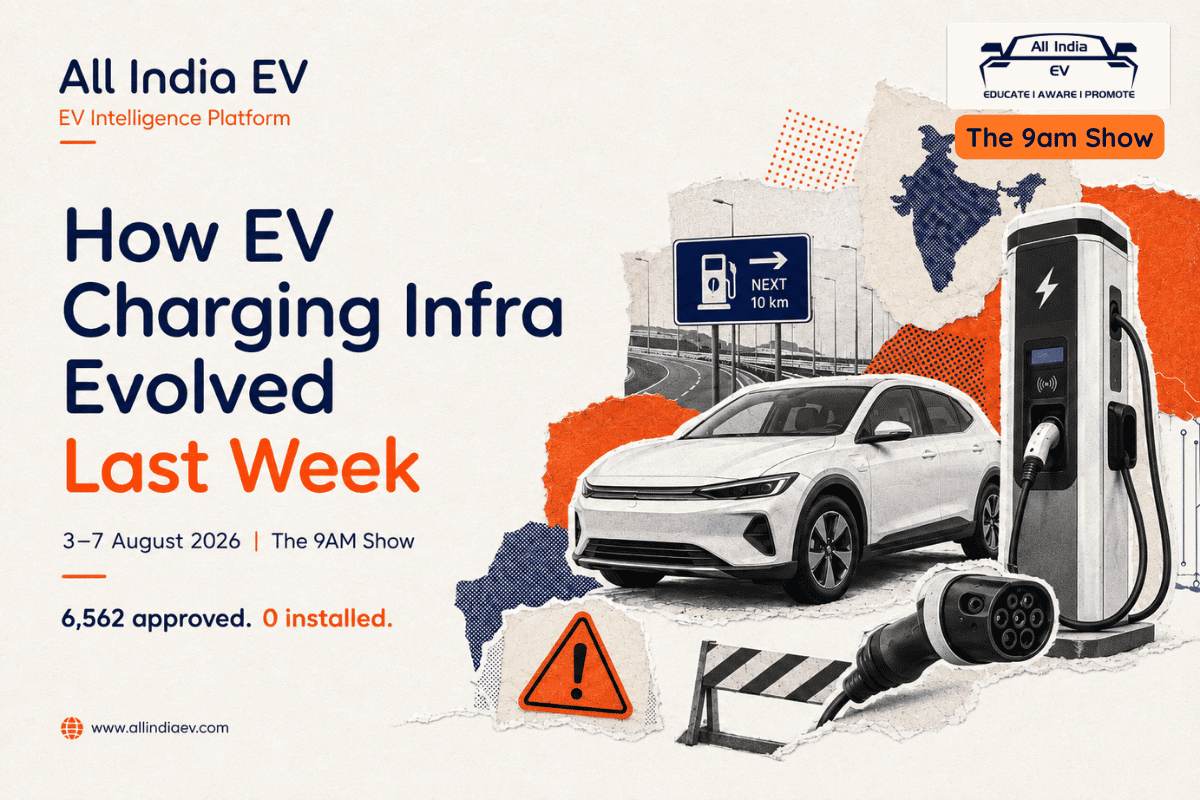
India approved 6,562 public chargers last week and installed none of them. That gap is the week’s real story.
Last week produced two kinds of charging news, and they were pointing in opposite directions.
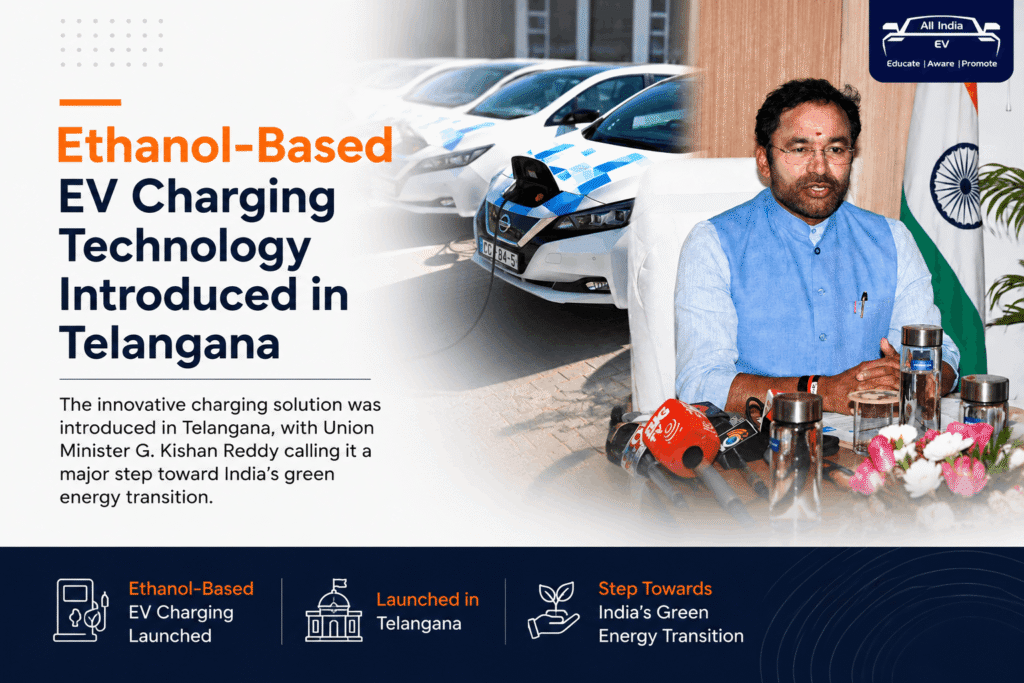
One kind was announcements. Tamil Nadu said it would build 20,000 charging stations. The Centre told Parliament that 52,718 charging stations now exist across India. Bharat Electronics inaugurated an integrated solar-plus-storage-plus-charging installation. Telangana introduced an ethanol-powered mobile fast charger.
The other kind was arithmetic. Under PM E-DRIVE, 6,562 public chargers have been approved and, as of the parliamentary reply, none had been installed. Pimpri-Chinchwad cancelled its charging tender for the fourth time after receiving no bids. The Madras High Court issued notices over charging stations that exist but do not work. And across the entire national highway network, just 84 wayside amenities have an operational charger.
India’s charging problem is no longer a shortage of announcements. It is that announcement, approval, installation and function have become four separate things, and only the first one gets a press release.
The gap nobody is measuring
Start with the number that is supposed to be reassuring. As of 29 July 2026, India has 52,718 EV charging stations, per data presented in the Rajya Sabha on 7 August. Maharashtra leads with 6,985, Karnataka follows with 6,805, and Jammu & Kashmir has 295.
Now put three of last week’s other findings next to it.
One (4 August). Of the 6,562 public chargers approved under PM E-DRIVE, against a ₹2,000 crore allocation, none had been installed at the time of the reply. Approval is not a charger. It is a line item.
Two (5 August). The Madras High Court’s Madurai Bench issued notices to central and state authorities, IOCL and BPCL, following a PIL about non-functional charging stations on the Madurai–Tenkasi corridor. Those stations are inside the 52,718. They are counted. They do not charge anything.
Three (6–7 August). Only 84 wayside amenities on India’s entire national highway network have operational EV chargers. In Karnataka — the state with the second-highest station count in the country — the number of highway WSAs with chargers is four.
Read together, these say something specific: the 52,718 figure is an installation count, not a functional network count, and India currently has no published measure of the second. A charger that was installed in 2023 and has been dead since 2024 stays in the total. A charger approved but never built is not in the total, but is in the policy narrative. Both distortions run in the direction of making the network look better than it is.
Every EV buyer in India makes a purchase decision partly on the assumption that public charging works. Nobody is currently telling them how often it does.
The Failure File
What did not work in charging last week.
Pimpri-Chinchwad cancelled its EV charging tender for the fourth time (4 August). No bids, again. The municipal corporation has identified 21 locations. The city reportedly has 17 private charging stations operating.
This is the same PCMC we flagged in June, when it re-invited bidders after three years of poor response. It is now four cancellations deep. That is not a procurement delay; that is a market telling a municipality that its terms do not work. Somewhere in the tender — site economics, revenue share, land tenure, power connection responsibility, concession length — is a condition no operator will accept. Four rounds of silence is a very clear answer.
The uncomfortable comparison is in the same paragraph: private operators built 17 stations in Pimpri-Chinchwad while the corporation built none at 21 identified sites. The sites are not the constraint.
And a broader failure worth naming: PM E-DRIVE’s 6,562 approvals with zero installations, alongside PCMC’s fourth cancellation and the Madurai PIL, describe one problem, not three. Public charging in India has a delivery failure, not a funding or a policy-intent failure. The money is allocated. The targets are set. The sites are identified. The chargers are not there.
Policy moved, mostly in Tamil Nadu
Tamil Nadu announced 20,000 public charging stations over five years (6 August) under a PPP model, with roughly ₹50 crore allocated for FY27 and a further ₹5 crore earmarked for residential charging subsidies routed through RWAs. Phase one targets about 1,000 stations.
Two things stand out, one good and one worth watching.
The good: the RWA subsidy line. It is a small number — ₹5 crore — but it is one of the first state allocations we have seen aimed directly at the residential-society layer, which is where the actual charging bottleneck sits for apartment-dwelling buyers. Public charging gets the headline; the RWA line item is the more useful policy.
The one to watch: 20,000 stations over five years is 4,000 a year, against a ₹50 crore FY27 allocation and a PPP structure that requires private operators to fund most of the build. Tamil Nadu has 498 charging points cleared under PM E-DRIVE phase one and now a 20,000-station ambition. Given what PM E-DRIVE’s national approval-to-installation record looks like, the number to hold Tamil Nadu to is phase one’s 1,000 — not the 20,000.
Jammu & Kashmir (5 August): 76 public chargers installed under FAME-II, alongside 200 e-buses allocated under PM E-DRIVE. Note the arithmetic against last week’s other J&K figure of 295 total stations — different schemes, different counting bases, and a good illustration of why national charging totals are difficult to interpret.
Swapping networks are outbuilding the state
Here is the week’s sharpest contrast, and almost nobody drew it.
Battery Smart (3 August) operates more than 1,500 swapping stations across 75+ cities, serving close to 100,000 commercial EV drivers, and is targeting 70–80% annual growth alongside a proposed IPO. Indofast Energy (4 August), which partnered with Zeon Charging to expand into Bengaluru, Hyderabad and Chennai starting with six Quick Interchange Stations, reports a network of 1,900+ swapping stations across 24 cities.
Two private companies. Roughly 3,400 energy-replenishment points between them, built and running.
In the same week, a national scheme with ₹2,000 crore behind it reported 6,562 approvals and zero installations.
The difference is not capital and it is not ambition. It is that swapping networks are built by operators who lose money the day a station is down, and public charging is built by a chain in which nobody’s revenue depends on whether the charger works next Tuesday.
We are treating swapping as charging infrastructure in this section, because for the commercial two- and three-wheeler segment — which, as we noted yesterday, holds above 65% of India’s EV volume — it is the charging infrastructure.
Technology, briefly
Bharat Electronics (3 August) inaugurated SUSTRAGRID at its Bengaluru campus, combining solar generation, battery energy storage and EV charging in one installation. Telangana (3 August) introduced a mobile 150 kW DC fast-charging unit powered by ethanol, designed to run without a conventional grid connection.
Both are worth logging for the same reason: they address the constraint that does not appear in charger counts — the grid connection. A large share of India’s charging delay is not site availability or capex; it is sanctioned load and transformer capacity. Off-grid and behind-the-meter approaches sidestep that queue entirely.
Neither is proven at scale, and the ethanol unit in particular needs an honest fuel-cycle and cost-per-kWh comparison before anyone calls it clean or cheap. We will run those numbers when they are published.
The Desk View
India does not currently have a charging shortage narrative problem. It has a verification problem.
We can tell you how many chargers have been announced. We can tell you how many have been approved. We can tell you, to the unit, how many are installed — 52,718 as of 29 July. What no public dataset tells you, and what the Madurai PIL and the 84-wayside-amenity figure both point at, is how many of them actually delivered electricity to a vehicle last week.
Until that number is published, every other charging number in this country is a construction statistic being read as a service statistic.
Here is the one this section will keep asking for: not how many chargers India has, but what share of them worked yesterday. Any operator, state nodal agency or ministry that publishes an uptime figure will get the front of this section. So far, none has.