

The Quick Update
What Happened:
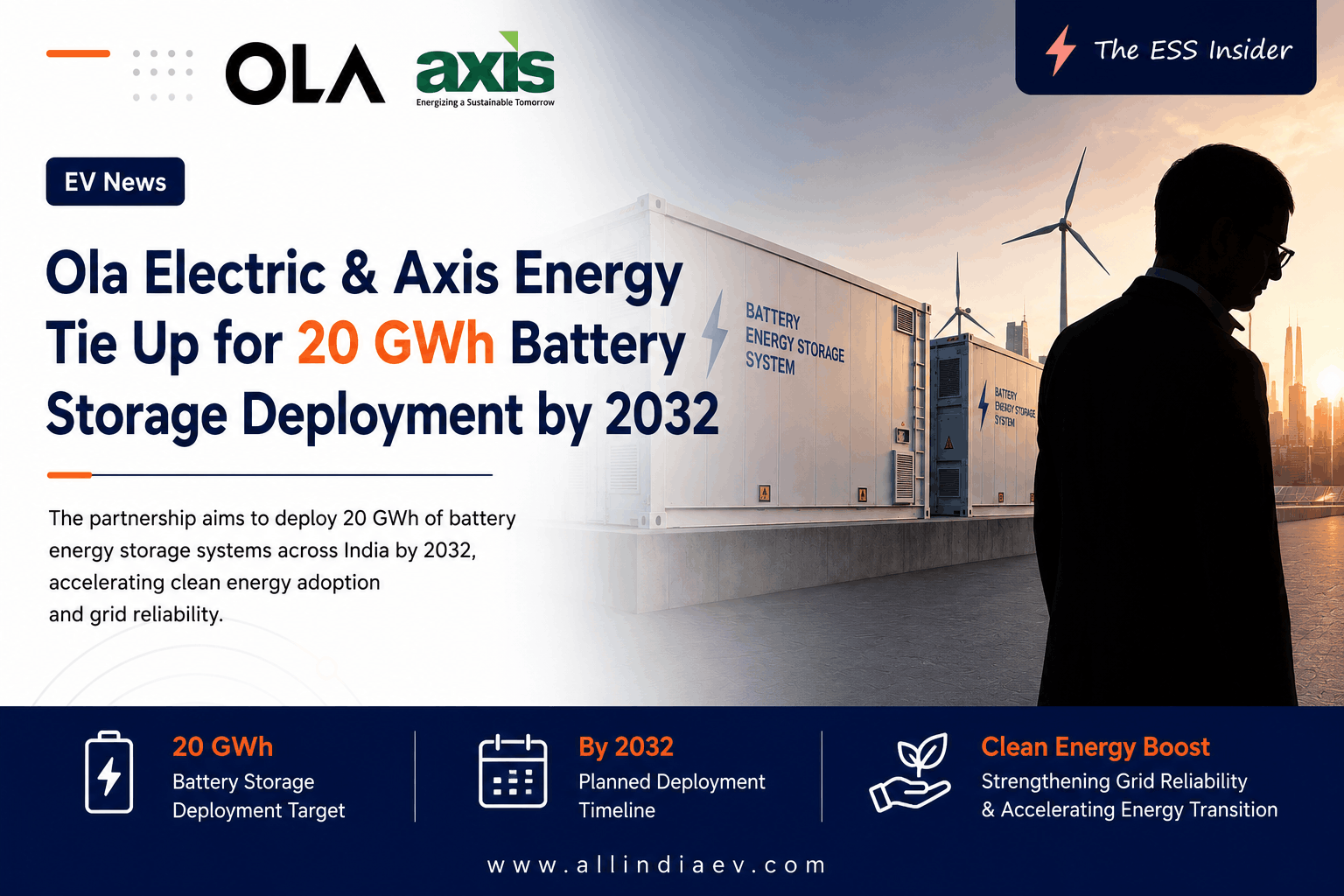
Ola Electric has signed a Memorandum of Understanding (MoU) with renewable energy developer Axis Energy to explore deployment of up to 20 GWh of battery energy storage systems (BESS) by 2032.
The Key Number:
20 GWh — the maximum battery storage capacity covered by the proposed partnership through 2032.
Why It Matters:
The agreement marks Ola Electric’s expansion beyond electric vehicles into utility-scale energy storage, positioning its battery technology and manufacturing capabilities for the wider power sector.
The Core News
Ola Electric has signed an MoU with Axis Energy to explore the deployment of up to 20 GWh of battery energy storage systems (BESS) by 2032. The partnership is expected to support Axis Energy’s renewable-energy projects while giving Ola Electric a pathway into India’s growing grid-scale storage market.
The agreement comes as Ola Electric prepares to expand its battery business through its upcoming Ola Mahashakti energy-storage platform. Under the proposed arrangement, deployment could scale to as much as 5 GWh annually from 2028, creating a multi-year demand pipeline for the company’s storage systems.
For Ola Electric, the deal represents a strategic move to apply its battery manufacturing and energy-storage capabilities beyond mobility. For Axis Energy, access to battery storage can complement its renewable-energy portfolio by providing a mechanism to manage variable renewable generation and improve grid flexibility. The partnership therefore connects India’s EV manufacturing ecosystem with its rapidly developing stationary-storage market.
Breaking Down the Update
- Partnership: Ola Electric and Axis Energy have signed an MoU.
- Storage Target: Up to 20 GWh of BESS deployment by 2032.
- Annual Scale: Deployment is planned to reach up to 5 GWh per year from 2028.
- Technology: Battery Energy Storage Systems for stationary applications.
- Ola’s Expansion: The agreement takes Ola Electric further into the energy-storage business.
- Ola Mahashakti: The partnership is linked to Ola Electric’s upcoming energy-storage platform.
- Renewable Integration: BESS can help manage variability from renewable power generation.
- Market Opportunity: The deal gives Ola Electric a potential route into India’s utility-scale storage market.
How Ola Electric battery storage deployment Will Help the Indian EV Market
The Ola Electric battery storage deployment plan could have implications beyond stationary power storage, particularly as India develops a larger domestic battery ecosystem. The same broad battery technologies, manufacturing capabilities and supply chains that support electric vehicles can increasingly serve stationary energy-storage applications.
For Indian EV manufacturers, diversification into BESS can create an additional market for cells, battery packs, thermal-management systems, power electronics and battery-management systems. This could potentially improve manufacturing scale and utilisation while reducing dependence on vehicle demand alone.
The partnership is also relevant to India’s renewable-energy expansion. Solar and wind generation fluctuate according to weather and time of day, creating a need for flexible storage capacity. Grid-scale batteries can store electricity when generation is high and discharge it when demand or system requirements increase.
For policymakers, the development demonstrates how India’s EV and energy-storage sectors are becoming increasingly interconnected. A stronger domestic BESS industry could support renewable integration while building demand for locally manufactured battery systems.
Over the longer term, the Ola Electric battery storage deployment strategy could help establish EV manufacturers as broader energy-technology companies rather than mobility-only businesses. Its success, however, will depend on project execution, storage economics, financing and the pace at which India’s stationary-storage market develops.
Conclusion & Next Steps
The Ola Electric battery storage deployment partnership with Axis Energy gives Ola Electric a potential 20 GWh pathway into India’s utility-scale BESS market through 2032. The next milestones will be the development of specific projects, commercial agreements and the planned scale-up from 2028. If executed as outlined, the partnership could become an important test of whether India’s EV battery manufacturers can translate their manufacturing capabilities into large-scale stationary energy storage.