

The Quick Update
What Happened:
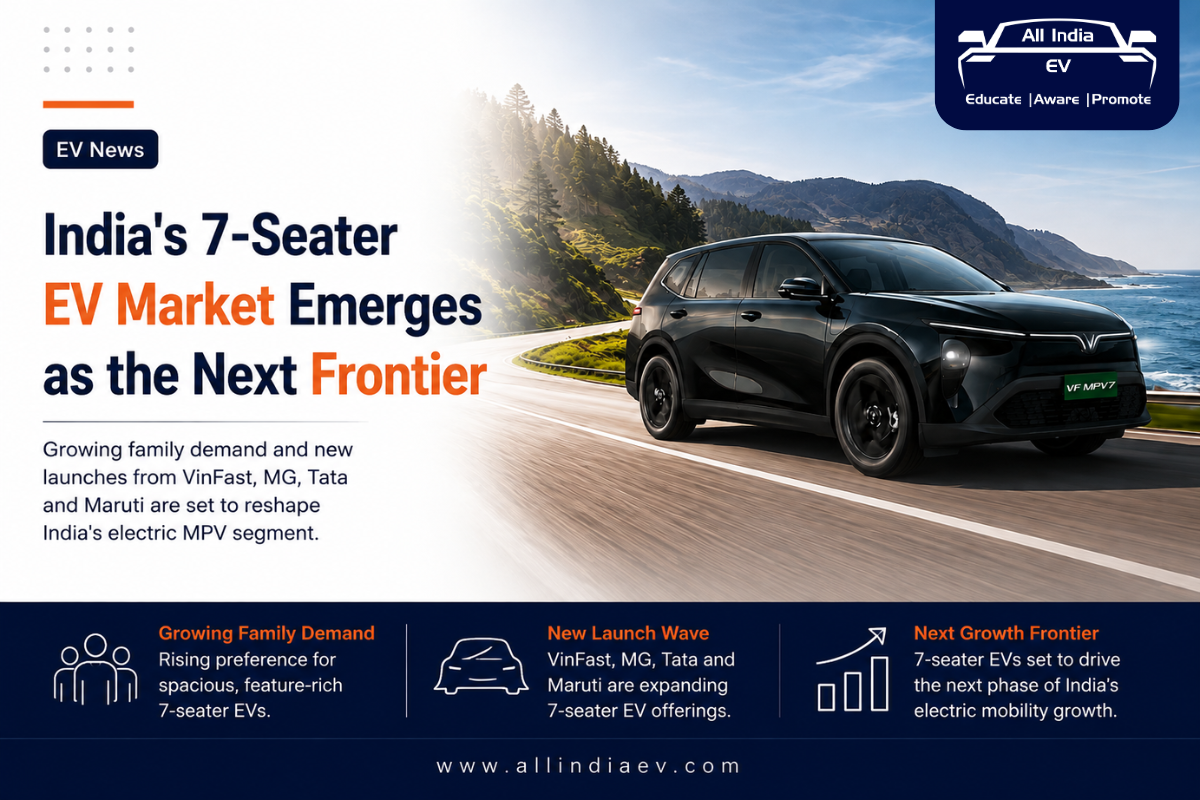
India’s electric passenger vehicle market is entering a new phase as automakers increasingly focus on seven-seater electric MPVs and SUVs. Multiple new launches and upcoming models indicate that the segment is poised to become the country’s next major EV growth opportunity.
The Key Number:
50,000 units — India’s electric seven-seater segment is expected to surpass this sales milestone in 2026 after recording fewer than 10,000 units in 2025.
Why It Matters:
The emergence of three-row electric vehicles broadens India’s EV market beyond urban commuters, addressing the needs of larger families, fleet operators and premium buyers. It also signals growing confidence among manufacturers in India’s evolving EV ecosystem
The Core News
India’s electric seven-seater market is rapidly evolving from a niche category into one of the country’s most promising EV segments. Recent launches including the VinFast VF MPV 7, Kia Carens Clavis EV and MG M9, alongside planned offerings from Tata Motors, Maruti Suzuki and other manufacturers, demonstrate that automakers now see significant demand for larger electric family vehicles.
The shift comes as India’s passenger EV market matures beyond compact city cars. Buyers are increasingly looking for a single vehicle capable of handling daily commuting, family travel and long-distance journeys. Improvements in battery technology, longer driving ranges, expanding charging infrastructure and competitive ownership packages have made larger EVs more practical than in previous years. Manufacturers are also competing through extended warranties, complimentary charging programmes and comprehensive maintenance plans to strengthen the ownership proposition.
For the broader EV ecosystem, this represents an important transition. Success in the electric seven-seater market will depend not only on vehicle launches but also on charging accessibility, service networks, battery reliability and overall ownership experience. As competition intensifies over the next two years, manufacturers that deliver dependable products backed by strong after-sales support are likely to gain an early advantage in a segment expected to accelerate India’s premium EV adoption.
Breaking Down the Update
- Market Growth: Seven-seater EV sales are projected to exceed 50,000 units in 2026 after remaining below 10,000 units in 2025.
- Recent Launches: VinFast VF MPV 7, Kia Carens Clavis EV and MG M9 have expanded buyer choices.
- Upcoming Models: Tata Motors, Maruti Suzuki and other OEMs are preparing new three-row electric offerings over the next 12–18 months.
- Customer Focus: Target buyers include large families, fleet operators and chauffeur-driven mobility users.
- Key Differentiators: Driving range, charging convenience, warranty coverage, maintenance packages and service support are becoming major purchase factors.
- Industry Trend: Competition is shifting from product availability to ownership experience and infrastructure readiness.
How electric seven-seater market Will Help the Indian EV Market
India’s electric seven-seater market has the potential to significantly broaden electric vehicle adoption by addressing customer groups that have so far remained underserved. While compact electric hatchbacks and SUVs have driven early adoption, many Indian households require larger vehicles capable of accommodating extended families, business travel and intercity journeys.
The arrival of multiple seven-seater EVs expands consumer choice while encouraging competition across pricing, technology and ownership benefits. Automakers are expected to accelerate investments in larger battery packs, improved thermal management systems, connected technologies and fast-charging capabilities to meet customer expectations.
The segment can also stimulate investment in high-capacity charging infrastructure along highways, improving long-distance EV usability for all vehicle categories. Fleet operators, corporate mobility providers and premium taxi services stand to benefit from lower operating costs compared with diesel alternatives, potentially increasing commercial EV adoption.
For policymakers, stronger demand in this segment supports India’s objective of increasing passenger EV penetration while strengthening domestic manufacturing under localisation initiatives. As production volumes rise, economies of scale could gradually reduce costs, making larger electric vehicles accessible to a broader customer base. Over the long term, the segment could become a key contributor to India’s transition toward cleaner and more sustainable personal mobility.
Way Forward …
The electric seven-seater market is emerging as the next competitive battleground for India’s passenger EV industry. With several major launches scheduled over the coming months, attention will increasingly shift toward charging infrastructure expansion, localisation, customer experience and long-term ownership costs. Manufacturers that successfully combine practical range, reliable charging access and comprehensive after-sales support are likely to shape the future of India’s growing family EV segment and strengthen the country’s transition toward mainstream electric mobility.