



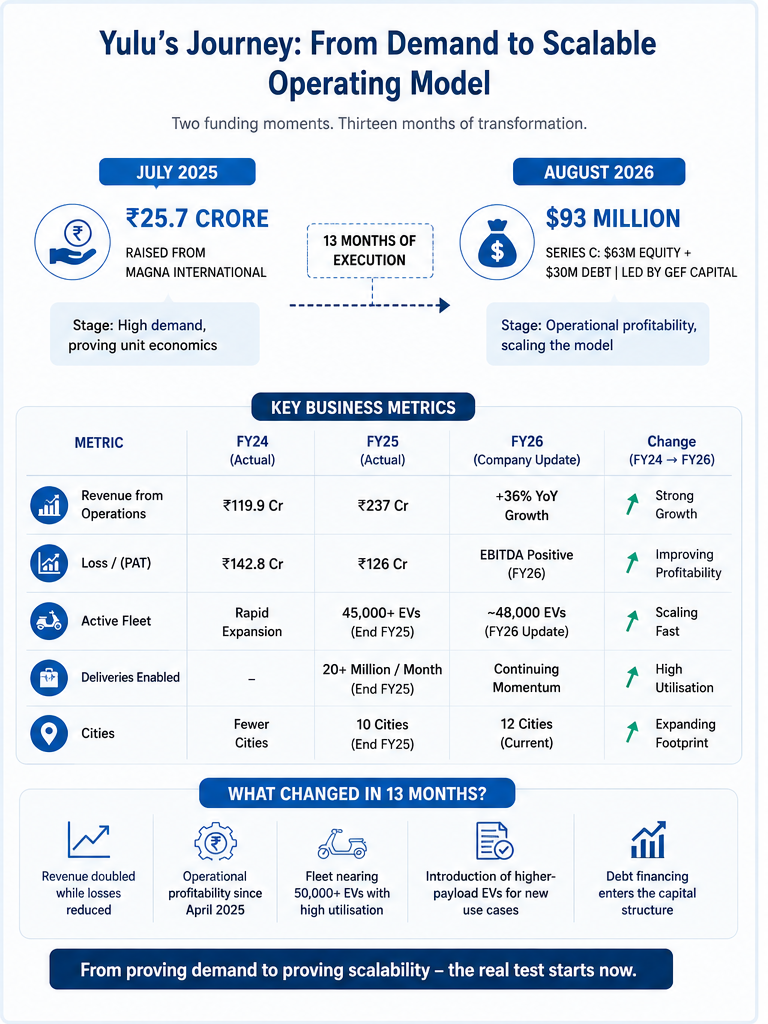
July 2025 was about funding a company that had found demand. August 2026 is about financing a company that believes it has found a scalable operating model.
- The business underneath the funding round has changed
- The $30 million debt component may matter more than the equity headline
- Yulu is not building this system alone
- Quick commerce created the opportunity, but it could also become the concentration risk
- The next 150,000 vehicles will tell us more than the first 50,000
- Geographic expansion is another stress test
- The investor profile is changing too
- The ₹1,200-1,500 crore revenue ambition changes the benchmark
- The All India EV Intelligence thesis
When Yulu raised ₹25.7 crore from Magna International in July 2025, the transaction was hardly large enough to alter the funding landscape of India’s EV industry. A little over a year later, the company has returned with something considerably more consequential: a $93 million Series C, consisting of $63 million in equity and $30 million in debt.
The obvious way to read these two transactions is that Yulu has grown and therefore requires more capital. But that explanation misses what has happened to the business between the two rounds.
Yulu is increasingly difficult to describe simply as an electric two-wheeler rental company.
Its vehicles are becoming productive assets inside India’s gig economy. Its battery ecosystem is being separated and scaled through Yuma Energy. Bajaj Auto has become deeply embedded in the vehicle-supply side. And the company’s demand increasingly comes from an economy built around food delivery, quick commerce and hyperlocal logistics.
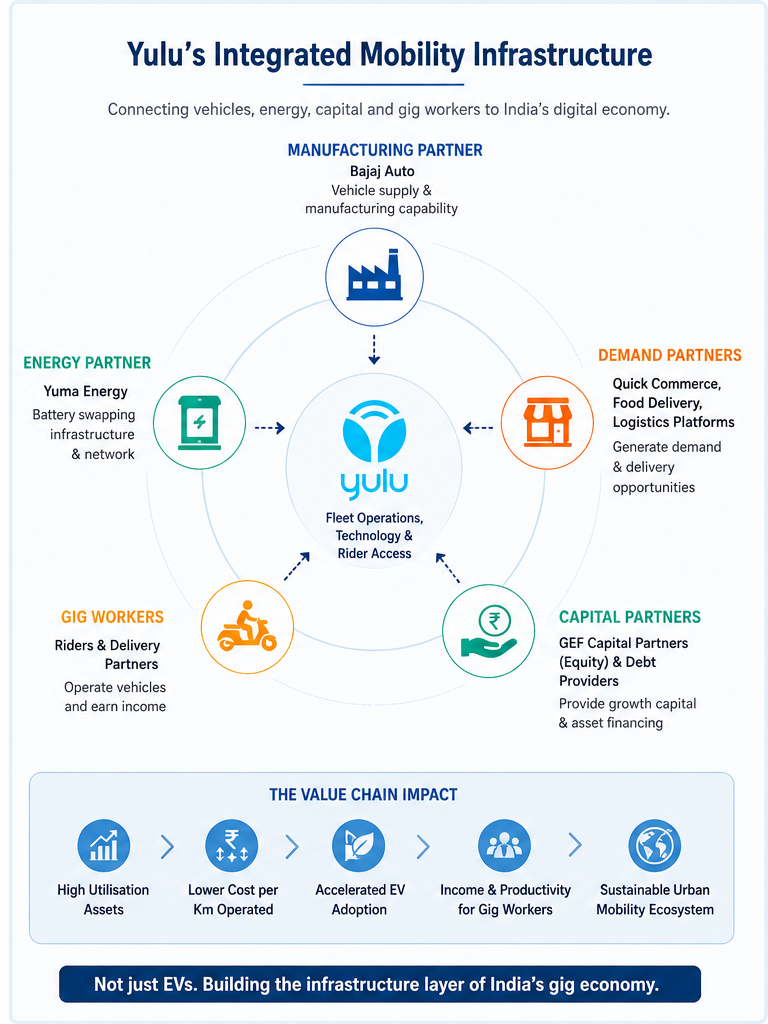
What Yulu appears to be building is therefore not merely a fleet of electric two-wheelers. It is an increasingly integrated mobility layer connecting:
- Vehicles
- Energy infrastructure
- Capital
- Gig workers
- Digital commerce platforms
That distinction is important because it changes the question investors should be asking.
The question is no longer whether India needs shared electric vehicles. There is enough evidence that commercial users will rent them.
The harder question is whether Yulu can convert that demand into an infrastructure business capable of scaling without requiring proportionately larger amounts of equity every time its fleet grows.
The business underneath the funding round has changed
Yulu’s early consumer proposition was easy to understand. Put small electric vehicles across dense urban areas and allow consumers to access them without owning them.
But the Yulu being financed in 2026 is increasingly different from the consumer mobility company many people still associate with the brand.
The biggest change has been the rise of the gig economy as Yulu’s demand engine.
Quick commerce has created an unusually attractive operating environment for electric fleet businesses. A dark store produces hundreds of short, repetitive delivery movements within a relatively concentrated geographical radius. Vehicles operate for significantly more kilometres than privately owned scooters, riders need continuous access to mobility, and every hour of downtime potentially means lost income.
For an EV fleet operator, these characteristics solve one of the hardest problems in asset-heavy mobility businesses: utilisation.
By the end of 2025, Yulu said its fleet was facilitating more than 20 million deliveries every month. It also reported an average 35%+ fleet share at dark stores within the areas where it operated.
That number needs to be handled carefully. It is not a 35% share of India’s quick-commerce delivery fleet. It is a company-reported figure limited to Yulu’s operational clusters.
But it still tells us something strategically important.
Yulu is not merely selling mobility to riders. It is selling vehicle availability to an economy where vehicle uptime directly affects income generation.
The financial numbers support that shift.
- FY24 revenue from operations: ₹119.9 crore
- FY25 revenue: approximately ₹237 crore
- FY25 losses: approximately ₹126 crore, down despite rapid revenue growth
- FY26 revenue growth: 36% YoY, according to Bajaj Auto
- Profitability: Yulu says it has been operationally profitable since April 2025 and achieved EBITDA profitability during FY26
This is where the July 2025 and August 2026 funding rounds begin to look fundamentally different.
The ₹25.7 crore Magna investment came when Yulu had already demonstrated rapidly growing demand but was still working through the economics of scaling that demand.
The $93 million Series C arrives after the company says its core operations have crossed into profitability.
Yulu is effectively arguing that equity is no longer required to keep the existing machine running. Capital is required to build a much larger machine.
And the composition of the latest round gives that argument some credibility.
The $30 million debt component may matter more than the equity headline
Most funding coverage will naturally focus on the $93 million headline and GEF Capital Partners’ participation.
For us, the more revealing number may be the $30 million debt component.
Electric mobility is an asset-heavy business. A software company can theoretically add thousands of customers without purchasing thousands of physical assets first. Yulu cannot.
Every incremental rider requires access to a vehicle, and every vehicle ultimately requires:
- vehicle capex,
- battery access,
- maintenance,
- insurance,
- working capital,
- charging or swapping infrastructure,
- and a route to sufficient utilisation.
Moving from approximately 50,000 active EVs to 200,000 therefore means adding roughly 150,000 productive assets to the ecosystem.
Financing that expansion entirely through equity would be expensive and highly dilutive.
Debt creates another possibility.
If vehicle utilisation and cash generation have become sufficiently predictable, part of the fleet can increasingly be financed against the economic output those assets are expected to generate.
That is a major transition.
A vehicle stops being something venture capital must continually pay for and begins moving towards a financeable revenue-generating asset.
This does not make Yulu capital-light. A 200,000-vehicle fleet remains a huge physical asset base, and leverage introduces its own risks.
But it changes the quality of the capital stack.
For investors, the emerging question is no longer simply:
How much money can Yulu raise?
It is: How much of future fleet expansion can be financed with debt, operating cash flows and partner capital rather than fresh equity?
That metric may ultimately tell us more about the maturity of the business than valuation.
Yulu is not building this system alone
Another reason the conventional “rental startup” description is becoming inadequate is the ecosystem that has formed around the company.
Bajaj Auto is not simply a financial shareholder. It has become a meaningful part of Yulu’s vehicle-supply architecture. Bajaj disclosed that it had supplied nearly 30,000 low-speed electric two-wheelers to Yulu and had invested ₹165 crore in the company as of 31 March 2026.
The energy layer has followed a similar path through Yuma Energy, created from the Yulu-Magna relationship to build battery-swapping infrastructure.
The structure increasingly looks like this:
Bajaj Auto → vehicle manufacturing
Yuma Energy → battery and swapping infrastructure
Yulu → fleet access, technology and rider interface
Gig workers → operating workforce
Quick-commerce and delivery platforms → demand
Yulu sits close to the centre of this value chain.
That position could ultimately prove more important than vehicle ownership itself.
For a delivery rider, the actual product is not an electric scooter. The rider needs income-generating mobility.
Vehicle ownership creates several burdens:
- upfront capital or EMI,
- maintenance responsibility,
- battery risk,
- residual-value risk,
- repair downtime,
- and financing exposure.
A rental or subscription model converts much of that complexity into access. In that sense, Yulu is increasingly selling mobility uptime, not transportation. That is a much larger proposition.
Quick commerce created the opportunity, but it could also become the concentration risk
There is an important contradiction inside Yulu’s growth story.
Quick commerce may have created almost ideal conditions for the company’s model, but excessive dependence on quick commerce could eventually become a weakness.
Dense dark-store networks provide:
- high trip frequency,
- short operating radii,
- predictable demand clusters,
- strong vehicle utilisation,
- repeat rider demand,
- and natural use cases for battery swapping.
This is almost tailor-made for shared commercial EVs.
But an infrastructure business becomes stronger when its assets can serve multiple demand pools.
If Yulu’s economics depend overwhelmingly on one segment, changes in quick-commerce growth, delivery pricing, rider compensation or platform strategy could directly affect fleet utilisation.
This is why Yulu’s push into higher-payload scooters matters.
The company is now targeting broader use cases such as:
- e-commerce logistics,
- express parcel delivery,
- bike taxis,
- and wider intra-city commercial mobility.
If successful, that would materially expand Yulu’s addressable market. But it also introduces a new test. A low-speed vehicle operating around dense dark-store clusters and a higher-speed vehicle moving across wider urban networks are economically different assets.
Vehicle cost changes. Battery requirements change. Insurance changes. Maintenance changes. Utilisation patterns change.
Yulu has demonstrated demand in one particularly favourable operating environment. It now has to prove that the operating model can travel beyond it.
The next 150,000 vehicles will tell us more than the first 50,000
This is ultimately why Yulu’s 200,000-vehicle target matters more than the $93 million funding announcement. Going from zero to 50,000 vehicles demonstrated that a market exists.
Going from 50,000 to 200,000 will test whether there is a scalable economic engine underneath it. At that scale, small inefficiencies become material.
The numbers that should matter to serious investors are not simply fleet deployment or city count. They are:
- Revenue per active vehicle
- EBITDA per active vehicle
- Utilisation rate
- Maintenance cost per kilometre
- Vehicle downtime
- Debt per productive asset
- Rider churn
- Battery replacement cost
- Residual value
- Capital required per incremental vehicle
These are the metrics that determine whether Yulu becomes a compounding infrastructure business or simply a larger fleet operator. A 5% deterioration in utilisation across 200,000 vehicles is not an operational footnote. It can become a balance-sheet event.
That is why fleet size without fleet productivity is a vanity metric.
Geographic expansion is another stress test
Yulu currently operates across 12 cities and intends to reach 20 within the next 12 months. But cities are not interchangeable. Bengaluru, Mumbai, NCR and Hyderabad each have different combinations of delivery density, labour availability, road conditions, logistics demand, electricity infrastructure and rider economics.
A model that works exceptionally well in dense Bengaluru dark-store clusters cannot simply be assumed to work identically in every Tier-I or Tier-II market.
This makes Yulu’s partner-led and franchise expansion particularly interesting.
If local operators can increasingly own or operate physical assets while Yulu provides:
- vehicle access,
- fleet technology,
- battery infrastructure,
- operating processes,
- data,
- and demand integrations,
then the company can potentially expand without reproducing the same corporate capex in every market. That could create two distinct versions of Yulu:
Yulu the fleet operator
and
Yulu the mobility operating system
The second is significantly more scalable. It is also potentially more valuable. But it remains a thesis, not yet a proven reality.
The investor profile is changing too
There is another subtle signal in the latest round. Yulu’s earlier strategic investors included Bajaj Auto and Magna International. Both brought more than capital. Bajaj brought manufacturing capability. Magna helped shape the battery-swapping ecosystem through Yuma.
But according to the latest funding disclosures, neither participated in the new Series C. Instead, GEF Capital Partners, a climate-focused investment firm, led the equity component.
That does not automatically mean the strategic investors are stepping away. But it does indicate a shift in the type of capital entering Yulu. Earlier capital helped build the ecosystem.
The latest capital appears designed to scale the economics of that ecosystem. For institutional investors, that changes the diligence framework.
The relevant questions now become:
- Can Yulu sustain EBITDA profitability during 4X fleet expansion?
- Can debt finance a growing proportion of fleet capex?
- Can utilisation remain strong outside core quick-commerce clusters?
- Can partner-led expansion reduce corporate capital intensity?
- Can higher-payload vehicles diversify demand beyond food and grocery delivery?
- Can Yulu reach PAT profitability before another large equity round is required?
These are no longer startup questions. They are infrastructure questions.
The ₹1,200-1,500 crore revenue ambition changes the benchmark
Yulu has spoken about reaching approximately ₹1,200-1,500 crore in annualised revenue, becoming monthly PAT-positive and eventually pursuing a public-market listing. Put that against FY25 revenue of approximately ₹237 crore.
The company is not targeting incremental growth. It is attempting to move into an entirely different scale bracket. Public-market investors will eventually judge Yulu very differently from venture investors.
They will ask:
- What is the return on capital employed across the fleet?
- How much capital is required to generate ₹1 of incremental revenue?
- What proportion of fleet is company-funded versus debt-funded versus partner-funded?
- How quickly does each new city reach breakeven?
- What is contribution margin per vehicle?
- What is the residual value of retired fleet assets?
- How dependent is the business on quick commerce?
- What percentage of revenue comes from mature versus newly entered markets?
That is where the valuation debate will eventually move. Not from fleet growth to revenue growth, but from revenue growth to capital productivity.
The All India EV Intelligence thesis
There are three possible Yulus emerging from this transition.
The first is Yulu as a rental company.
The company owns or finances vehicles and rents them to commercial riders. It can become large, but remains structurally capital-intensive.
The second is Yulu as a fleet-infrastructure company.
Vehicles, batteries, financing, maintenance and rider access are integrated into a commercial mobility service serving multiple logistics use cases.
The third is Yulu as a mobility operating system.
Partners increasingly fund or operate physical assets while Yulu controls the software, fleet intelligence, energy access, rider relationship and demand integrations.
The third model is potentially the most valuable because it changes the relationship between growth and capital.
Instead of asking: How many vehicles does Yulu own?
the market may eventually ask: How many productive vehicles operate through the Yulu ecosystem?
That distinction could determine whether Yulu remains an asset-heavy fleet company or evolves into something closer to a commercial mobility infrastructure platform.
But Yulu has not proved that transition yet. The $93 million Series C gives it the capital to attempt it at scale.
The real Yulu story is no longer how many electric vehicles it can deploy. It is how much economic output it can generate from every rupee of capital locked inside them.