
The Weekend Wrap · Monday, 10 August 2026 · 9:00 AM IST
Everything that moved on Saturday and Sunday, sorted by consequence. Reading time: five minutes.
The weekend’s EV coverage was one Friday sales figure reprinted forty ways. Underneath it: a global carmaker preparing to give up control of its India business to get an electric platform built, an Indian materials company testing whether it can break into the one layer of the battery chain China effectively owns, and 57 electric trucks that actually reached the road.
If you read one thing
Volkswagen is negotiating away the majority of its India arm — and the money is for EVs
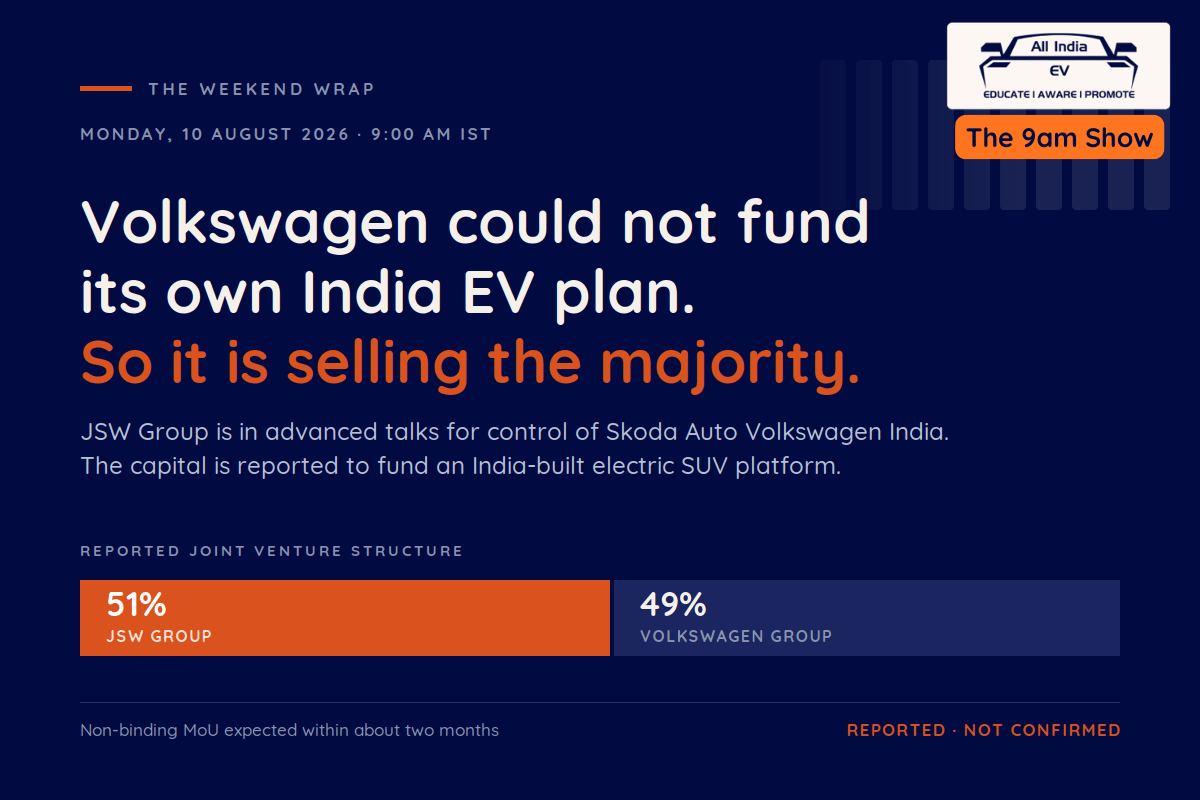
Skoda Auto Volkswagen India (SAVWIPL) is in advanced talks with the JSW Group over a manufacturing joint venture reportedly structured 51:49, with JSW holding the majority. A non-binding MoU is expected within about two months. Senior Volkswagen and Skoda executives are due in India in the second half of August, with one report placing a Mumbai meeting on 18 August to discuss approving the transaction.
Where the capital goes is the EV part, and it is the whole point. The equity infusion is reported to fund development and localisation of the India Main Platform (IMP) — an architecture derived from Volkswagen’s China Main Platform — which would underpin locally manufactured electric SUVs for both Volkswagen and Skoda brands.
Read the sequence, not the announcement. Volkswagen has been in India for over twenty years. Its plan to build affordable electric vehicles here has moved slower than intended. It spent years looking for a local partner. The resolution now on the table is that a global automaker accepts minority ownership of its own India subsidiary in order to get its electric programme funded and localised.
That is a specific and uncomfortable data point about what building EVs in India actually costs. Not the sticker price of a car — the price of admission for a manufacturer that already has plants, dealers and two decades here.
For JSW, this would sit alongside its 35% in JSW MG Motor, and would be an EV alliance with no Chinese participation — relevant for a group whose current automotive exposure runs through SAIC and Chery.
Being straight with you: the JV as reported is broader than electric — localisation of the next-generation Kodiaq platform and sales operations for multiple brands are also in the discussion. Our interest, and the largest single use of funds reported, is the electric platform. Nothing is confirmed by either company; emails to both reportedly went unanswered. 51:49 is reported, not agreed.
Watch: whether the second half of August produces a date for the MoU.
The rest of the weekend
2. Epsilon’s Gen 3.0 LFP cathode material entered customer validation with cell makers in Asia-Pacific, Europe and the US. Cathode active material is the layer below the cell — and it is where China’s real chokehold sits, at roughly 99% of global LFP CAM production, with export controls now on the technology for the newest generation. India’s entire battery policy conversation, the ₹18,100 crore ACC PLI included, operates one layer above this. Epsilon’s pitch is performance and provenance: non-Chinese technology and process, compliant with US Prohibited Foreign Entity rules. Stated figures are 159 mAh/g discharge capacity and 2.51 g/cc electrode density, with 20,000 TPA planned in India by 2028. No customers named, no timeline given. Validation is not a purchase order — but no purchase order arrives without one. Supply.
3. Montra Electric has 57 Rhino electric heavy trucks deployed, 300+ in the pipeline. TVS-backed, offered in fast-charge and battery-swap configurations. Fifty-seven is a small number and it is a deployed number, which in Indian electric HCVs is rarer than a large announced one. This segment produces far more MoUs than movement. Supply.
4. Ola Electric narrowed its Q1 loss. Higher electric two-wheeler volumes, lower operating expenses. A narrower loss is direction of travel, not arrival, and the two get reported in the same tone far too often. The question for the next four quarters is whether the opex reduction is structural or whether it reverses the moment volumes need spending again. Capital.
5. VinFast entered the top five electric car brands in India. From effectively nothing to top-five alongside Tata, MG, Mahindra and Maruti Suzuki, with electric car sales up 83% YoY in July. Logged, not celebrated. Registration data confirms a vehicle reached a buyer; it does not disclose the discount that got it there. The rank worth watching is October’s, after the festive push clears and the first owners have had a service experience. Demand.
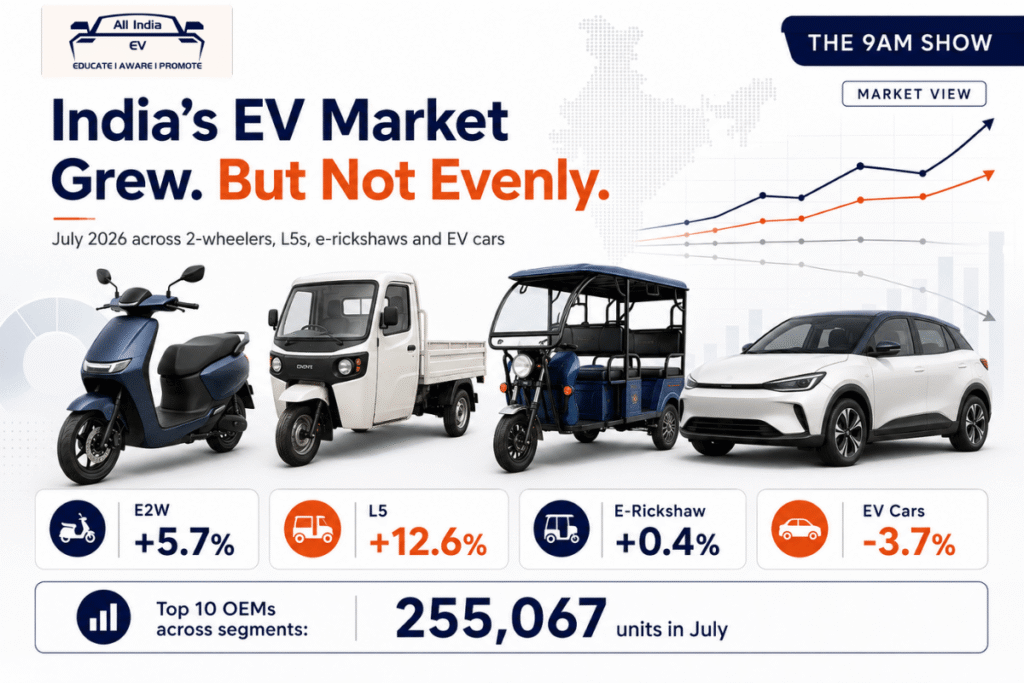
6. July EV retail hit 3,27,901 units, up 66% YoY (FADA). You have read the number. The part under it: three-wheelers held above 65% share, and electric cars — just over 32,900 units — were roughly one in ten EVs sold. June was 3,06,220 at +63%, so this is a trend line, not a spike. India’s EV record is being set by vehicles that work for a living, not by vehicles that get launch events. Demand.
7. E3 launched the Trion, marketed as an AI-powered electric scooter. Logged for completeness. We will assess it when there is something to test. “AI-powered” on an Indian scooter spec sheet has so far meant a connected app and a ride-mode algorithm. Demand.
One number that needs a follow-up question
Jammu & Kashmir has 295 EV charging points, the Centre told the Rajya Sabha on Friday. Separately, SIDCO’s board reviewed proposed charging facilities at Zanskar, Nyoma, Kargil and Leh.
Both things are true: extending charging into Ladakh’s altitude and winter is genuinely hard engineering, and a figure tabled in Parliament is an installation count, not an uptime count. Those two numbers are never the same, anywhere in India, and the gap between them is the actual state of the network.
We are taking that apart in tomorrow’s Charging Report.
The Desk View
Put the weekend’s two biggest items side by side. Volkswagen, one of the largest carmakers on earth, is preparing to hand over majority control of its India business in order to get an electric platform built and localised. Epsilon, an Indian company, is trying to qualify into the cathode layer that China supplies at 99%.
Same question from opposite ends: who pays for, and who owns, the parts of an EV that are hard to make.
The monthly sales number answers neither. It goes up, it gets quoted, and it tells you nothing about whether India ends up assembling electric vehicles designed and supplied elsewhere, or supplying and designing them.
A bigger EV market and a better position in the EV chain are different achievements. Only one of them compounds. The weekend delivered news on the second, and almost nobody covered it that way.