

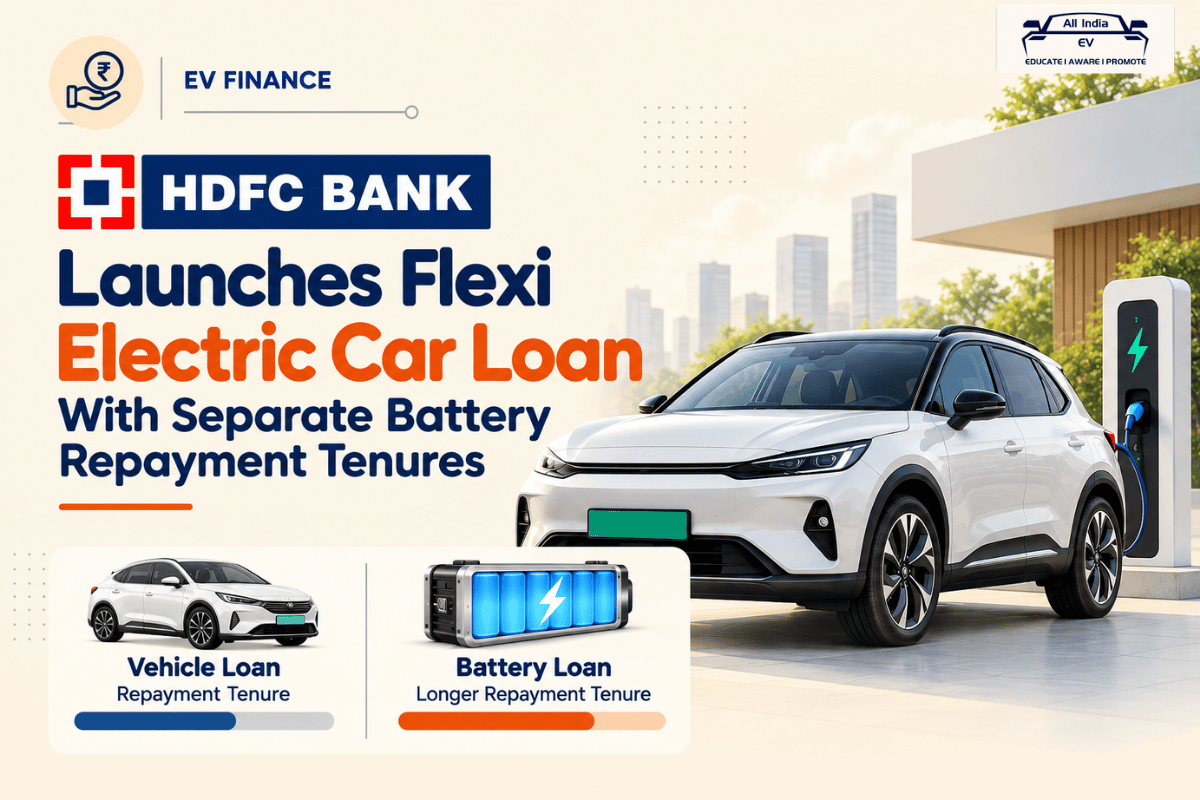
HDFC Bank has launched its Flexi Electric Car Loan in India, introducing a financing model that separates the cost of an electric car’s body and battery. The new loan structure allows customers to repay the battery component over a longer tenure, offering greater flexibility in managing monthly equated monthly instalments (EMIs).
Announced on October 25, 2026, the initiative aims to address one of the major barriers to electric vehicle (EV) adoption in India: the high upfront purchase cost. According to HDFC Bank, the battery is the most expensive component of an electric car, contributing significantly to its overall price compared with conventional petrol and diesel vehicles.
Separate Repayment Tenures for Vehicle and Battery
The Flexi Electric Car Loan introduces a financing structure in which the vehicle body and battery can be financed separately. Unlike conventional car loans, which generally cover the entire vehicle under a single repayment schedule, this approach allows borrowers to customise their EMI commitments.
The battery component can be repaid over a longer period than the vehicle financing, potentially helping customers distribute their financial obligations more effectively. The structure is designed to provide greater flexibility for buyers who want to transition to electric mobility without placing excessive pressure on their monthly budgets.
HDFC Bank has positioned the product as an innovative financing option aligned with the growing popularity of battery subscription and Battery-as-a-Service (BaaS) models in the electric vehicle industry.
Making Electric Cars More Affordable
The higher purchase price of electric cars remains a concern for many prospective buyers in India. Although EVs can offer lower running and maintenance costs, their initial acquisition cost can be higher than that of comparable internal combustion engine vehicles.
By extending the repayment period for the battery component, HDFC Bank aims to make monthly payments more manageable. The bank stated that the EMI associated with the battery portion is intended to be comparable to the running cost of a conventional petrol or diesel vehicle.
However, actual savings and monthly payments will depend on factors such as the loan amount, applicable interest rate, repayment tenure and individual customer eligibility. Buyers should evaluate the total repayment amount alongside the monthly EMI before selecting a financing option.
Available Across HDFC Bank Branches
The Flexi Electric Car Loan is designed for customers purchasing electric cars from leading original equipment manufacturers (OEMs). According to the bank’s announcement, the facility is available through more than 9,700 HDFC Bank branches across India.
Arvind Vohra, Group Head of Retail Assets and Rural Banking at HDFC Bank, said India’s electric mobility transition is gaining momentum, supported by government incentives, technological advancements and evolving policies. He expressed confidence that the new loan product would help make EV ownership more cost-effective and convenient for customers.
Supporting India’s Electric Mobility Transition
The launch highlights the growing role of financial institutions in accelerating India’s shift towards electric mobility. As manufacturers expand their electric car portfolios and charging infrastructure continues to develop, accessible financing options could encourage more consumers to consider EVs.
Separating vehicle and battery repayments also reflects changing approaches to electric vehicle ownership, where battery financing and subscription models are gaining attention.
For prospective buyers, the new loan offers another financing option to explore when comparing electric cars. Nevertheless, customers should carefully review interest rates, processing fees, repayment conditions and the total cost of borrowing before making a decision.
With its Flexi Electric Car Loan, HDFC Bank is seeking to address the affordability challenge and support wider electric car adoption in India. The product could provide greater repayment flexibility for customers evaluating the switch to electric mobility.