

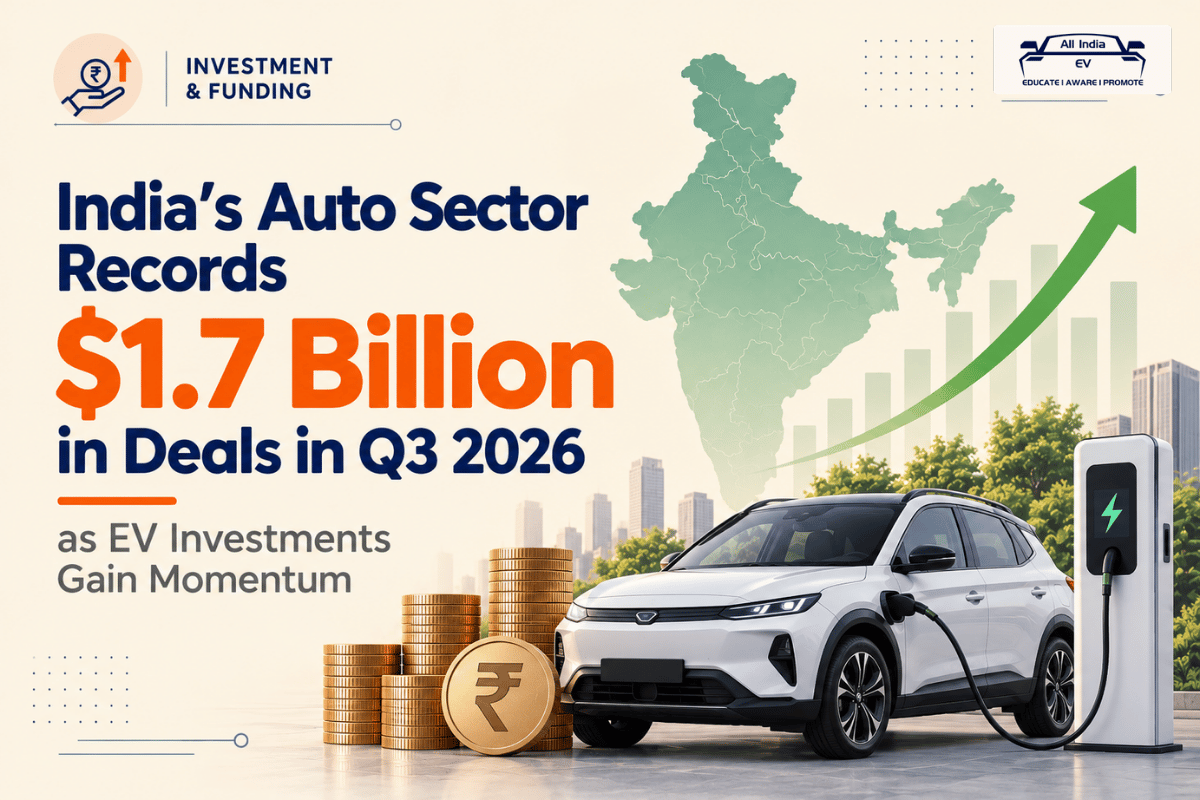
India’s automotive industry witnessed a significant investment revival in the July–September quarter of 2026, with electric vehicles (EVs), battery technology and mobility solutions emerging as key drivers of growth. According to Grant Thornton Bharat’s Q3 2026 Auto Dealtracker, the sector recorded 33 deals worth $1.7 billion, marking a 65% increase in deal volume and a 131% rise in deal value compared with the previous quarter.
In April–June 2026, the industry registered 20 transactions valued at $717 million. The latest figures highlight growing investor confidence in India’s evolving automotive ecosystem, particularly businesses supporting the transition towards electric mobility.
EV-focused businesses accounted for 54% of overall deal activity during the quarter. Investment flowed into electric vehicle manufacturers, battery technologies, charging infrastructure and shared mobility platforms, demonstrating that the EV opportunity extends beyond vehicle sales to the wider ecosystem required for adoption.
Hero MotoCorp’s Ather Energy Investment Drives M&A Growth
Mergers and acquisitions (M&A) recorded a substantial increase during Q3 2026. The sector reported 12 transactions worth $389 million, compared with five deals valued at $138 million in the preceding quarter.
Hero MotoCorp’s cumulative investment of $285 million in Ather Energy was the quarter’s major transaction, accounting for approximately 73% of total M&A value. The investment underscores the strategic importance of electric two-wheelers as established automotive manufacturers strengthen their positions in the growing EV market.
Domestic transactions contributed 75% of M&A deal volume and 87% of transaction value. Activity across EV manufacturing, automotive technology, mobility services and component production also reflected a growing emphasis on acquiring capabilities and expanding market presence.
EV Startups Attract Fresh Private Capital
Private equity and venture capital (PE/VC) investment also gained momentum, reaching $419 million across 16 transactions. This represented a 23% increase in both deal value and volume compared with the previous quarter’s 13 transactions worth $341 million.
River Mobility raised $120 million, while electric motorcycle manufacturer Ultraviolette Automotive secured $85 million. Shared mobility company Yulu received $63 million. Together, these three investments accounted for nearly 64% of quarterly PE/VC funding.
The funding activity highlights investor interest in companies developing differentiated products, scalable mobility services and technology-led business models. It also reflects the importance of capital in supporting product development, market expansion and the commercialisation of new electric mobility solutions.
Public Markets Raise $846 Million
Public-market fundraising made a substantial contribution to the quarter’s overall deal value. Two initial public offerings (IPOs) raised $428 million, while three qualified institutional placements (QIPs) generated another $418 million.
Dhoot Transmission and Hero Motors featured in IPO activity, while Belrise Industries, Ather Energy and SPR Auto Technologies raised capital through QIPs. These transactions demonstrate the continuing role of public markets in financing automotive businesses and companies connected to the EV ecosystem.
Auto Components and Charging Infrastructure Gain Attention
The quarter also saw auto components and manufacturing record four deals, compared with just one in Q2 2026. Meanwhile, mobility platforms registered five transactions, down from six in the previous quarter.
Although automotive technology and infrastructure recorded two deals against three previously, batteries, charging solutions and specialised automotive technologies remain important areas within the broader electrification transition.
Outlook for India’s EV Industry
The Q3 2026 deal figures indicate that investors are increasingly evaluating the entire electric mobility value chain, including vehicle manufacturing, battery systems, charging networks and mobility platforms. However, the concentration of funding in a handful of large transactions suggests that investors continue to favour companies with strong technology, credible growth prospects and scalable operations.
For India’s EV industry, sustained investment could help strengthen manufacturing capabilities, accelerate innovation and support the infrastructure needed for wider electric vehicle adoption. The coming quarters will show whether this investment momentum translates into broader industry expansion and more accessible electric mobility solutions.