

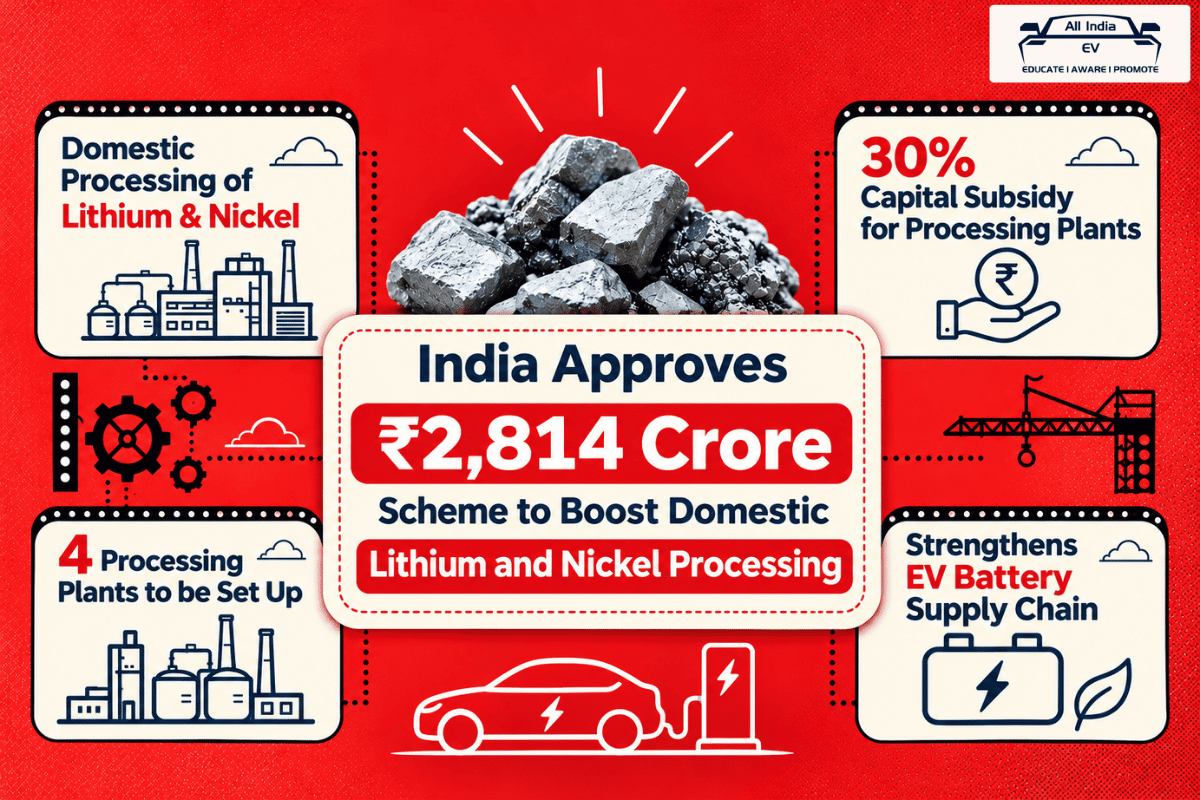
The Government of India has approved a ₹2,814 crore capital expenditure (CAPEX) support scheme to strengthen domestic processing of critical minerals, including lithium and nickel. The initiative aims to reduce India’s dependence on imported refined minerals while building a stronger domestic supply chain for electric vehicle batteries and energy storage technologies.
The decision was approved by the Union Cabinet on November 4, 2026, under the leadership of Prime Minister Narendra Modi. The five-year scheme will be implemented from FY 2026-27 to FY 2030-31 and is expected to support the development of large-scale mineral processing facilities across the country.
The scheme is particularly important for India’s growing electric mobility sector, as lithium, nickel and cobalt are essential raw materials used in lithium-ion batteries that power electric cars, two-wheelers, buses and commercial vehicles.
Government to Support Four Critical Mineral Processing Plants
Under the newly approved scheme, the government will provide a capital subsidy of 30% of eligible investment for establishing four critical mineral processing facilities. These will include two lithium processing plants and two nickel processing plants.
The proposed facilities will have the following minimum processing capacities:
- Lithium Processing: Two plants with a minimum capacity of 30,000 tonnes each.
- Nickel Processing: Two plants with a minimum capacity of 50,000 tonnes each.
The maximum financial assistance will be capped at ₹500 crore per beneficiary for lithium processing facilities and ₹900 crore per beneficiary for nickel processing facilities.
The government will select beneficiaries through a two-stage process. Applicants will first undergo technical qualification, followed by financial bidding. Two companies will be selected for each mineral based on the least-cost criterion, prioritising applicants seeking the lowest government capital support.
Financial incentives will be released in three instalments linked to the achievement of specified project milestones.
Focus on Reducing India’s Dependence on Imported Battery Materials
India currently relies substantially on imports for refined critical minerals and high-purity materials, including lithium, nickel and cobalt. The country’s domestic mineral processing infrastructure remains at an early stage, creating challenges for manufacturers looking to establish a reliable local battery supply chain.
The concentration of critical mineral processing facilities in a limited number of countries also exposes global supply chains to geopolitical disruptions, export restrictions and price fluctuations.
Through this initiative, the government aims to encourage domestic companies to process lithium and nickel ores and intermediate materials into high-purity compounds within India. Additionally, cobalt is expected to be recovered as a by-product of nickel processing.
Developing these capabilities could strengthen India’s position in the global battery manufacturing ecosystem while supporting domestic value addition and reducing dependence on overseas suppliers.
Boost for India’s Electric Vehicle and Battery Manufacturing Industry
The new scheme is expected to benefit several strategic industries, particularly electric mobility and battery energy storage systems (BESS).
Lithium and nickel are important materials used in various lithium-ion battery chemistries. Increasing their domestic processing capacity could help establish a more dependable supply of battery-grade materials for India’s EV manufacturers and battery producers.
The initiative is also expected to support electronics, defence and speciality steel industries, which depend on critical minerals for manufacturing and technological applications.
By encouraging investments in mineral processing infrastructure, the government aims to address an important gap in India’s critical mineral value chain.
Strengthening India’s Domestic Critical Mineral Ecosystem
The ₹2,814 crore scheme complements the government’s broader efforts to develop a self-reliant critical mineral ecosystem under the National Critical Mineral Mission.
India is also exploring the development of dedicated critical mineral processing parks in Gujarat, Maharashtra, Odisha and Andhra Pradesh to establish specialised industrial ecosystems for mineral processing.
The latest approval represents another step towards strengthening domestic capabilities across the battery materials supply chain.
For India’s electric vehicle industry, improved access to locally processed lithium, nickel and cobalt could support long-term battery manufacturing growth, strengthen supply chain resilience and reduce exposure to international market uncertainties.
As electric vehicle adoption continues to expand, developing domestic critical mineral processing capabilities will be increasingly important for building a competitive and sustainable EV manufacturing ecosystem in India.