

New Delhi: Delhi-NCR could witness a major transformation in its passenger vehicle market, with an expert panel constituted by the Commission for Air Quality Management (CAQM) recommending a phased transition towards electric cars by 2030. The proposal aims to reduce vehicular emissions and address the region’s persistent air pollution problem.
According to the recommendations, all new private cars sold or registered in Delhi-NCR should gradually shift towards zero-tailpipe-emission vehicles, with electric vehicles (EVs) expected to play a central role in the transition. The proposed roadmap sets increasing electrification targets for the automotive industry over the next four years.
Phased Electric Car Adoption from 2027
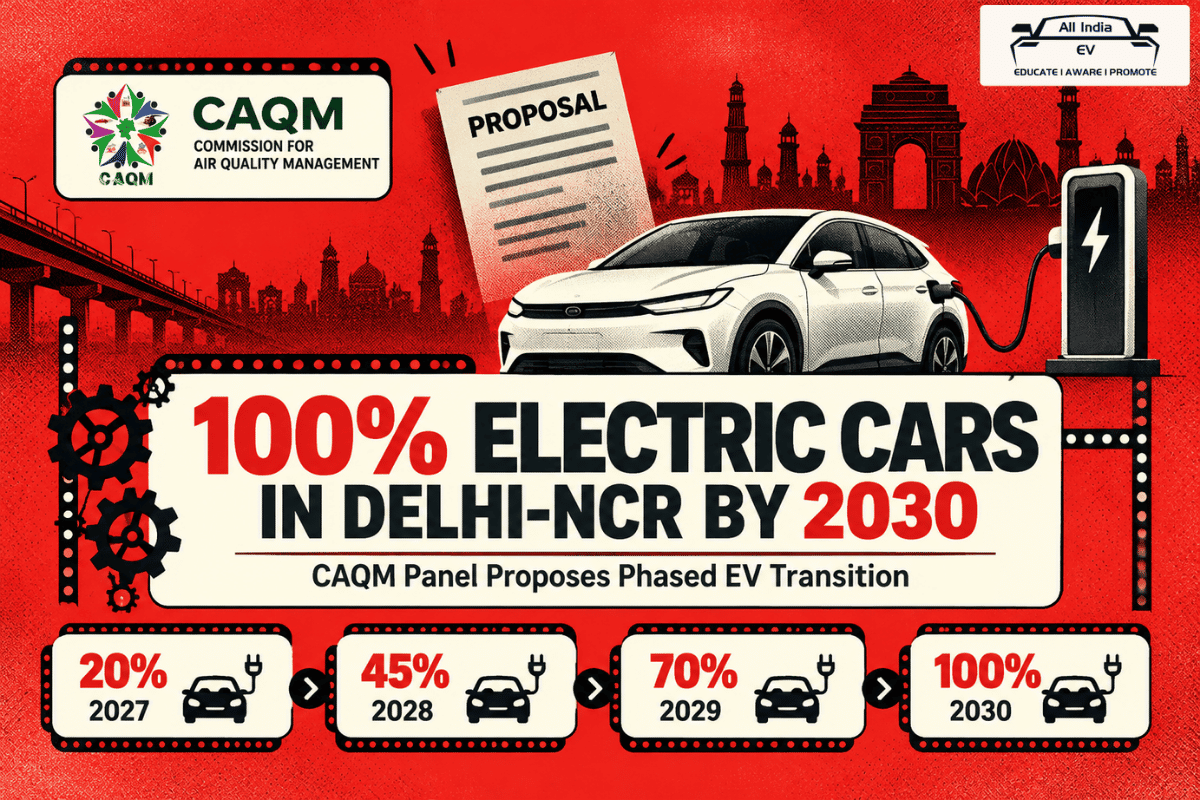
The CAQM expert panel has recommended a progressive timeline for electric car adoption, beginning in 2027. Under the proposed plan, the target for zero-emission vehicles in new private four-wheeler sales would increase from 20% in 2027 to 45% in 2028 and 70% in 2029, reaching 100% by 2030.
If implemented, the recommendation would significantly accelerate EV adoption across Delhi, Gurugram, Noida, Ghaziabad, Faridabad and other parts of the National Capital Region (NCR). It would also encourage automobile manufacturers to expand their electric vehicle portfolios and introduce more affordable models to meet the growing demand.
Older Petrol and Diesel Vehicles Face Phase-Out Proposals
Alongside electrification, the panel has recommended a phased exit for older vehicles to reduce pollution levels. It has proposed the immediate removal of BS-I, BS-II and BS-III vehicles, followed by the phase-out of BS-IV vehicles by 2030.
The recommendations also propose phasing out BS-VI two-wheelers by 2035 and BS-VI four-wheelers by 2040. Additionally, the panel has suggested that new internal combustion engine (ICE) private four-wheelers should no longer be registered from January 1, 2031.
These measures are intended to accelerate the transition from conventional petrol and diesel vehicles towards cleaner mobility solutions.
EV Incentives and Charging Infrastructure Remain Key
The panel has also recommended financial incentives to encourage electric vehicle adoption, along with support for retrofitting existing internal combustion engine vehicles with electric powertrains.
Affordable electric cars, accessible charging infrastructure and improved battery technology will be crucial to achieving the proposed targets. Automakers may also need to strengthen their EV manufacturing capabilities to offer a wider range of vehicles across different price segments.
The recommendations come as Delhi-NCR continues to face serious air quality challenges, particularly during the winter months. Battery electric vehicles produce no tailpipe emissions during operation, making them an important option for reducing local vehicular pollution.
It is important to note that these timelines are expert panel recommendations and should not be treated as a fully implemented region-wide mandate. Their implementation will depend on subsequent government decisions and official notifications.
If adopted, the proposed roadmap could mark a significant step towards accelerating electric mobility in India and establishing Delhi-NCR as a major centre for the country’s clean transportation transition.