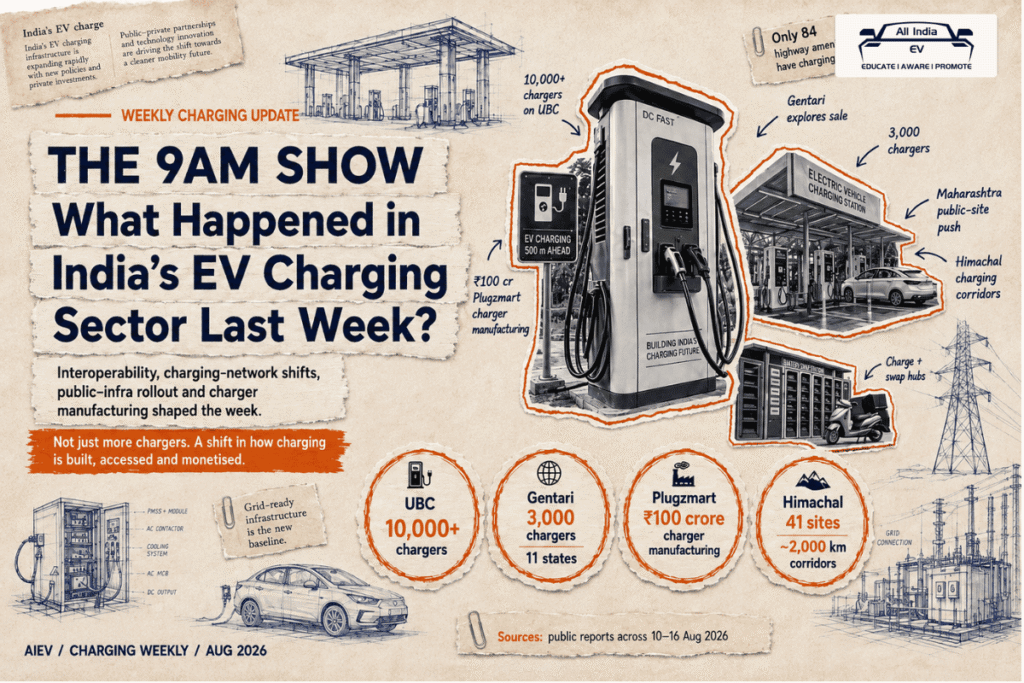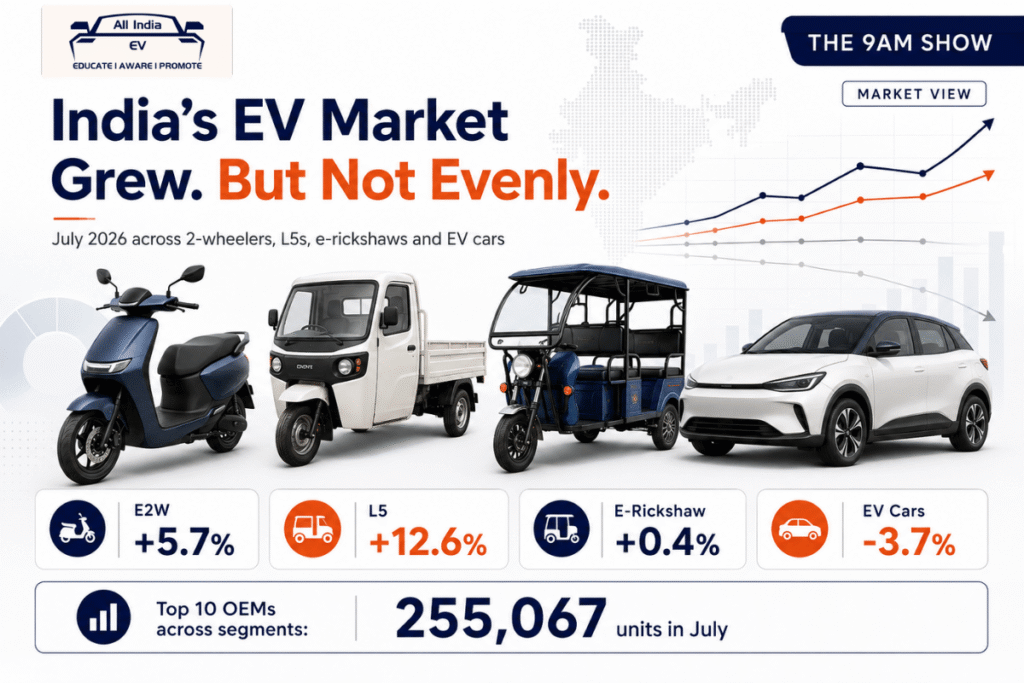


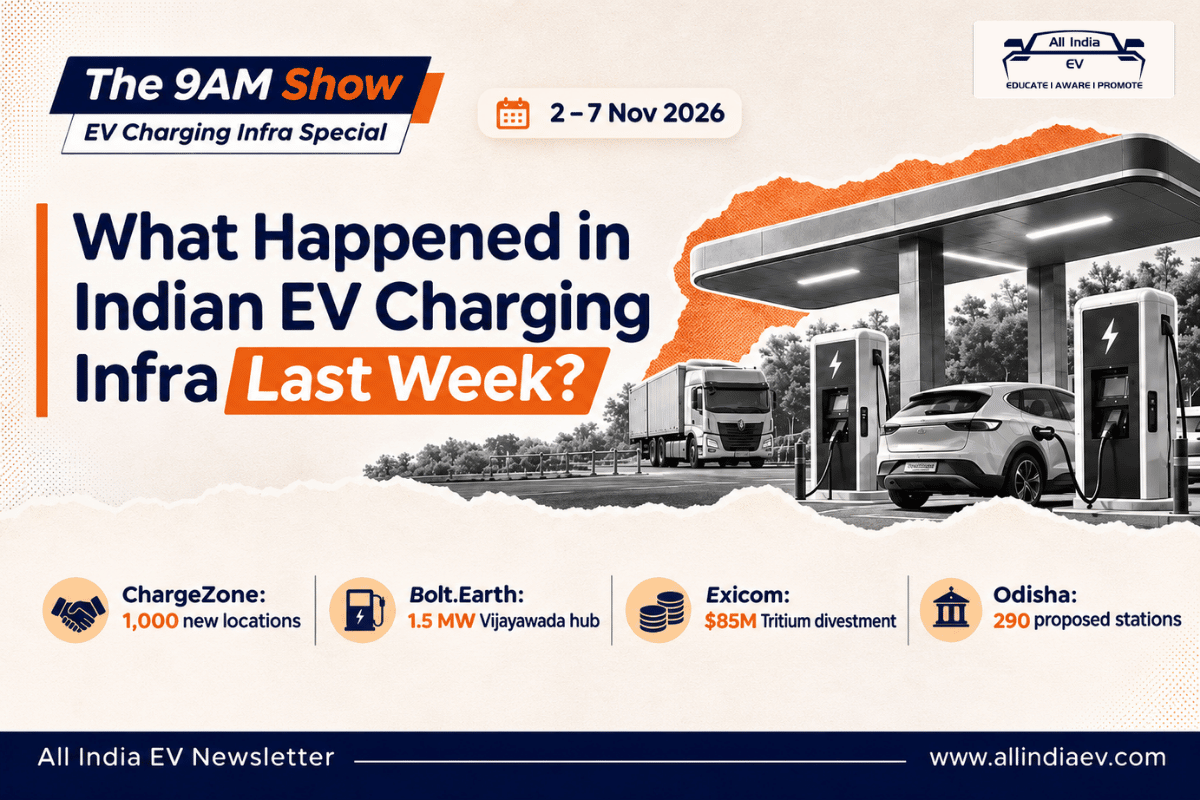
The 9AM Show | Tuesday Special: What Happened in Indian EV Charging Infrastructure Last Week?
2–7 November 2026 | All India EV
- India’s EV charging industry is expanding, but the bigger question is no longer just how many chargers are being installed. It is how quickly, reliably and profitably the infrastructure can support India’s growing electric mobility ecosystem.
- 1. ChargeZone and Ador-Quench Plan 1,000 New DC Fast-Charging Locations
- 2. Bolt.Earth Commissions a 1.5 MW EV Charging Hub in Vijayawada
- 3. Exicom Proposes $85 Million Tritium Divestment, Refocuses on India’s EV Charging Market
- 4. Odisha Proposes 290 Additional EV Charging Stations Under PM E-DRIVE
- 5. RIOD Logic Opens Charger Manufacturing Facility in Kerala
- 6. EKA Mobility Highlights Charging Depot Delays Affecting Electric Bus Deployment
- 7. India’s Battery-Swapping Industry Faces Utilisation and Profitability Questions
- 8. Madurai Begins Planning a Five-Year EV Charging Infrastructure Roadmap
- 9. Nitin Gadkari Proposes Lower Electricity Tariffs for EV Charging in Maharashtra
- The Bigger Picture: India’s Charging Industry Is Moving From Announcements to Execution
India’s EV charging industry is expanding, but the bigger question is no longer just how many chargers are being installed. It is how quickly, reliably and profitably the infrastructure can support India’s growing electric mobility ecosystem.
The first week of November brought several important developments in India’s EV charging infrastructure sector. From ChargeZone’s plan to expand across 1,000 new charging locations and Bolt.Earth’s 1.5 MW charging hub in Andhra Pradesh to Exicom’s proposed $85 million Tritium divestment, the industry continued to move forward on multiple fronts.
But the week also revealed some of the challenges that don’t always make headlines.
EKA Mobility highlighted how charging depot readiness is delaying electric bus deployments, while a new industry analysis raised questions about utilisation and profitability across India’s battery-swapping ecosystem.
Meanwhile, government initiatives in Odisha, Tamil Nadu and Maharashtra demonstrated that public charging infrastructure remains an important policy priority, even as the focus increasingly shifts towards execution.
Welcome to another Tuesday edition of The 9AM Show by All India EV, where we track the developments shaping India’s EV charging infrastructure.
Here is everything important that happened between November 2 and November 7, 2026.
1. ChargeZone and Ador-Quench Plan 1,000 New DC Fast-Charging Locations
One of the week’s biggest announcements came from ChargeZone and Ador-Quench (Quench Chargers), which expanded their partnership to deploy Made-in-India DC fast chargers across 1,000 additional locations.
The planned deployment will include charging equipment ranging from 120 kW to 480 kW, supporting the growing demand for high-power charging infrastructure.
The partnership is particularly significant because it focuses on commercial electric mobility, including electric trucks, buses and intercity passenger transportation.
ChargeZone is working towards a cumulative network capacity of approximately 300 MW, reflecting the industry’s shift towards larger charging installations.
For electric commercial vehicles, charging requirements differ considerably from those of passenger cars. Fleet operators need high-power chargers, predictable availability and infrastructure capable of supporting repeated daily operations.
The ChargeZone–Ador-Quench collaboration reflects this transition.
Why it matters: India’s next stage of charging infrastructure growth will increasingly depend on high-capacity stations designed for commercial vehicles rather than simply expanding the number of low-capacity charging points.
2. Bolt.Earth Commissions a 1.5 MW EV Charging Hub in Vijayawada
Another major infrastructure development came from Bolt.Earth, which commissioned a 1.5 MW EV charging facility in Vijayawada, Andhra Pradesh, in collaboration with P Qube Solutions.
Located near NH-16 Cross in Nunna, the facility has been described as Andhra Pradesh’s largest EV charging station.
The highway location is strategically important, given the increasing need for reliable fast-charging infrastructure along interstate transportation corridors.
Unlike smaller urban charging locations, large-capacity highway stations can support multiple charging requirements, including private vehicles, commercial fleets and long-distance mobility.
The project also highlights how charging infrastructure is beginning to evolve from individual charger installations into dedicated energy facilities.
As electric vehicle penetration increases, charging stations with megawatt-scale electrical capacity could become increasingly important, especially along major logistics corridors.
Why it matters: The commissioning of a 1.5 MW facility demonstrates how charging infrastructure is moving towards larger installations capable of serving higher vehicle volumes.
3. Exicom Proposes $85 Million Tritium Divestment, Refocuses on India’s EV Charging Market
Exicom made an important business announcement during the week, revealing plans for the proposed divestment of its Tritium business at an indicative enterprise valuation of approximately $85 million.
The proposed transaction forms part of the company’s broader effort to recalibrate its business strategy.
Exicom also reported approximately ₹388 crore in consolidated quarterly revenue, while its standalone Indian EV charging equipment business crossed ₹100 crore in quarterly revenue for the first time.
The company intends to maintain access to TRI-FLEX charging technology even as it explores divestment.
This development is important for India’s charging equipment manufacturing ecosystem.
The industry is becoming increasingly competitive, with companies balancing domestic growth opportunities, international technology requirements, manufacturing investments and profitability.
Exicom’s performance in the Indian EV charging equipment market indicates continued demand for domestic charging solutions.
At the same time, the proposed transaction raises an interesting question about how Indian charging equipment manufacturers should balance global expansion with opportunities in their home market.
Why it matters: The next stage of India’s charging infrastructure industry will not be defined by deployments alone. Equipment manufacturing economics, technological capabilities and profitability will also determine which companies scale successfully.
4. Odisha Proposes 290 Additional EV Charging Stations Under PM E-DRIVE
The Odisha government submitted a proposal to establish 290 additional public EV charging stations across 13 cities under the central government’s PM E-DRIVE framework.
The proposal represents another step towards expanding charging availability beyond India’s largest metropolitan markets.
Public charging accessibility remains an important consideration for electric vehicle adoption, particularly among buyers who do not have access to dedicated residential charging facilities.
For state governments, developing a charging network also requires coordination between local authorities, electricity distribution companies and charging operators.
However, it is important to distinguish between infrastructure proposals and completed installations.
Odisha’s 290 stations have been proposed, not commissioned. Their actual rollout will depend on approvals, site readiness and implementation.
Why it matters: State-level charging initiatives can help reduce geographical gaps in India’s public charging network, provided proposals translate into operational infrastructure.
5. RIOD Logic Opens Charger Manufacturing Facility in Kerala
RIOD Logic inaugurated a new EV charger manufacturing facility at Vengoor, Nedumbassery, Kerala.
The facility has an initial manufacturing capacity of approximately 2,500 AC chargers per month.
Alongside the manufacturing expansion, the company introduced a dynamic UPI-based charging-payment solution.
This development is interesting because it combines two important elements of India’s charging infrastructure ecosystem: domestic hardware manufacturing and payment accessibility.
While high-power DC chargers receive significant attention, AC chargers continue to play an important role in residential, workplace and destination charging.
Meanwhile, simpler digital payment systems can help address friction in the public charging experience.
India’s broader digital payments ecosystem provides opportunities for charging operators to make transactions more convenient for users.
Why it matters: As the charging market expands, locally manufactured equipment and accessible payment systems will become important components of infrastructure adoption.
6. EKA Mobility Highlights Charging Depot Delays Affecting Electric Bus Deployment
Not every important charging infrastructure development last week involved new chargers.
EKA Mobility chairman Sudhir Mehta highlighted charging depot readiness and electricity connection delays as important constraints on electric bus deployment.
The company reportedly has an order book of approximately 11,000 electric buses, but expects to deliver around 2,000 buses over the next two years, reflecting infrastructure and execution constraints.
Developing a charging depot can take approximately a year.
This exposes a critical challenge in India’s electric public transportation ecosystem.
An electric bus cannot begin reliable commercial operations simply because the vehicle has been manufactured or delivered.
It needs an operational charging depot, adequate electricity supply, appropriate connections and supporting infrastructure.
When any of these components are delayed, vehicle deployment can be affected.
For charging companies, fleet operators and policymakers, this creates an important need for coordinated infrastructure planning.
Why it matters: India’s electric bus transition depends as much on electricity connections and charging depot readiness as it does on vehicle manufacturing capacity.
7. India’s Battery-Swapping Industry Faces Utilisation and Profitability Questions
A new industry analysis highlighted the operational challenges facing India’s battery-swapping infrastructure.
According to figures discussed in the report, India had more than 3,500 battery-swapping stations, alongside approximately 52,700 public charging stations, based on sector data referenced as of July 2026.
Although battery swapping offers advantages for commercial electric mobility, particularly two-wheelers and last-mile delivery fleets, network expansion alone does not guarantee profitability.
Station utilisation, battery inventory costs, operational efficiency and predictable demand remain important business considerations.
For swapping companies, recurring usage from delivery fleets and commercial operators can be especially valuable.
The findings suggest that the industry’s next challenge is to improve utilisation across existing infrastructure rather than focusing exclusively on adding new locations.
Why it matters: Battery swapping will need sustainable unit economics alongside physical network expansion to become a financially scalable component of India’s EV ecosystem.
8. Madurai Begins Planning a Five-Year EV Charging Infrastructure Roadmap
Madurai is preparing a five-year roadmap to strengthen its EV charging infrastructure.
The initiative involves identifying potential charging locations, assessing electricity requirements and coordinating responsibilities among relevant government departments.
The planning effort follows discussions involving the municipal corporation, Guidance Tamil Nadu and ITDP India.
Rather than announcing immediate installations, the city is taking a longer-term planning approach.
Such planning is relevant because charging infrastructure development involves more than identifying available land.
Grid capacity, accessibility, traffic movement, utilisation potential and operating models must also be considered.
Why it matters: City-level planning can help create more coordinated and commercially viable charging networks instead of fragmented infrastructure deployments.
9. Nitin Gadkari Proposes Lower Electricity Tariffs for EV Charging in Maharashtra
Union Minister Nitin Gadkari proposed differentiated electricity tariffs for EV charging in Maharashtra.
The suggested rates were ₹3 per kWh for night-time charging and ₹5 per kWh for daytime charging.
The objective is to make EV charging more affordable and encourage wider adoption.
These figures remain a proposal rather than an implemented statewide charging tariff.
Electricity pricing is an important component of charging infrastructure economics.
For commercial fleet operators, charging costs directly influence the financial viability of electric mobility.
Lower electricity tariffs, particularly during off-peak hours, could encourage operators to schedule charging more efficiently.
However, actual implementation would require decisions by the relevant authorities and electricity regulators.
Why it matters: Charging tariffs could become an increasingly important policy lever in improving the operating economics of electric fleets and public charging infrastructure.
The Bigger Picture: India’s Charging Industry Is Moving From Announcements to Execution
Looking at the developments collectively, an important shift is becoming visible.
ChargeZone and Bolt.Earth represent infrastructure capacity expansion. Exicom and RIOD Logic highlight equipment manufacturing and business strategy. Odisha and Madurai demonstrate government-level planning. EKA Mobility and the battery-swapping study reveal operational challenges.
These developments are connected by one underlying question:
Can India’s charging infrastructure grow at the same pace as electric vehicle deployment while remaining operationally reliable and financially sustainable?
The industry is no longer at a stage where simply announcing thousands of chargers is sufficient evidence of progress.
Infrastructure readiness, grid connections, equipment reliability, energy pricing, network utilisation and customer experience will increasingly determine success.
The commercial vehicle segment makes these challenges particularly visible because trucks, buses and delivery fleets depend on charging infrastructure for daily operations.
For charging operators, the opportunity is substantial. But so is the need to execute.
The coming years may distinguish charging companies that build large networks from those that build networks capable of consistently supporting real commercial demand.
That is the story worth watching.
This was The 9AM Show — Tuesday EV Charging Infrastructure Special, covering November 2–7, 2026.
Follow All India EV for developments across India’s EV charging infrastructure, battery ecosystem, electric mobility and energy transition.
#AllIndiaEV #The9AMShow #EVCharging #EVInfrastructure #ElectricVehicles #ChargeZone #BoltEarth #Exicom #BatterySwapping #ElectricMobility #IndiaEV