

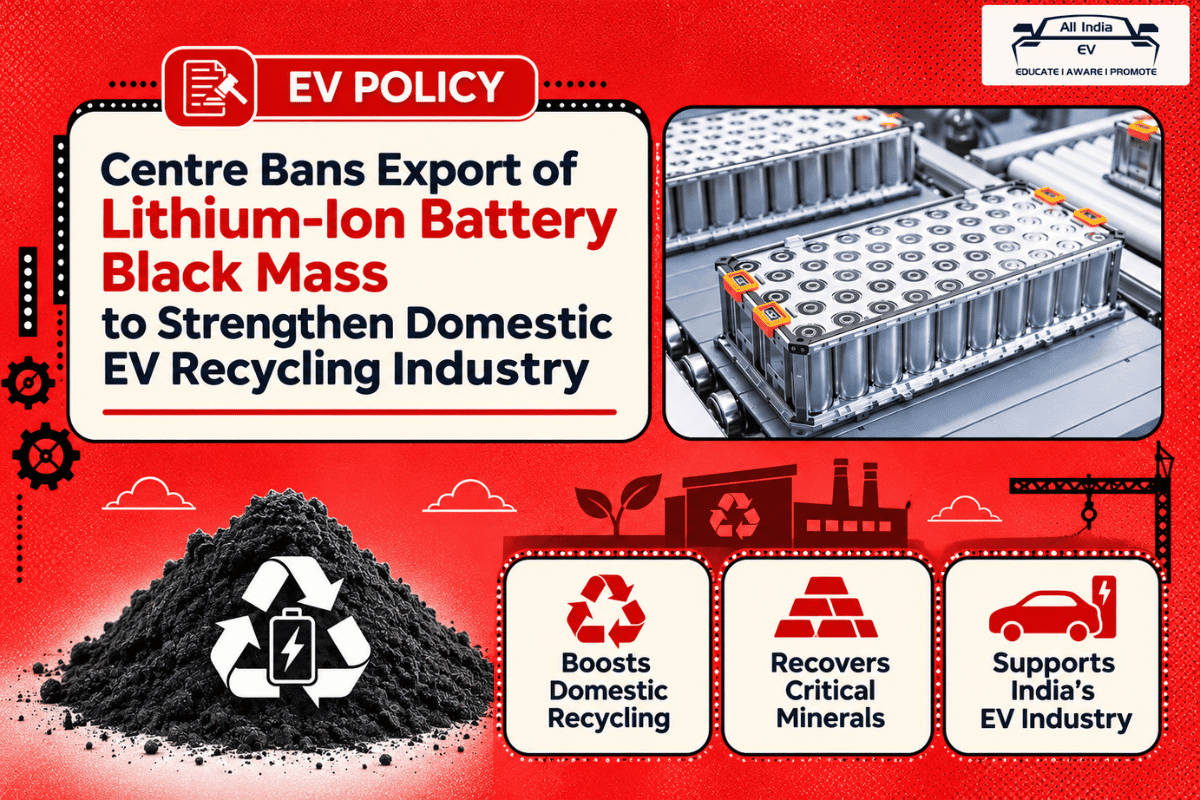
The Government of India has prohibited the export of specified categories of battery waste and scrap, including lithium-ion battery black mass, with immediate effect. The decision is aimed at strengthening India’s domestic battery recycling ecosystem, securing critical mineral resources and supporting the country’s growing electric vehicle (EV) manufacturing industry.
The Directorate General of Foreign Trade (DGFT), under the Ministry of Commerce and Industry, announced the policy change through an official notification. Under the revised regulation, the export classification of specified unsorted battery waste and scrap has been changed from ‘Free’ to ‘Prohibited’. The restriction will remain in force until further orders.
The notification covers waste and scrap of primary cells, primary batteries and electric accumulators, including spent batteries that do not contain lead, cadmium or mercury. These materials are classified under ITC (HS) Code 85491400 and include lithium-ion battery black mass.
Understanding the Importance of Lithium-Ion Battery Black Mass
Black mass is a powder-like material obtained through the dismantling, shredding and processing of used lithium-ion batteries. It contains several valuable materials, including lithium, cobalt, nickel, manganese and graphite, which are essential for manufacturing batteries used in electric vehicles and energy storage systems.
Through advanced recycling technologies, particularly hydrometallurgical processing, these materials can be recovered and converted into battery-grade compounds for reuse in battery manufacturing.
Previously, specified categories of battery waste could be exported under the ‘Free’ export category. However, the government believes that retaining these materials within India can help increase domestic recovery of critical minerals and reduce the loss of valuable resources through exports.
Government Focuses on Domestic Battery Recycling Capacity
The export restriction comes amid the government’s broader efforts to establish a stronger domestic critical mineral processing ecosystem. India currently depends significantly on imports for several critical minerals and refined materials required for battery manufacturing.
Despite the growing availability of used batteries from electric vehicles, consumer electronics and energy storage applications, domestic capacity for processing black mass and recovering battery-grade materials remains limited.
In September 2026, the government introduced a ₹1,500 crore incentive scheme to encourage the recycling of critical minerals from secondary sources, including spent batteries and electronic waste.
The initiative aims to attract investments in recycling infrastructure, improve mineral recovery capabilities and support the development of advanced processing technologies within the country.
Positive Implications for India’s Electric Vehicle Industry
The latest export prohibition could provide significant opportunities for domestic battery recyclers and EV manufacturers. By ensuring greater availability of locally generated battery waste, the government intends to encourage investments in recycling facilities and critical mineral recovery operations.
For India’s EV industry, a stronger recycling ecosystem could help establish a more sustainable battery supply chain. Recovered lithium, cobalt and nickel can potentially be reused in new battery production, reducing dependence on imported raw materials and supporting long-term cost efficiency.
The policy may also encourage battery manufacturers, recycling companies and technology providers to collaborate on developing a circular battery economy.
Strengthening India’s Critical Mineral Security
As electric vehicle adoption accelerates, demand for lithium-ion batteries is expected to increase across electric two-wheelers, passenger vehicles, commercial vehicles and stationary energy storage systems.
The government’s decision to restrict specified battery waste exports represents an important step towards retaining valuable resources within the country.
By combining export restrictions with financial incentives and investments in recycling infrastructure, India aims to develop a stronger domestic battery recycling industry, improve critical mineral security and support its long-term electric mobility ambitions.
The success of this initiative will depend on how quickly domestic recycling facilities expand their processing capabilities and convert available battery waste into reusable materials for India’s growing EV manufacturing ecosystem.