

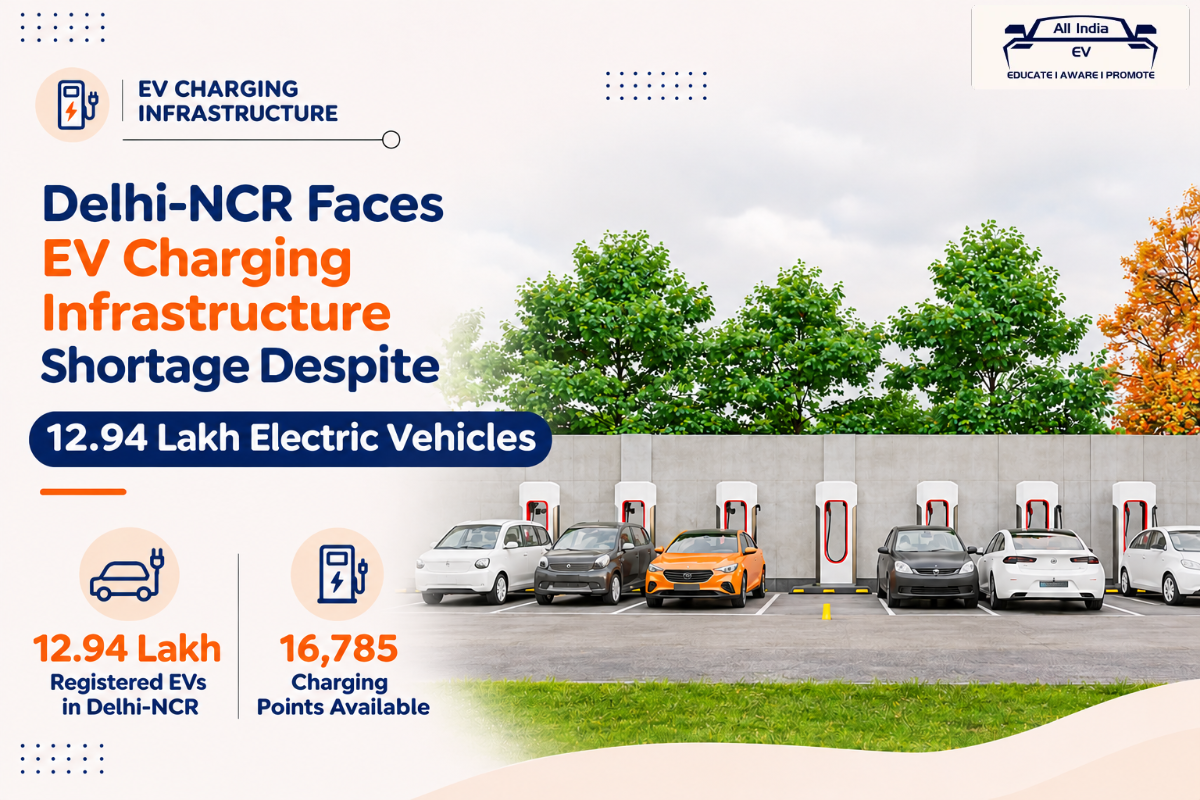
Delhi-NCR is facing a significant shortage of electric vehicle (EV) charging infrastructure despite the growing adoption of electric mobility across the region. According to a report by The Hindu, citing the Commission for Air Quality Management (CAQM), Delhi and its neighbouring states of Uttar Pradesh, Haryana and Rajasthan collectively have 12.94 lakh registered electric vehicles but only 16,785 charging points.
The findings highlight a major gap between EV adoption targets and the availability of supporting infrastructure, raising concerns about the region’s ability to accelerate its transition towards cleaner transportation.
The CAQM recently submitted its latest status report to the Supreme Court, identifying vehicular emissions as one of the major contributors to poor air quality across Delhi-NCR. The report also highlighted inadequate charging facilities, limited enforcement against older vehicles and uneven progress in electric mobility adoption.
Delhi Accounts for Nearly 89% of NCR Charging Points
The distribution of EV charging infrastructure across Delhi-NCR remains highly uneven, with Delhi accounting for the overwhelming majority of available charging points.
As of October 31, 2026, Delhi had 14,913 operational charging points supporting 6,83,251 registered electric vehicles. This represents approximately 88.85% of the total charging infrastructure across the four regions.
In comparison, Uttar Pradesh had 565 charging points for 3,47,587 EVs, while Haryana recorded 1,285 charging points against 2,18,530 electric vehicles.
Rajasthan reported the most significant infrastructure gap, with just 22 charging points supporting 44,987 registered electric vehicles.
These figures underline the challenges faced by EV owners outside Delhi, particularly those who depend on public charging facilities for daily commuting and longer journeys.
The infrastructure imbalance could also affect commercial EV operators, logistics companies and fleet businesses looking to expand their electric vehicle operations across NCR.
Delhi EV Policy 2026 Sets Electrification Targets
To accelerate electric mobility and reduce transportation-related pollution, the Delhi government introduced the Delhi Electric Vehicle Policy 2026 on June 30, with implementation beginning July 1, 2026.
The policy establishes phased electrification targets for different vehicle categories. Under the new framework, only electric L5-category three-wheelers will be registered from January 2027. The transition will extend to electric two-wheelers from April 1, 2028.
The policy also includes electrification targets for commercial fleet operators, logistics aggregators and private schools.
Meanwhile, CAQM has advised neighbouring NCR states to strengthen and revise their respective EV policies to support faster adoption of electric vehicles.
The Commission has also emphasised the importance of developing supporting infrastructure beyond conventional public charging stations. Battery-swapping facilities and proper systems for collecting, recycling and disposing of used EV batteries will become increasingly important as electric vehicle adoption expands.
Older Vehicles Continue to Contribute to Air Pollution
Apart from charging infrastructure, the CAQM report highlighted the continued presence of older, highly polluting vehicles across Delhi-NCR.
Of the 1.71 crore vehicles operating across the region, approximately 60.55 lakh fall under emission standards ranging from BS-I to BS-IV.
The Commission also noted that enforcement against end-of-life vehicles remains inadequate. Between January and October 2026, nearly 1.86 lakh vehicles out of 25.43 lakh reported active end-of-life vehicles were either scrapped or moved outside the region.
Charging Infrastructure Expansion Remains Critical
The latest findings highlight that EV adoption cannot depend on government incentives and registration targets alone. Accessible charging stations, battery-swapping networks and coordinated policies across neighbouring states will be essential for supporting the transition.
For Delhi-NCR, expanding charging infrastructure beyond the capital will be particularly important to encourage electric vehicle adoption among private owners and commercial operators.
As the region continues its efforts to tackle air pollution, coordinated action between Delhi, Uttar Pradesh, Haryana and Rajasthan could play a crucial role in building a reliable EV ecosystem and achieving long-term clean mobility goals.