

Most EV chargers are built around a fairly simple lifecycle: manufacture the hardware, install it and use software updates to keep it functioning until the underlying electronics eventually become outdated.
Vanix Technologies is trying to change that model.
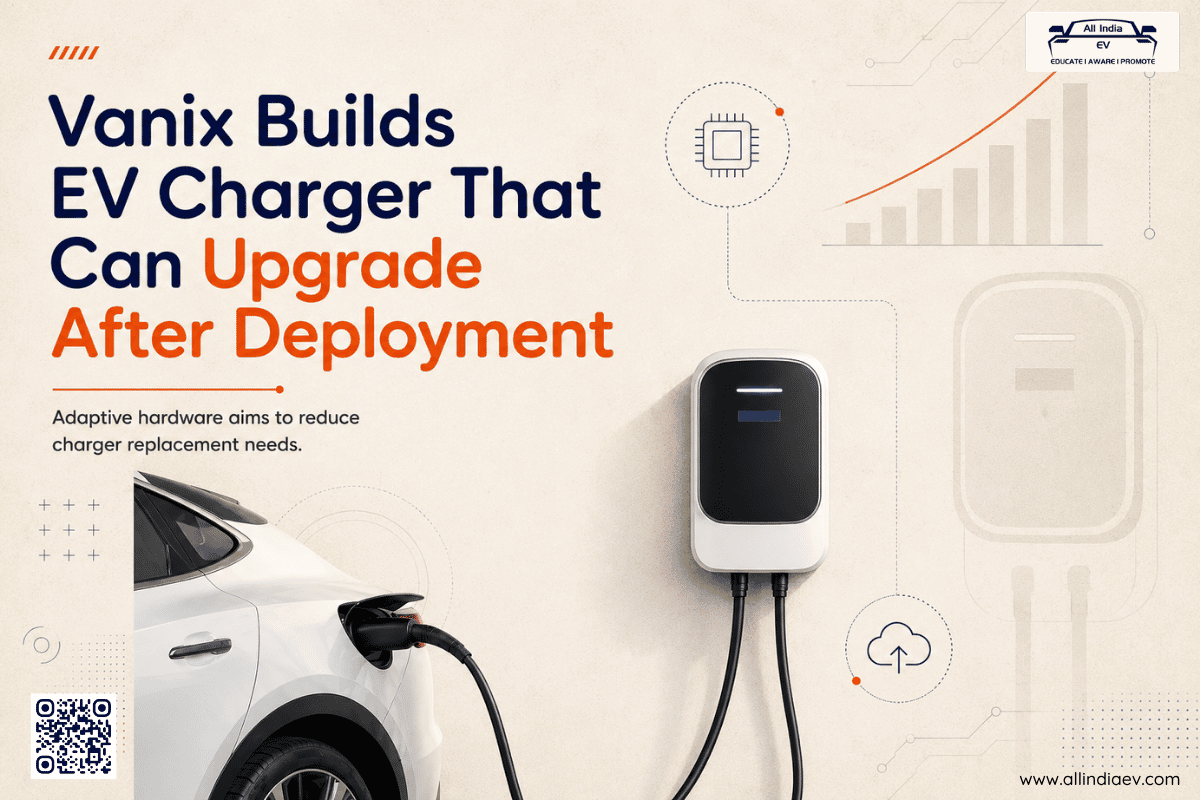
The Indian deep-tech company has developed an AC EV charging platform based on AMD’s Zynq Adaptive SoC, allowing not only software but selected hardware functions to be reconfigured after the charger has already been installed.
The idea is to make charging hardware more adaptable to changing grid conditions, standards and customer requirements without replacing the charger controller every time specifications evolve.
Why Conventional Chargers Can Become Difficult to Upgrade
Traditional AC chargers generally use fixed microcontroller-based architectures.
Software and firmware can be updated remotely, but the basic hardware configuration remains largely fixed.
That can create problems in a market such as India, where Vanix says supply voltage may range from approximately 180V to 260V, while earthing quality and electrical infrastructure can vary significantly between locations.
Charging standards are evolving too.
Four-wheelers largely follow Type 2 AC and CCS2 DC standards, but India’s two- and three-wheeler charging ecosystem continues to use multiple connector and charging configurations. Vanix CTO Muddasani Satyanarayana has argued that greater standardisation is required to improve safety and interoperability.
Charger Uses AMD Zynq Adaptive SoC
Vanix’s platform uses an AMD Zynq device combining Arm processor cores with FPGA-based programmable logic.
The processor handles software applications while programmable logic allows selected hardware functions to be changed after deployment.
AMD itself positions the architecture around adaptability, including the ability to update hardware functions over the air as requirements evolve.
Vanix says this could allow a charger to initially operate at a lower power rating and later be remotely upgraded when the site’s electrical connection supports additional capacity.
Instead of removing the existing controller and installing different hardware, selected functionality can potentially be reconfigured remotely.
Safety and Security Are Part of the Architecture
The company’s charging platform also incorporates functions such as:
- leakage detection
- relay weld detection
- protective earth loss detection
- secure boot
- cryptographic authentication
- hardware encryption
Vanix is positioning the platform as ready to adapt as charging communication and safety requirements develop.
The company has already been running pilot deployments in Hyderabad and Lucknow, while currently focusing primarily on R&D and product design rather than large-scale in-house manufacturing.
The Bigger Question Is Charger Lifespan
For charge point operators, hardware obsolescence is an expensive problem.
A charging station involves more than the charger itself. Installation can require civil work, cabling, electrical panels, grid connections and commissioning.
Replacing equipment every time standards or system requirements change adds cost and downtime.
Vanix’s approach therefore raises an interesting question for the EV charging industry:
Can chargers become upgradeable infrastructure rather than fixed appliances?
The concept still needs long-term field validation, particularly around reliability and how much functionality can practically be upgraded without physical intervention. But if adaptive hardware performs reliably at scale, the value proposition is fairly clear.
The future of EV charging may not only be about building chargers that deliver more power.
It may also be about building chargers that do not become obsolete every time the technology around them changes.