

By All India EV Intelligence
- An Early Bet Finally Finds Liquidity
- A Very Different Company From the One 3one4 Backed
- Inside the $93 Million: Funding Breakup and Valuation
- Who Actually Owns Yulu Now
- A New Vehicle Category Brings New Risk
- Bajaj’s Role Is Part of the Template
- Why This Exit Matters Beyond Yulu
- The Exit Isn’t Proof the Model Is Finished
- What This Means
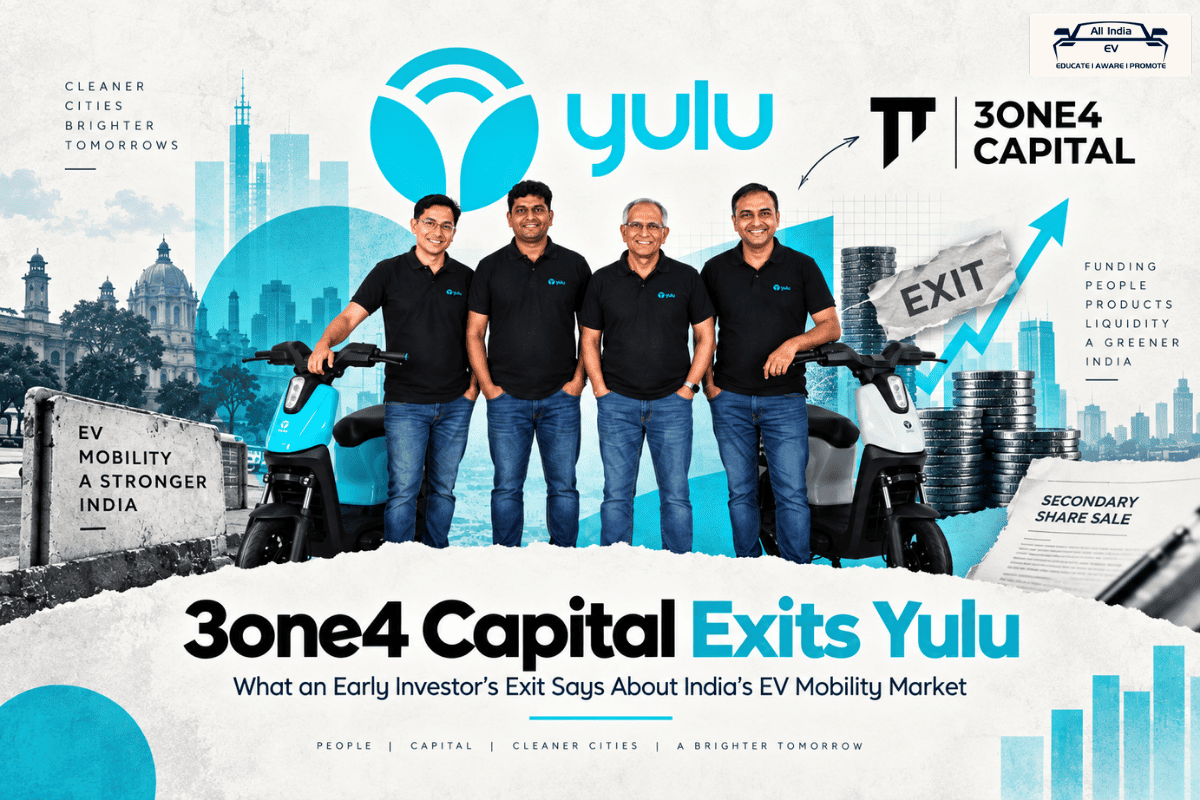
Venture capital firm 3one4 Capital has exited its investment in Yulu through a secondary share sale, closing out a relationship that began when shared electric mobility was still an unproven proposition in Indian cities. The transaction rode alongside Yulu’s recent $93 million Series C, a round that combined $63 million of equity with $30 million of debt.
On the surface, this looks like a routine venture exit. It deserves closer scrutiny, because Indian EV companies have spent most of the past decade proving they can raise capital; the next phase will test whether they can also return capital to early backers while still attracting new investors for the next stage of growth.
Yulu has now produced one such liquidity event, which makes the story relevant well beyond 3one4’s own fund returns.
An Early Bet Finally Finds Liquidity
3one4 backed Yulu at the seed stage, when the viability of shared micro-mobility in India was still an open question. Public funding databases list the firm among Yulu’s earliest institutional investors, alongside Blume Ventures, Wavemaker Partners and Incubate Fund Asia.
The Series C round included a $5.5 million secondary component, explicitly structured, per CEO Amit Gupta, to give early backers an exit, and 3one4 was among those who took it.
What’s missing is the number that would make the story fully concrete. Neither Yulu nor 3one4 has disclosed how much the firm received, what stake it sold, or the multiple on invested capital the exit generated. That omission is notable given that 3one4 has been transparent about returns elsewhere in its portfolio: a 58.07x MOIC on Darwinbox and roughly 90% IRR on a partial Kuku FM exit are both public.
No comparable figure has been attached to Yulu. So for now, this should be described as a successful liquidity event, not quantified as a specific return.
A Very Different Company From the One 3one4 Backed
The more interesting story is what happened to Yulu between investment and exit. It started as a short-distance, consumer-facing urban mobility platform. That model didn’t survive contact with the market; quick commerce, food delivery and e-commerce rewrote the economics of the fleet.
Yulu now operates roughly 50,000 electric vehicles across 12 cities plus franchise markets, supporting more than 750,000 doorstep deliveries a day. About 95% of revenue comes from weekly vehicle rentals to gig workers, according to Gupta.
In effect, Yulu didn’t scale its original idea, it abandoned it for a better one, repositioning itself as infrastructure for India’s gig and hyperlocal delivery economy rather than a consumer mobility brand. That pivot explains most of the recent growth: revenue is up sevenfold since the 2022 Series B, and the company says it has been EBITDA-positive since April 2025.
Reuters has reported that Yulu is targeting net profitability and eventual annual revenue of ₹1,200–1,500 crore ahead of a planned public listing. For an early investor, it’s that structural transformation, not simply a higher valuation, that opens an exit window.
Inside the $93 Million: Funding Breakup and Valuation
It would be a mistake to treat the full $93 million as fresh capital flowing into the company. The round actually breaks down into three distinct pieces: $57.5 million of new primary equity from GEF Capital Partners, about $5.5 million of secondary equity used to cash out existing investors like 3one4, and $30 million of debt.
GEF Capital Partners led the equity round with an investment of ₹456 Cr, with the remaining amount, ₹91 Cr, infused by One Planet Partners. As per Entrackr’s estimates, Yulu’s post-money valuation now stands at around $180–200 million, giving the market its first reasonably concrete valuation marker for the company at this stage of its evolution.
That financing mix also says something about how Yulu’s risk profile has changed. Early-stage startups lean almost entirely on equity because lenders won’t touch unproven businesses or fast-depreciating assets.
The presence of meaningful debt in this round signals growing confidence, among both investors and lenders, in Yulu’s utilization rates, cash flows and fleet economics. That matters for an asset-heavy business: if every additional vehicle had to be equity-funded, scaling to hundreds of thousands of units would be punishingly expensive for shareholders. Yulu plans to grow its fleet from roughly 50,000 to 200,000 vehicles within two years, and Gupta has said that expansion will lean on debt and leasing as well as equity. That financing shift may ultimately matter more than the round’s headline number.
Who Actually Owns Yulu Now
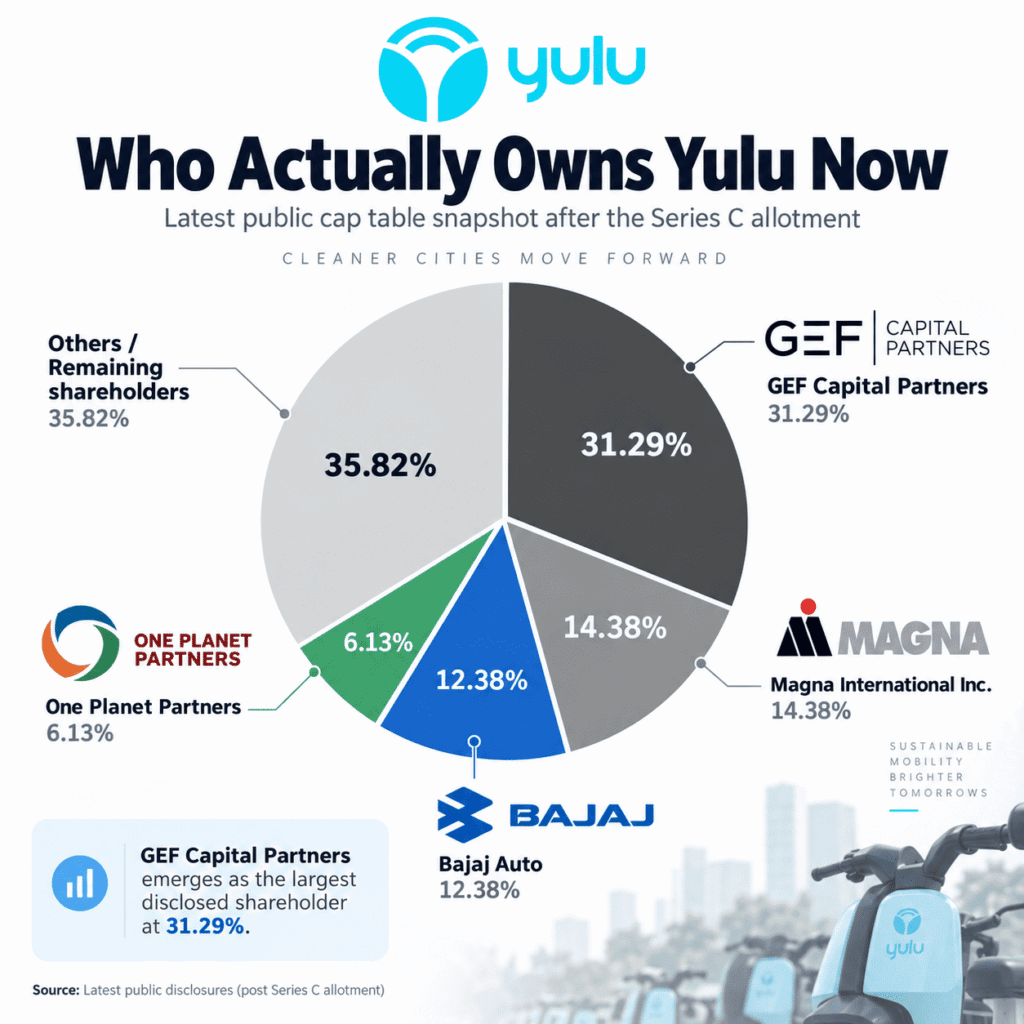
The Series C allotment also gives the clearest public picture yet of Yulu’s cap table. Following the latest allotment:
- GEF Capital Partners: 31.29% stake
- Magna International Inc.: 14.38% stake
- Bajaj Auto: 12.38% stake
- One Planet Partners: 6.13% stake
Two things stand out. First, GEF’s stake, at nearly a third of the company, makes it Yulu’s dominant shareholder heading into this next phase, notable given that GEF Capital Partners typically invests with a climate and sustainability infrastructure lens rather than a pure consumer-tech growth mandate.
Second, Bajaj Auto’s 12.38% stake confirms its role goes well beyond manufacturing partner; it is a meaningfully large equity holder in the very company whose vehicles it builds, reinforcing how tightly the manufacturing and mobility-operations sides of this business are now linked.
Magna International’s presence on the cap table is also a reminder that Yulu’s investor base includes global automotive supply-chain players, not just financial VCs, a detail that could matter if the upcoming high-speed Express platform requires new component or engineering partnerships.
Notably absent from the disclosed post-allotment percentages is 3one4 Capital itself, consistent with the secondary sale it just completed.
A New Vehicle Category Brings New Risk
Yulu’s next chapter also introduces a fresh set of variables. The business to date has been built around low-speed EVs used by delivery workers. Its next product, Yulu Express, is a larger, higher-speed electric scooter aimed at e-commerce logistics, express delivery and bike-taxi use cases, potentially accounting for a third of the planned 200,000-vehicle fleet, according to comments reported by TechCrunch.
That’s a bigger addressable market, but a different operating model. Higher-speed vehicles carry different homologation, insurance, licensing, servicing and financing requirements. Yulu now has to show that the operational discipline it built around low-speed vehicles actually transfers to a new vehicle class, and the next 150,000 vehicles will almost certainly be harder to add than the first 50,000.
Bajaj’s Role Is Part of the Template
Bajaj Auto has been both an investor in and manufacturing partner to Yulu, developing the startup’s current low-speed platform rather than forcing Yulu to build vehicle manufacturing capacity from scratch. That arrangement, now reflected in Bajaj’s 12.38% equity stake, has let Yulu concentrate on fleet deployment, software, battery swapping and rider operations, and it may offer a useful template for other mobility startups. Not every EV platform needs to become an OEM; separating vehicle manufacturing from mobility operations may in some cases be the stronger model.
Why This Exit Matters Beyond Yulu
India’s EV funding conversation is dominated by capital going into companies: rounds, valuations, strategic investments, incentives.
Exits get far less attention, but venture capital only functions over the long run if capital eventually comes back out. 3one4 has made this central to its own strategy: its first fund reportedly reached more than 1.0x DPI within seven years, meaning investors had already recovered their committed capital while substantial unrealized value remained in the portfolio.
The Yulu transaction adds an EV company to that track record, and that’s meaningful for the broader ecosystem: it’s evidence that EV investing doesn’t have to depend entirely on an eventual IPO or acquisition. Secondary sales can be a legitimate liquidity path, which matters especially for climate and mobility companies where holding periods run long and capital intensity is far higher than in software.
The Exit Isn’t Proof the Model Is Finished
Still, an investor exit is not the same thing as a company reaching maturity, and Yulu’s scaling challenge is far from over. Its fleet needs to roughly quadruple. Its geographic footprint needs to expand. The new high-speed vehicle still has to prove product-market fit. Debt needs servicing, utilization needs to stay high enough to support the economics, and EBITDA positivity has to eventually become sustained cash generation and net profitability.
In FY25, Yulu’s revenue grew 98% to ₹237.4 Cr, while its net loss narrowed 12% to ₹126 Cr. That is a business improving on both lines at once, a healthier signal than growth alone would be, but a ₹126 Cr loss against ₹237 Cr of revenue is still a company with real distance left to travel before “EBITDA positive” becomes “profitable.” The business is progressing. It isn’t finished.
What This Means
3one4 Capital’s exit from Yulu captures two things happening at once: an early investor taking money off the table, and a new investor, GEF Capital Partners, putting in substantially more than that investor took out at a fresh $180–200 million valuation. That’s how a venture-backed company begins its transition from startup capital to institutional growth capital, and the newly disclosed cap table, with GEF, Magna, Bajaj and One Planet Partners now holding a combined 64.18% stake, shows exactly what that transition looks like on paper.
For India’s EV ecosystem, that may be the more important signal buried inside Yulu’s $93 million raise. The industry has spent years proving it can attract investors. The harder, still-unanswered question has always been whether those investors can get their money back, and whether that money then goes on to fund the next generation of EV businesses. Yulu has now offered one affirmative data point. Whether it can justify the confidence of the investors who just replaced 3one4, at a valuation and cap table now firmly on the public record, is the test that actually matters.