

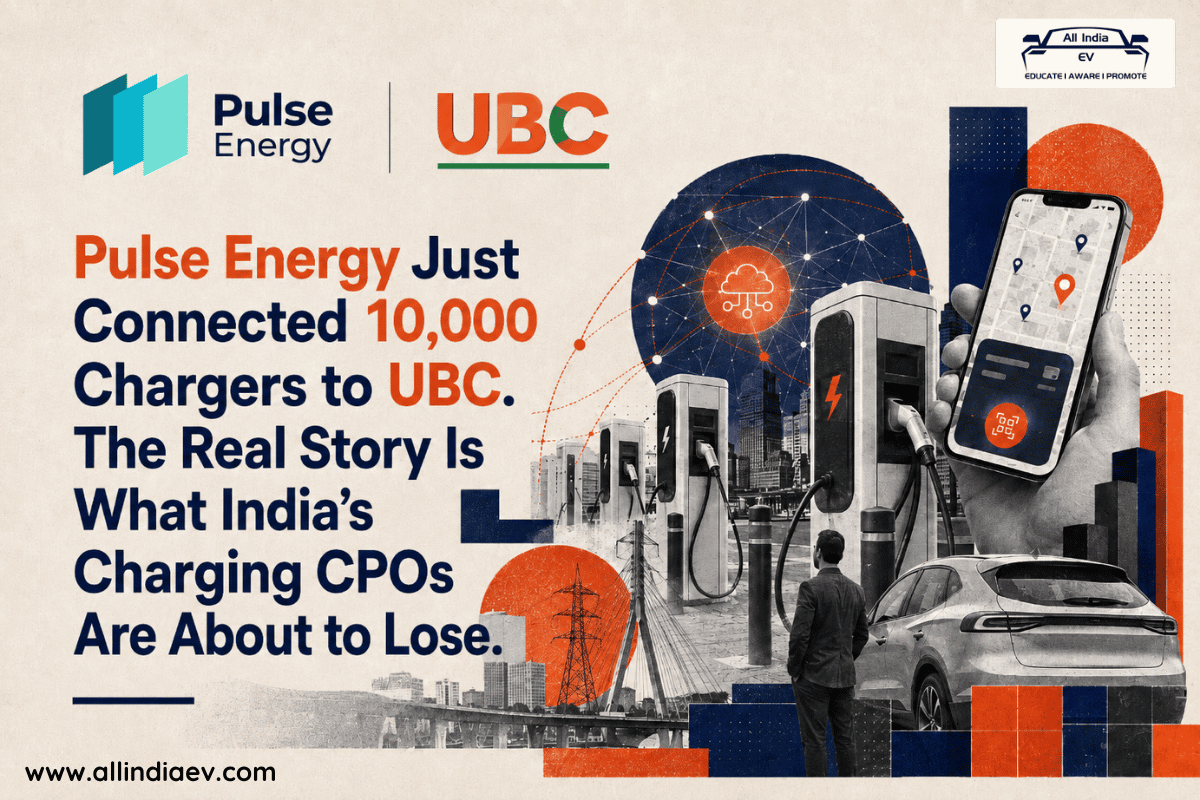
Pulse Energy UBC chargers: The real story is what India’s charging CPOs are about to lose.
Not a charger-count milestone. Moreover, Pulse Energy UBC chargers signal a market-structure event. It could determine which layer of India’s EV charging stack captures value over the next five years.
- Pulse Energy UBC chargers: The real story is what India’s charging CPOs are about to lose.
- The headline everyone will write
- 1. What actually changed, and what didn’t
- 2. The unbundling AIEV Intelligence is tracking
- 3. Why this reshuffles who wins in Indian charging
- 4. The policy lever that makes this more than a product launch
- 5. What this does, and does not, tell us
- 6. The open questions we’re now pursuing
- Our view
The headline everyone will write
Pulse Energy has become one of the first certified technology enablers on Unified Bharat eCharge (UBC), the interoperable EV charging network built by the Ministry of Heavy Industries, BHEL, and NPCI. The company collaborates with more than 100 charge point operators to support standardization and reliable performance across the network. This collaboration helps ensure a consistent experience for users and operators alike.
Pulse Energy UBC chargers can be discovered and paid for through BHIM via UPI. Additionally, there is no separate CPO app, no operator wallet, and no re-registration at each charger. Pulse Energy works with 100+ CPOs and reports more than 10,000 connected chargers. This design simplifies access for users and helps operators scale nationwide.
Most coverage will stop there: a fintech-style integration, a nice UX upgrade, a bigger number for Pulse’s homepage.
That is not the story All India EV is interested in.
The story is what happens to the basis of competition in Indian EV charging once discovery and payment stop belonging to the company that owns the charger.
1. What actually changed, and what didn’t
Pulse did not build 10,000 new chargers. This is a software and interoperability expansion layered on top of existing CPO infrastructure, not fresh capital deployed into steel, copper and power electronics. The underlying chargers still belong to, and are still operated by, the CPOs Pulse works with. Pulse’s role is the connective layer, APIs, transaction routing, and now a UBC-certified bridge into BHIM.
That distinction matters for how this number should be read against India’s public charging base. Government figures put the country’s public charging station count in the tens of thousands as of mid-2026, with a meaningful subset built out for fast DC charging. Ten thousand connected chargers is a real and useful base for an interoperability layer to launch on, but it should be read as a software network reaching existing hardware, not as new physical capacity entering the market. Conflating the two overstates what actually happened this week.
The consumer flow itself is the more consequential part. UBC is built on the open Beckn protocol, with BHIM as the first consumer-facing app. This approach mirrors the architecture pattern India used for UPI and ONDC. It prioritizes openness and interoperability.
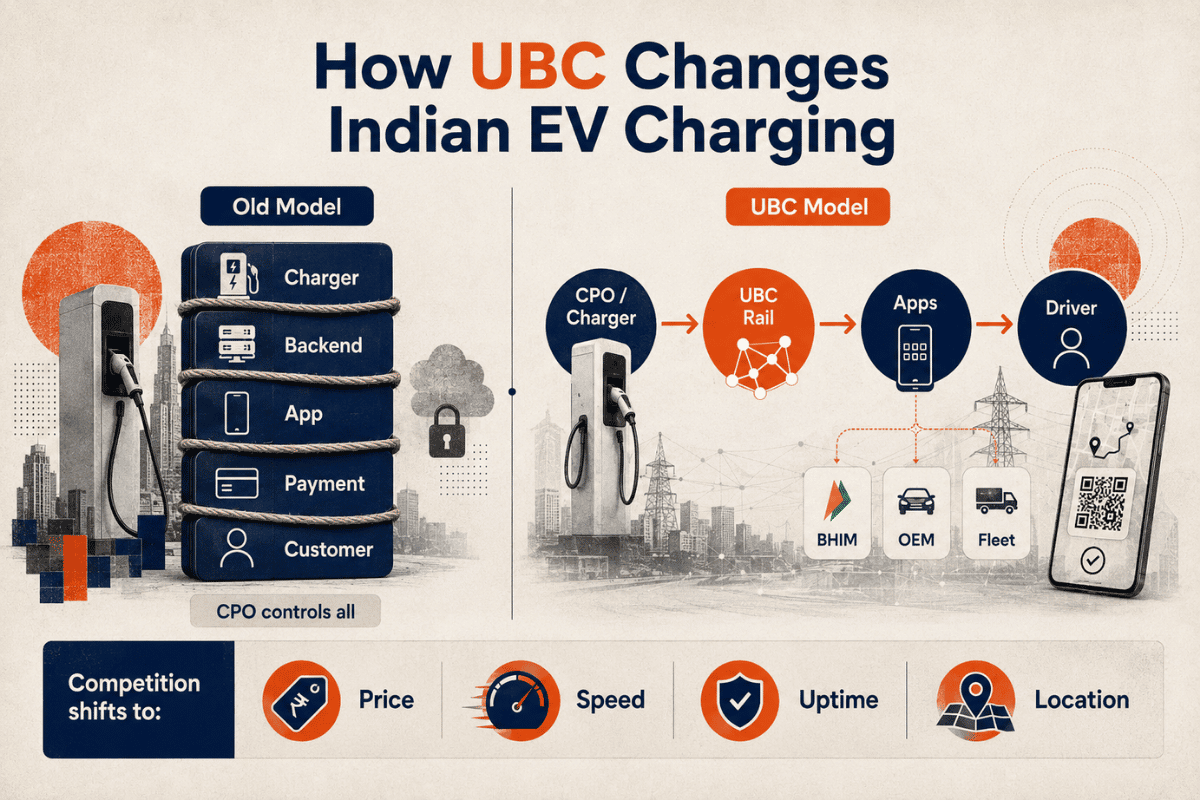
That is the same architecture India used for UPI and ONDC. Instead of finding CPO, users follow a shorter path: download the CPO app, register, load wallet, find charger. The path then becomes open BHIM, discover charger, scan QR, and pay by UPI.
In time, Pulse Energy UBC chargers and other apps, mobility, OEM, and fleet, will plug into the same rail. That unified flow supports scalable, interoperable charging experiences across networks. As adoption grows, policymakers and operators benefit from consistent interfaces and clearer eligibility rules.
This is the part that should get every CPO’s attention: the app is being pulled out of the charger’s control.
2. The unbundling AIEV Intelligence is tracking
For most of the last four years, India’s charging competition has effectively rewarded companies that could build all of this at once:
charger + backend + app + payment + customer relationship
UBC starts to take that stack apart, layer by layer:
CPO (owns and operates the charger) → UBC interoperability rail → consumer-facing app (BHIM, OEM app, fleet app, mobility app) → the driver
Once that separation is real and working at scale, the driver no longer needs a direct relationship with whichever company physically operates the charger. Three chargers sitting 300 meters apart today compete partly on which app you already have installed. Under genuine interoperability, they compete on price, speed, uptime and location, full stop.
That is a structurally different market. It rewards operational discipline over app-store downloads.
3. Why this reshuffles who wins in Indian charging
This does not eliminate branded CPO apps, fleet accounts, subscriptions, loyalty pricing, route planning and dedicated support remain real value-adds that a national interoperability rail won’t replicate on day one. But “we have our own app” stops functioning as a moat on its own.
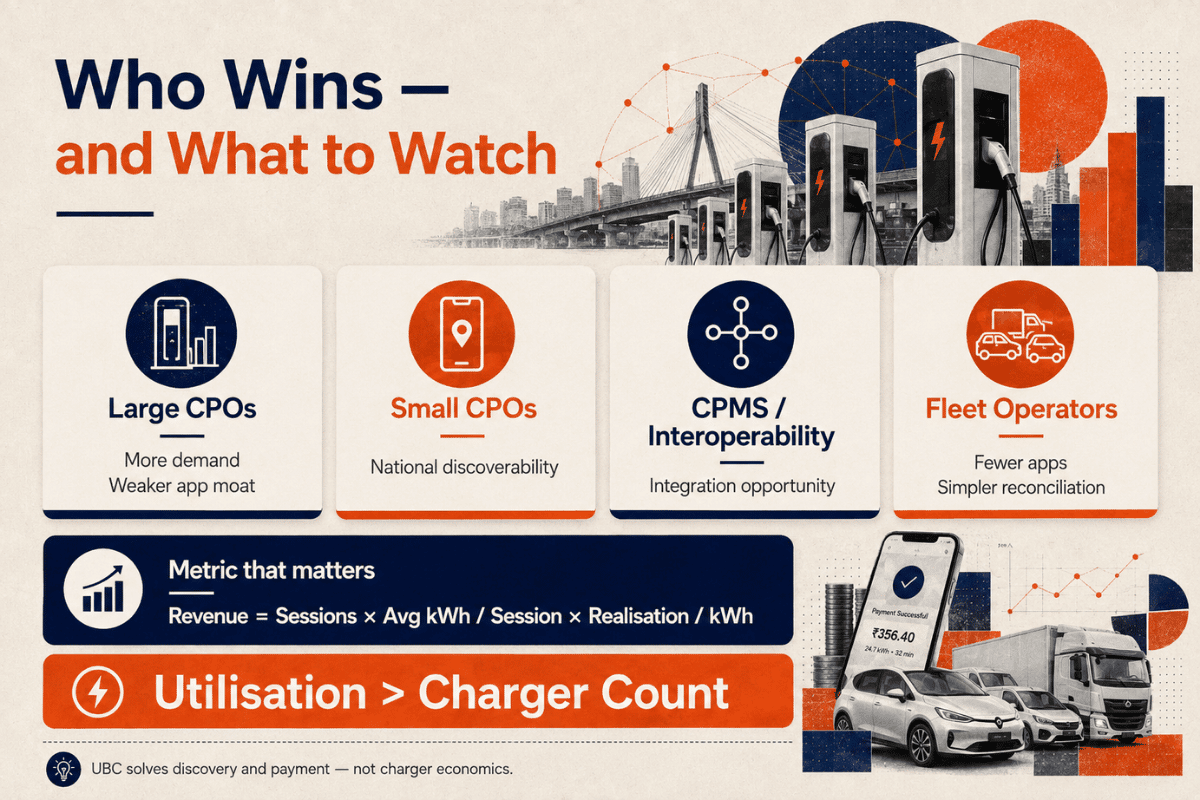
Four groups look meaningfully repositioned:
- Large CPOs face a mixed picture, more addressable demand through UBC, but a weakened consumer-app moat they’ve spent years and crores building.
- Small and long-tail CPOs may be the most underrated winners. A 75-charger operator with no brand recognition and no consumer-acquisition budget can, in principle, become nationally discoverable through a payment rail it didn’t have to build.
- Interoperability and CPMS providers, Pulse’s category, become structurally important, because every fragmented CPO is a fresh integration opportunity rather than a competitor to out-market.
- Fleet operators stand to gain the most operational simplicity: fewer CPO contracts, fewer apps, simpler reconciliation across a mixed-network vehicle base.
The common thread: value migrates from “who owns the customer relationship” toward “who owns the highest-utilization, most reliable charger.”
4. The policy lever that makes this more than a product launch
The reason this deserves an investor-grade read rather than a product-news read is the subsidy architecture sitting underneath it. Government support for public charging infrastructure under PM E-DRIVE has been structured with an onboarding condition attached to it: chargers installed under the scheme are required to be onboarded onto the government’s unified charging hub as part of the conditions tied to the second and final subsidy tranche.
That is a materially different adoption mechanism than most interoperability initiatives get. UBC does not have to depend entirely on CPOs voluntarily deciding that interoperability is strategically wise. A meaningful share of new subsidized supply may be onboarded because the subsidy requires it. That converts UBC from “a nice-to-have integration” into policy-linked plumbing for a chunk of India’s future charging base, a supply-acquisition engine that doesn’t rely purely on commercial persuasion.
This is the detail we’d flag first to anyone evaluating capital exposure to Indian charging infrastructure right now.
5. What this does, and does not, tell us
UBC solves discovery and payment friction. It does not, by itself, solve charger economics.
A charger can be interoperable, UPI-enabled and discoverable on BHIM, and still be poorly sited, frequently offline, grid-constrained or badly maintained. “10,000 chargers connected” is not the same claim as “10,000 commercially healthy chargers.” All India EV will treat these as separate questions until the underlying utilization data says otherwise.
That reframes the metric worth watching going forward. The industry has spent three years asking who can install the most chargers and then who can build the largest network. The number that actually determines who makes money from here is:
Revenue = Sessions × Average energy per session × Realization per kWh
If interoperability increases discovery and reduces app friction, it can lift session count and utilization without a single new charger being installed. Utilization per charger, not chargers deployed, is the number that should be driving valuation conversations in this sector over the next 18 months.
6. The open questions we’re now pursuing
A press release confirms there is a connection. It does not specify what kind of connection it is. All India EV Intelligence is pursuing data. It aims to distinguish a useful integration from a load-bearing piece of India’s charging market plumbing. It asks how many Pulse’s 10,000 chargers, Pulse Energy UBC chargers, are actually live on UBC today. It covers the AC/DC and public versus captive split.
It also looks at current session volumes routed through roaming versus direct CPO relationships. It covers the commercial model between Pulse, CPOs and BAP/app providers. It asks who controls pricing when the same charger is visible through multiple apps. It notes how many additional CPOs are currently in certification.
We’ll publish what we find.
Our view
India’s EV charging market has moved through two phases. The first asks who can install chargers. The second asks who can build the largest network. This shift reflects how access, scale, and service consistency influence consumer choices. Industry players adapt quickly.
Pulse Energy UBC chargers push the market into a third phase. They focus on uptime, price and location when customers can reach almost every charger from the same app. A fourth phase seems visible behind it, emphasizing software, data, fleet demand and reliability signals.
That is the layer of the stack investors and industry leaders should be underwriting for next, not the charger count in this week’s press release.