

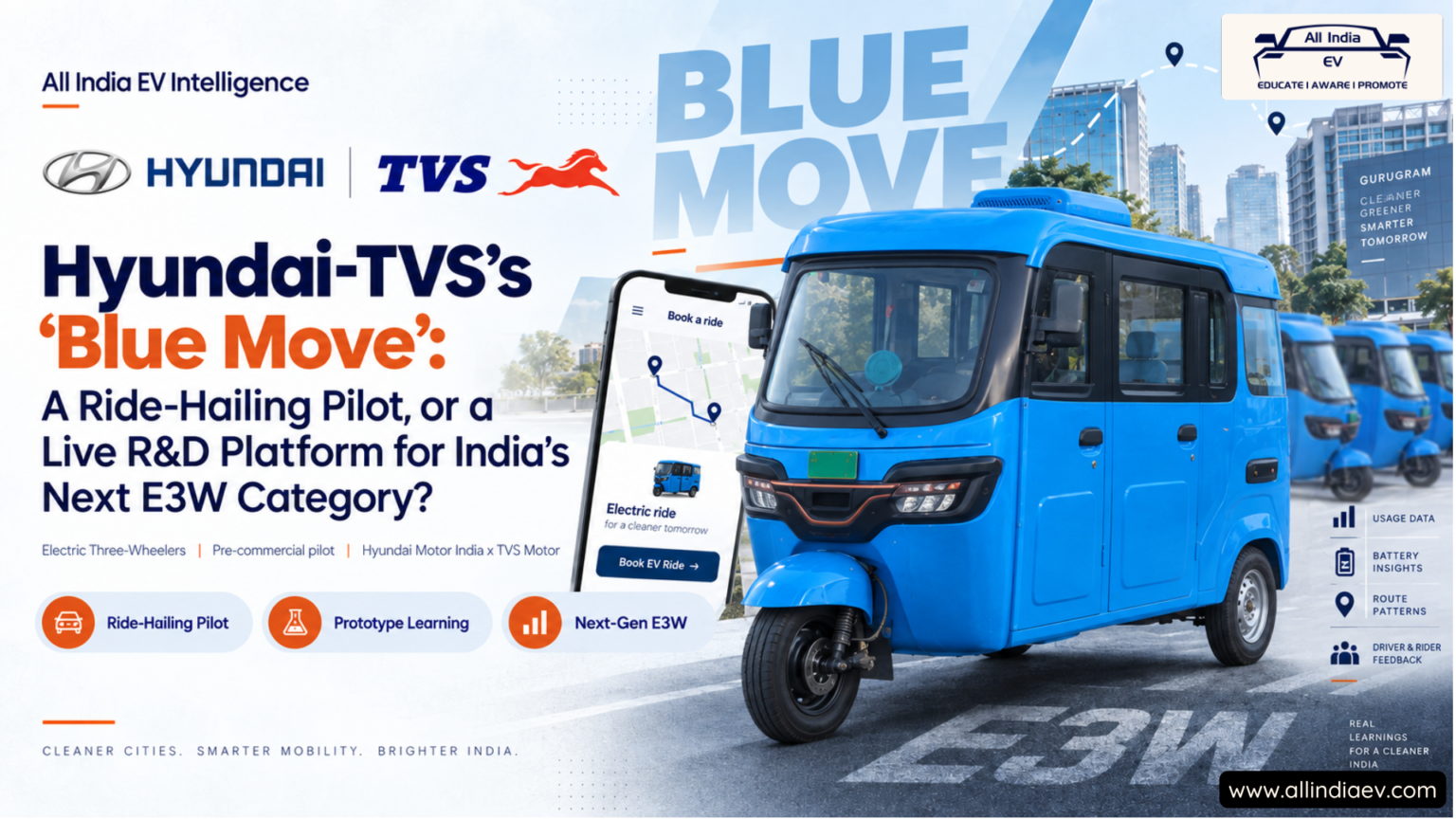
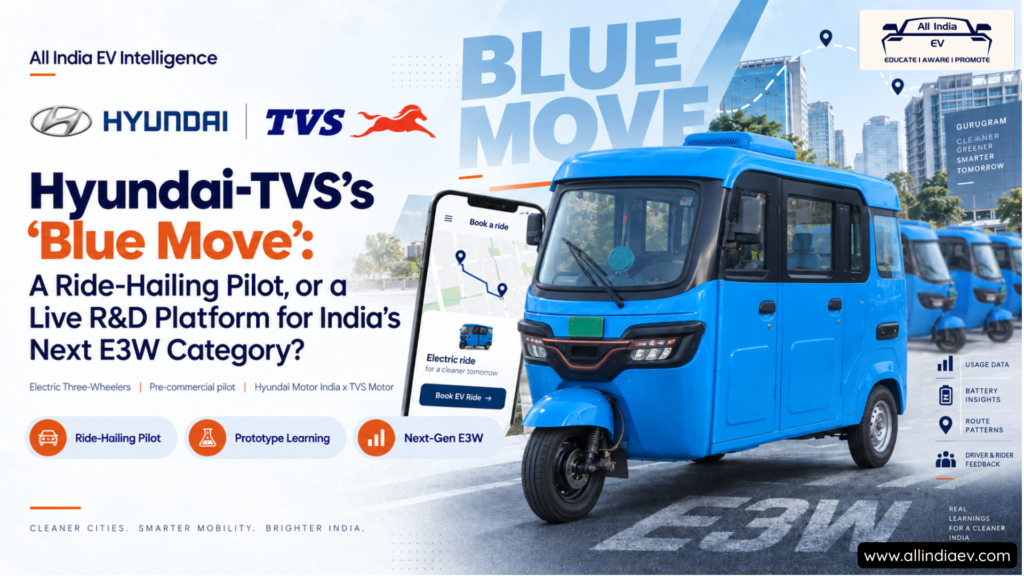
The Hyundai TVS electric three-wheeler programme just got a fresh, and easy to miss, data point. Two months after a small ride-hailing pilot called Blue Move quietly began operating around Hyundai’s Gurugram headquarters, Hyundai has publicly reconfirmed that its E3W partnership with TVS has moved from concept to prototype. Read together, the two updates suggest Blue Move may be less a consumer experiment and more a live testbed for the vehicle Hyundai and TVS eventually plan to sell.
- Executive Summary
- 1. Hyundai TVS Electric Three-Wheeler Timeline: From Concept to Prototype
- 2. Division of Labour Under the Hyundai TVS Joint Development Agreement
- 3. Why a Ride-Hailing App? The Strategic Logic Behind Blue Move
- 4. Product Positioning: A New E3W Category, Not Just an Electrified Auto
- 5. What the Blue Move Pilot Could Feed Back Into Vehicle Engineering
- 6. What Remains Unconfirmed About the Hyundai TVS Electric Three-Wheeler Pilot
- 7. The Broader Industry Signal for Electric Three-Wheeler India
- 8. Questions the Market Should Be Asking Next
- Frequently Asked Questions
- Bottom Line for Investors and Sector Trackers
Executive Summary
- In June 2026, a small fleet of unusual, enclosed, air-conditioned electric three-wheelers began operating around Hyundai Motor India’s Gurugram headquarters under a pilot ride-hailing app called Blue Move.
- Initial coverage treated this as a minor, low-visibility mobility trial. That framing now looks incomplete.
- At its September 2026 CEO Investor Day, Hyundai publicly reiterated that its Hyundai TVS electric three-wheeler programme has moved “from concept to prototype in under 24 months.”
- Read against that timeline, Blue Move looks less like a consumer product test and more like a controlled data-generation exercise feeding directly into vehicle design decisions: battery sizing, thermal management, cabin architecture, and duty-cycle economics.
- The investable question has shifted: this is no longer “did Hyundai test an electric auto,” but “is Hyundai/TVS using a ride-hailing sandbox to de-risk the commercial specification of a new E3W category before capital is committed to mass production?”
1. Hyundai TVS Electric Three-Wheeler Timeline: From Concept to Prototype
A sequence worth tracking as a single thread, not four isolated news items:
| Date | Milestone |
|---|---|
| Jan 2025 | Hyundai unveils electric three-wheeler and micro-four-wheeler concepts at Bharat Mobility Global Expo, designed for Indian conditions (longer wheelbase, flat floor, improved visibility). |
| 20 Apr 2026 | Hyundai and TVS sign a formal Joint Development Agreement to co-develop and commercialise E3Ws for India and potentially export markets. |
| Jun 2026 | Blue Move pilot reported in Gurugram: Hyundai-built app, TVS-manufactured vehicles, free rides, restricted to employees/selected users within an 8-10 km radius. |
| Sep 2026 | Hyundai reconfirms the Hyundai TVS electric three-wheeler programme at CEO Investor Day: concept to prototype in under 24 months. |
Key takeaway: Blue Move sits precisely between the formal JDA and the prototype-stage disclosure. Its timing suggests it functioned as an operating-model test running in parallel with vehicle engineering, not a standalone side project.
2. Division of Labour Under the Hyundai TVS Joint Development Agreement
- Hyundai: vehicle design, co-engineering, and (per the Blue Move pilot) the ride-hailing application/software layer.
- TVS Motor: electric three-wheeler platform, local manufacturing, distribution, and go-to-market/sales leadership.
- Both companies have established dedicated cross-functional teams, with the vehicle expected to progress through localisation, testing, certification, and mass production.
Investor read: This is a capital-light entry structure for Hyundai. It leverages TVS’s manufacturing base and three-wheeler market knowledge rather than building parallel capacity, while Hyundai supplies global engineering and software/platform IP.
3. Why a Ride-Hailing App? The Strategic Logic Behind Blue Move
A test track generates engineering telemetry: range, braking, thermal load, component wear. It cannot answer commercial questions that determine whether an electric three-wheeler succeeds in the market. A live ride-hailing pilot can. Key data points Blue Move is positioned to generate:
- Trips completed per vehicle, per day
- Demand peaks and route/trip-length patterns
- Idle time and charging-window behaviour
- Acceptable downtime thresholds for operators
- Passenger response to cabin features (AC, touchscreen, enclosed compartment)
- The operating radius at which unit economics work
Why this matters commercially: A prototype that performs well on a proving ground can still fail commercially if its charging windows, utilisation pattern, or cabin cost don’t match real driver duty cycles. Blue Move appears designed to close that gap before mass-production commitments are locked in.
4. Product Positioning: A New E3W Category, Not Just an Electrified Auto
The reported vehicle specification (enclosed, air-conditioned cabin, touchscreen infotainment, modern dashboard) points toward a deliberate positioning gap for this Hyundai TVS electric three-wheeler:
Three-wheeler cost economics + enclosed/AC cabin + digital booking + OEM-grade vehicle architecture
This sits between the traditional auto-rickshaw and an entry-level cab. If viable, it could open a distinct sub-segment within India’s electric three-wheeler market, which today is largely organised around e-rickshaws, electric autos, cargo three-wheelers, and fleet vehicles.
Open commercial risks:
- AC and premium cabin features add energy load, weight, and cost
- Uncertain willingness-to-pay among riders for the upgrade
- Drivers/fleet operators will prioritise acquisition cost, EMI burden, daily revenue, and uptime over cabin technology, the same variables a pilot like Blue Move is built to test
5. What the Blue Move Pilot Could Feed Back Into Vehicle Engineering
Commercial EV design typically works backward from the duty cycle. Illustrative implications if Blue Move data confirms certain usage patterns:
- Short, dense urban trips + predictable charging windows → smaller battery viable → lower vehicle cost, lower weight, potentially faster charging, lower capital requirement for drivers/fleet operators
- High daily utilisation with limited charging time → case for larger battery or faster-charging architecture
- Additional parameters plausibly informed by pilot data: thermal management, AC energy draw, seat configuration, suspension durability, turning radius, charging-port placement, and driver ergonomics
Investor read: If accurate, this positions Blue Move as an input into the bill-of-materials and cost structure of the production E3W, a materially different signal than a marketing pilot.
6. What Remains Unconfirmed About the Hyundai TVS Electric Three-Wheeler Pilot
Neither Hyundai nor TVS has provided public disclosure on:
- Number of vehicles in the pilot
- Total rides or kilometres completed
- Charging utilisation data
- Pilot duration or current operating status
- Customer feedback or NPS-type data
- Commercial pricing or driver economics
- Planned future operating cities
- Whether Hyundai intends to operate a ride-hailing business at all, versus handing mobility operations to fleet partners
This is the core caveat for this editorial: Blue Move remains a reported pilot, based on accounts from people familiar with the programme and vehicles observed in Gurugram, not a formally announced commercial mobility business. All strategic interpretation above should be weighted accordingly.
7. The Broader Industry Signal for Electric Three-Wheeler India
Blue Move is also a data point in a wider shift among EV OEMs, who increasingly participate beyond the traditional design → manufacture → dealer → customer chain into:
- Charging and financing/leasing
- Fleet management
- Vehicle software and subscriptions
- Mobility-as-a-service
- Post-sale usage data capture
For All India EV readers tracking OEM strategy: the ability to capture and act on post-sale usage data is emerging as a competitive differentiator in commercial EV segments, not just a consumer-tech trend.
8. Questions the Market Should Be Asking Next
- Is Blue Move still operating, and at what scale?
- What volume of trips/kilometres has the pilot accumulated?
- Did pilot findings result in specification changes to the production E3W?
- Will Hyundai run Blue Move commercially, partner with an existing ride-hailing platform, or exit mobility operations entirely to TVS/fleet partners?
- What is the actual target customer: driver-owners, fleet operators, or a new premium-auto rider segment?
Frequently Asked Questions
What is the Hyundai TVS electric three-wheeler programme? It is a joint development programme, formalised through a Joint Development Agreement signed in April 2026, under which Hyundai leads vehicle design and co-engineering while TVS Motor contributes its electric three-wheeler platform, local manufacturing, and distribution for the Indian market.
What is Blue Move? Blue Move is a pilot ride-hailing app reported in June 2026, using enclosed, air-conditioned electric three-wheelers jointly developed by Hyundai and TVS, operating within an 8-10 km radius of Hyundai’s Gurugram headquarters for employees and selected users.
Is Blue Move a commercial ride-hailing service? Not yet, or not confirmed as one. Neither Hyundai nor TVS has announced a commercial rollout, pricing, or expansion timeline. It remains a reported pilot based on accounts of people familiar with the programme.
When will the Hyundai TVS electric three-wheeler launch commercially? No commercial launch date has been announced. As of September 2026, Hyundai has stated the programme has progressed from concept to prototype stage.
Bottom Line for Investors and Sector Trackers
- Base case: Blue Move is a bounded, non-commercial pilot whose primary value is engineering and operating-model validation ahead of E3W mass production.
- Upside scenario: Blue Move data materially shapes a new, higher-margin E3W sub-category (enclosed, AC, app-booked) that neither pure e-rickshaw players nor conventional cab-hailing platforms currently occupy, with Hyundai/TVS as first movers.
- Key monitorable: the next disclosure milestone is likely to be either (a) a formal Blue Move commercial announcement, or (b) production E3W specifications that visibly reflect pilot-stage learnings (battery size, cabin features, pricing tier). Either would confirm the pilot’s strategic function retroactively.
Track this space: the significance of a June pilot is only becoming legible in September, a reminder that early, low-visibility mobility trials from major OEMs like the Hyundai TVS electric three-wheeler programme merit continued monitoring rather than one-off coverage.