

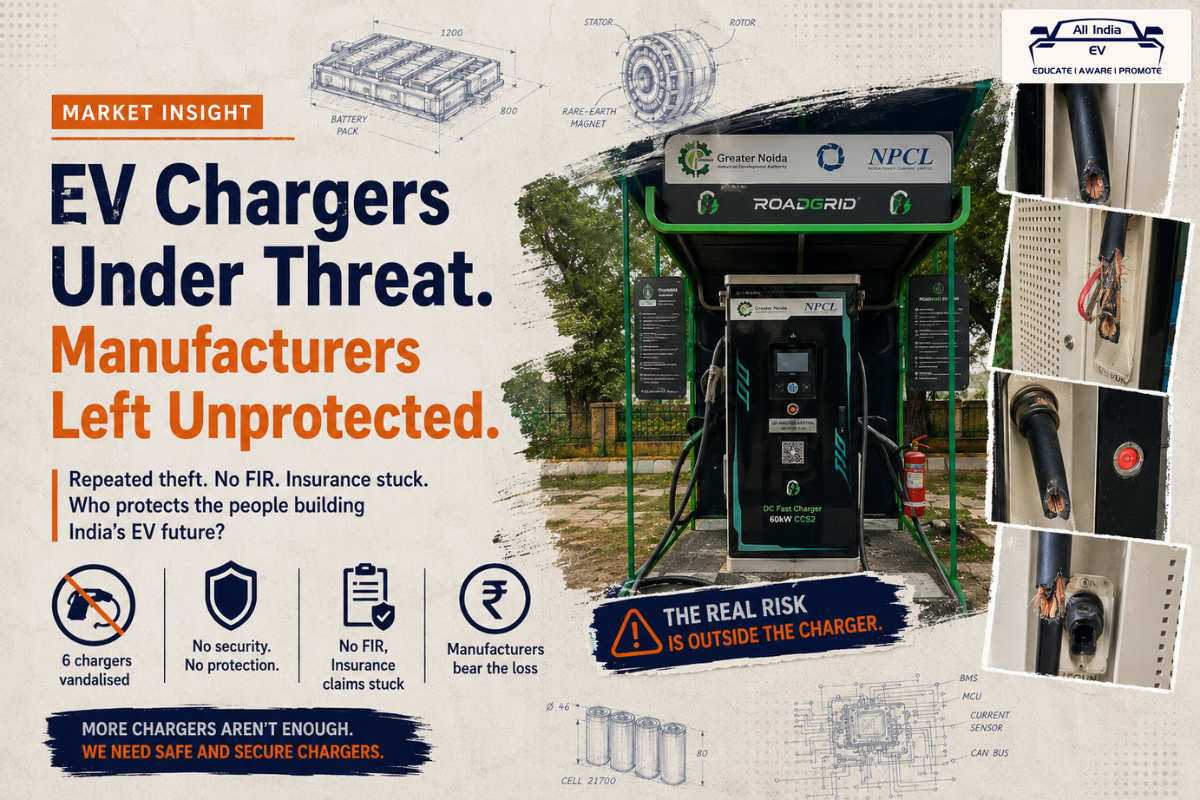
Around a month ago, RoadGrid recorded videos of its EV charging stations installed at different locations in Greater Noida. The chargers were operational, publicly accessible and ready to serve EV users. Within weeks, however, the situation changed dramatically.
The charging guns and cables of all six chargers were cut and stolen. More worryingly, two of these chargers were targeted three separate times, even after the damaged components had been replaced.
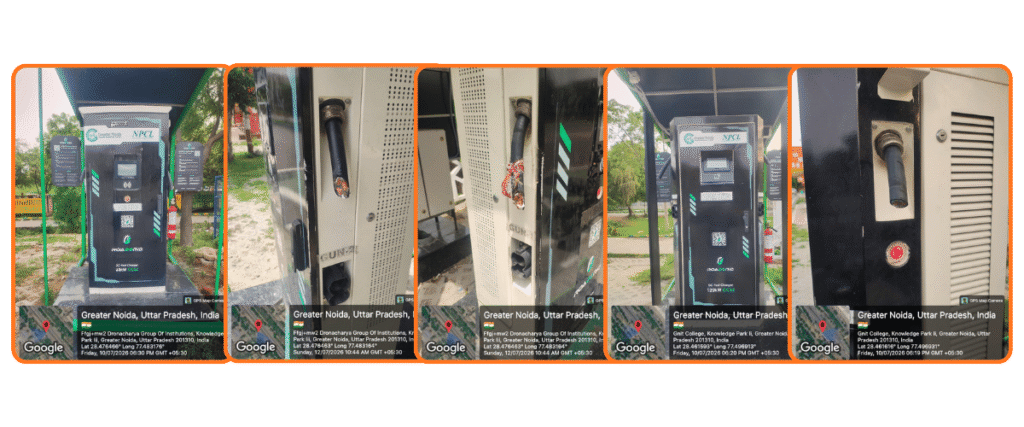
This is not merely a case of equipment damage. It exposes a serious gap in how public EV charging infrastructure is being planned, secured and insured in India.
For manufacturers such as RoadGrid, the problem becomes particularly difficult because they are expected to restore the chargers, replace the guns and keep the stations operational. However, they have little control over the physical security of the location where the chargers are installed.
The manufacturer becomes responsible for everything
When a charging cable is cut, the immediate complaint usually reaches the charger manufacturer. From the customer’s perspective, the charger is unavailable, so the equipment supplier is expected to resolve the issue.
However, charger manufacturers cannot prevent theft at locations where there is no guard, no active surveillance and no responsible person present after business hours.
A single incident can create multiple operational and financial burdens:
- Replacement of expensive DC charging guns and cables
- Deployment of technicians to inspect and repair the charger
- Transportation and installation expenses
- Extended charger downtime
- Loss of charging revenue for the operator
- Reputational damage for the manufacturer
- Repeated replacement costs if the location is attacked again
In the Greater Noida case, replacing the charging guns did not solve the underlying problem. Two chargers were vandalised repeatedly, indicating that the sites remained vulnerable even after repairs.
The manufacturer is therefore not repairing a technical fault. It is continuously compensating for the absence of physical security.
Insurance is available, but claims remain difficult
Insurance should ideally protect charging point operators and manufacturers from theft, vandalism and accidental damage. In reality, only a limited number of insurers currently offer meaningful coverage for EV charging equipment.
Even when a charger is insured, the claim process can become complicated because insurers generally require formal documentation, including a police FIR.
This creates another roadblock.
According to RoadGrid, getting an FIR registered for the theft of charging cables has become difficult. Without an FIR, the insurance claim cannot move forward smoothly. As a result, the damaged equipment remains unreimbursed while the manufacturer is still expected to replace it.
The current situation creates a frustrating cycle:
- A charging gun is cut or stolen.
- The charger becomes unavailable.
- The manufacturer receives the service complaint.
- Police documentation is sought for the insurance claim.
- The FIR is not registered or gets delayed.
- The insurance claim remains pending.
- The manufacturer bears the replacement cost.
- The charger is restored, but the site remains unsecured.
Unless this cycle is broken, repeated vandalism can make certain public charging locations commercially unviable.
Open public spaces may not be ready for unattended chargers
India’s charging infrastructure strategy has largely focused on the number of installations, charger capacity, connector standards and geographical coverage. Physical security is often treated as a secondary consideration.
That approach now needs to change.
A high-value DC charger should not be installed in an isolated open space simply because electricity and land are available. Before installation, the site should be assessed for security, visibility and operational supervision.
At a minimum, a public charging location should have:
- Functional CCTV coverage with recorded footage
- Adequate lighting during night hours
- A security guard or responsible site representative
- Controlled access to the charging equipment
- Regular inspection and monitoring
- Clear responsibility for theft and vandalism
- Immediate police and insurance support mechanisms
Without these safeguards, the charger becomes a high-value unattended asset with exposed copper cables.
Commercial premises offer a safer deployment model
For the time being, chargers may be better installed inside premises that already have security and regular human activity. Suitable locations include restaurants, cafés, hotels, fuel stations, shopping centres, hospitals, office campuses and fleet depots.
These establishments offer more than parking space. They usually provide lighting, CCTV coverage, staff presence and guards, significantly reducing the possibility of repeated vandalism.
Site owners also benefit because charging can increase customer dwell time and attract EV users to their businesses.
Responsibility cannot remain with the manufacturer alone
The EV charging ecosystem cannot expect manufacturers to carry the entire risk. Site owners, charging point operators, government authorities, police departments and insurance companies must share responsibility.
Manufacturers can build reliable chargers, provide technical support and replace faulty components. They cannot, however, act as permanent security agencies for every installed charger.
India does not only need more charging stations. It needs charging stations that remain available, protected and financially sustainable.
A charger that appears on a deployment dashboard but remains offline because its cable has been stolen is not infrastructure. It is merely an installation number.