
By All India EV Intelligence
Ask most analysts to size up Hero MotoCorp’s electric strategy and the conversation defaults to a single question: can VIDA compete with TVS, Bajaj and Ola?
That question is now the wrong one.
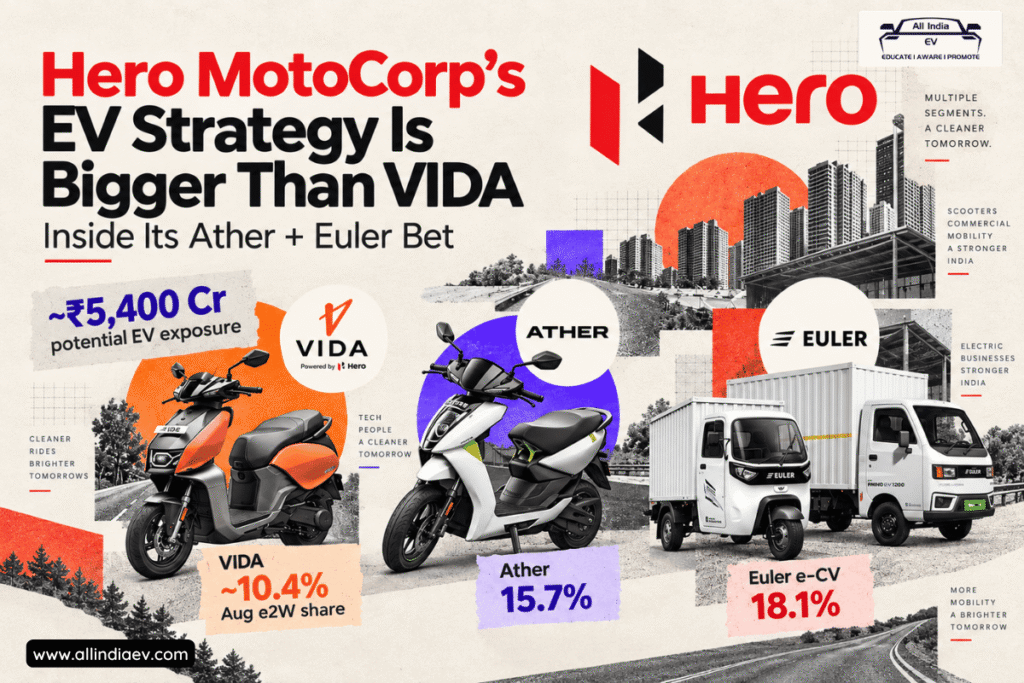
Over the past decade, Hero has quietly assembled something closer to a diversified holding structure than a product launch. It owns VIDA outright. It is the largest strategic shareholder in Ather Energy. And it now holds a 36.67% stake in Euler Motors, extending its reach into electric three-wheelers and four-wheel commercial vehicles. Taken together, this is capital allocation at index-fund scale applied to a single company’s transition risk — and it is large enough that institutional investors should be underwriting the portfolio, not just the brand.
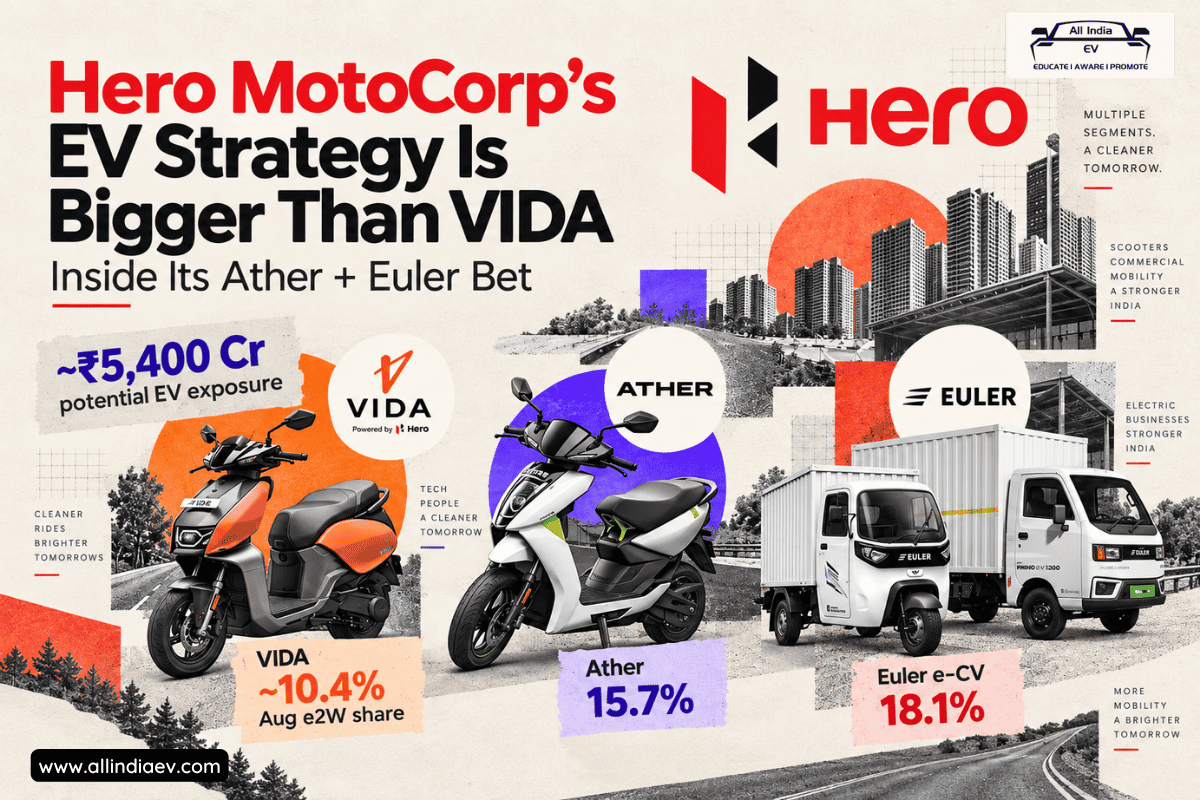
The headline number: All India EV Intelligence estimates Hero has deployed roughly ₹4,700 crore in disclosed external EV investment across Ather and Euler. Committed exposure rises to approximately ₹5,400 crore once the unpaid balance on its newly allotted Ather warrants is included. Notably, this figure excludes internal VIDA spend, which Hero does not disclose on a standalone, defensible basis — a gap worth flagging rather than papering over with estimates.
The Portfolio at a Glance
| Exposure | Hero’s Position | Latest Market Signal |
|---|---|---|
| VIDA | 100% Hero-owned | 19,007 units / ~10.4% of Aug ’26 E2W market |
| Ather Energy | 32.8% fully diluted | 28,757 units / 15.7% of Aug ’26 E2W market |
| Euler Motors | 36.67% fully diluted | 849 Aug e-CV units; ~18.1% of FADA electric-CV market |
| Disclosed capital deployed | ~₹4,700 crore | Ather + Euler combined |
| Total committed exposure | ~₹5,400 crore | Includes unpaid Ather warrant consideration |
In August 2026, VIDA and Ather combined for 47,764 electric two-wheeler registrations against a market of 182,936 units — roughly 26.1% of the segment. That figure demands an immediate caveat for anyone modeling this as market share: it isn’t Hero’s. Ather remains an independently managed, listed company. Hero owns equity in the business, not the vehicle sales. Collapsing the two numbers into one is the most common analytical error we see in coverage of this story, and it materially overstates Hero’s direct commercial position while understating the sophistication of its actual strategy.
VIDA: A Late Entrant That Has Finally Reached Materiality
Hero was slow off the mark. TVS had iQube. Bajaj had Chetak. Ola and Ather had already built distinct EV identities before VIDA formally launched — an uncomfortable position for a company that has spent decades dominating Indian two-wheelers on volume alone.
That gap is closing. VIDA registered approximately 19,007 units in August 2026, up roughly 38% year-on-year, making it India’s fourth-largest electric two-wheeler manufacturer at an estimated 10.4% share of the monthly market.
The caution for investors: scale within EVs still lags scale in the core business. JMK Research estimates EVs represented only about 2.4% of Hero’s total two-wheeler registrations in FY26. VIDA has become a real business. It has not yet become a Hero-sized one. That gap is precisely what makes the Ather stake strategically load-bearing rather than incidental.
Ather: From Early Hedge to Core Asset
Hero’s Ather relationship dates to 2016, when it committed approximately ₹205 crore for a 26–30% stake in what was then an early-stage scooter startup. It kept adding capital through every subsequent round: roughly ₹330.6 crore cumulative by March 2020, another ₹174 crore in FY21, ~₹420 crore around FY22, and ~₹262.5 crore in the first half of FY23.
Then the cheque sizes changed. Hero put in ₹550 crore through Ather’s 2023 rights issue, a further ~₹140 crore later that year, and ~₹124 crore in 2024 buying secondary shares. By our reconstruction of disclosed filings, that puts pre-2026 cumulative investment at roughly ₹2,000 crore.
2026 has been a decisive year:
- August 25, 2026: Ather allotted Hero 76.19 lakh convertible warrants at ₹1,260 apiece — a potential ₹959.99 crore commitment. Only 25% (₹239.99 crore) has been paid; the remaining 75% is due on conversion.
- Three days later: Hero completed a ₹1,758 crore secondary purchase, lifting its fully diluted stake to roughly 32.8%.
The distinction investors should not skip over: the ₹1,758 crore block trade was secondary — cash to an exiting shareholder, not new capital into Ather’s balance sheet. The warrants are the primary commitment; conversion would inject fresh funding directly into the company. Buying ownership and financing growth are different uses of capital, and they carry different signaling value. Treating them as interchangeable in a single “Hero spent X on Ather” headline obscures more than it reveals.
Cash actually deployed into Ather now approaches ₹4,000 crore; total potential exposure, including unpaid warrant consideration, approaches ₹4,700 crore.
Why the conviction is building: the operating picture supports it. Ather posted 28,757 August registrations (15.7% share, third nationally behind TVS and Bajaj). Q1 FY27 revenue rose 88.8% year-on-year to ₹1,216.92 crore, net loss narrowed to roughly ₹51 crore, and — the number that matters most to anyone tracking unit economics — Ather turned in positive EBITDA of ~₹9.45 crore, against a substantial negative EBITDA the year prior.
This produces a genuinely unusual structure: Hero operates one EV brand that competes directly against Ather, while owning roughly a third of Ather itself. If VIDA wins share, Hero captures it directly. If Ather wins share, Hero captures it as owner. It is, functionally, a hedged bet on the entire electric two-wheeler category rather than a bet on any one brand within it.
A rough, ownership-weighted exercise makes the point concrete (not an official market-share calculation, but a useful investor lens): Hero’s 32.8% Ather stake applied to Ather’s 15.7% share yields ~5.1 percentage points of indirect exposure. Add VIDA’s direct 10.4%, and Hero’s effective ownership-weighted exposure to the E2W category approaches 15.5% — meaningfully ahead of what VIDA’s standalone share implies.
Euler Motors: Extending the Thesis Beyond Scooters
If Ather is the hedge on two-wheelers, Euler is the diversification into commercial EVs — a segment with different demand drivers, dominated by total-cost-of-ownership economics rather than consumer preference.
Hero invested ₹510 crore in May 2025 for a 34.1% stake, then added ₹210 crore in April 2026, lifting fully diluted ownership to 36.67%. Total disclosed commitment: ₹720 crore.
Euler’s FY26 volumes: 7,576 vehicles sold, comprising 3,088 electric three-wheel cargo units, 1,760 passenger three-wheelers, and 2,728 four-wheel cargo units. Its Turbo EV 1000 alone moved 2,084 units, helping Euler capture an estimated 25.9% of the electric four-wheel cargo segment for the year. By August 2026, Euler’s 849 e-CV registrations placed it second nationally behind Tata Motors (1,416 units), good for roughly 18.1% of FADA’s electric-CV category.
The network build-out is the more interesting operating signal: Euler has scaled dealer presence from 30–35 cities to more than 100, with founder Saurav Kumar crediting Hero’s existing dealer relationships for the acceleration. That is not passive financial ownership. That is strategic integration — and it’s the clearest evidence yet that Hero intends to actively use its distribution muscle across the portfolio, not simply collect equity stakes.
The Cost Side: This Diversification Is Not Free
None of this comes without an earnings drag. Both associates are consolidated via the equity method, and both are still loss-making. FY26 losses attributable to Hero: approximately ₹157.22 crore from Ather and ₹107.79 crore from Euler — a combined ~₹265 crore hit to reported earnings.
For investors modeling Hero’s near-term P&L, this is the trade-off explicitly being made: the company is accepting a recurring associate-loss drag today in exchange for diversified optionality across the EV transition. It is a deliberate, financed bet — not a free option.
The Questions That Will Determine Whether This Is a Portfolio or a Patchwork
Hero’s capital commitment settles the question of intent. It does not settle the question of execution. The issues we would flag for anyone underwriting this story over a multi-year horizon:
- Procurement leverage. Can Hero extract shared sourcing or component advantages across VIDA and Ather without compromising the operational independence that has made Ather credible to its own investor base?
- Infrastructure interoperability. Does charging infrastructure converge across brands, or does duplication persist indefinitely?
- Distribution without dilution of agility. Can Hero’s dealer, financing and service network genuinely accelerate Euler’s growth — as the city-count expansion suggests it already is — without importing legacy-company decision speed into a startup that was valued for moving faster than that?
- Endgame on control. Does Hero remain content as a large minority holder indefinitely, or does one of these stakes eventually migrate toward consolidation or control? The warrant structure at Ather, in particular, is the kind of instrument that can be a step toward exactly that.
The Bottom Line for Investors
The old framing — “How much market share does VIDA have?” — materially understates what Hero MotoCorp is actually doing. The better question:
How much of India’s emerging EV economy has Hero positioned its balance sheet to participate in, across how many vehicle categories, and what return will that capital eventually generate?
By the numbers: VIDA at ~10.4% of the August E2W market, Ather at 15.7%, and Euler at ~18.1% of e-CV retail (with a stronger ~25.9% share in four-wheel electric cargo specifically). Hero does not own all of that share outright — but it has deliberately purchased economic exposure to nearly all of it, across three separate vehicle categories, using an ICE-era balance sheet to fund the transition.
That is a materially different risk profile than a single-brand EV bet, and it deserves to be modeled as one: a portfolio with real diversification benefits, real execution and governance risk, and a real — and rising — price tag.