

India’s electric three-wheeler segment is quietly becoming the country’s most contested EV battleground, and battery swapping is emerging as its defining infrastructure question. While two-wheeler swapping edges toward standardisation under BIS and industry-led efforts, the e-rickshaw and L5 cargo segment remains a fragmented, high-stakes experiment.
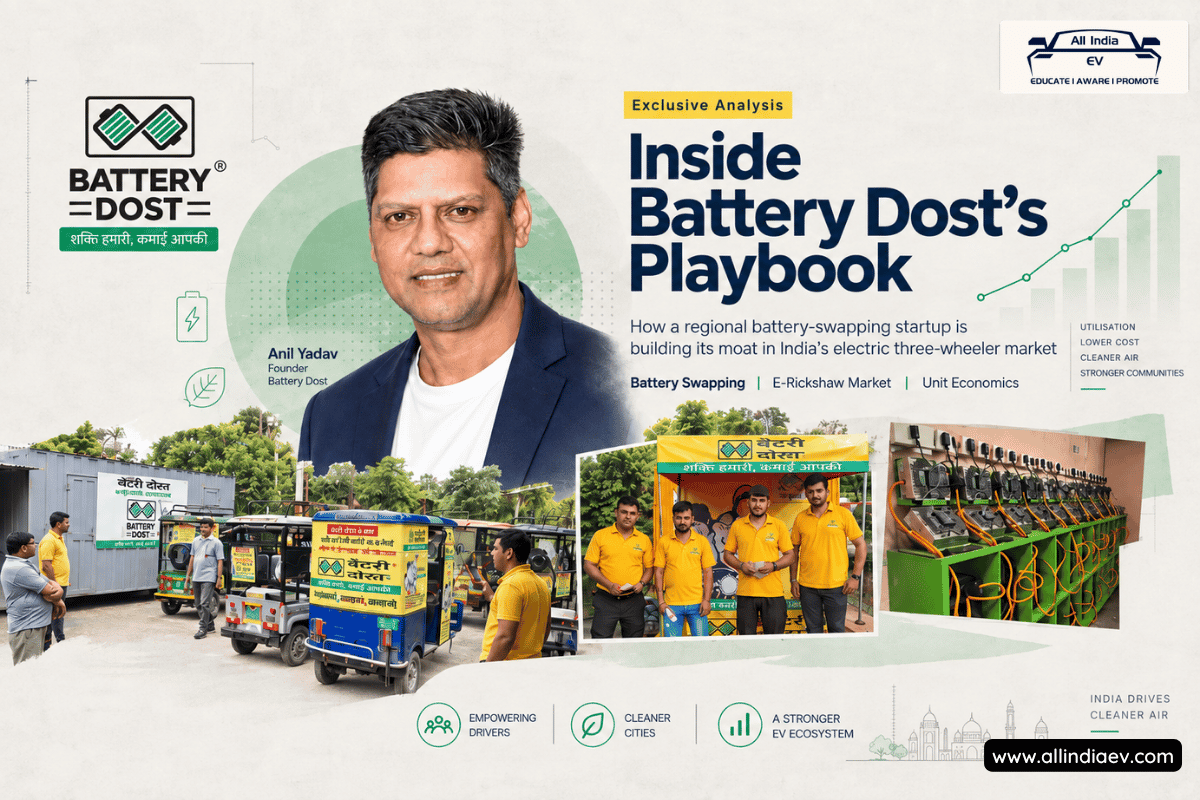
All India EV reached out to Battery Dost, a Chandigarh-headquartered battery-swapping and energy infrastructure startup, for a candid, numbers-first conversation on unit economics, ownership structures, safety, and how a regional player plans to hold its ground against national giants like Battery Smart and Sun Mobility.
Founded by Anil Yadav, Battery Dost is building more than swap cabinets, it is layering software on top of hardware to track battery health, optimise charging cycles, forecast demand, and squeeze more utilisation out of every pack in its network. Here’s the exchange, in full.
1. Unit Economics: Swap Pricing vs the Lead-Acid Benchmark
AIEV Q1: Battery swapping only wins long-term if the per-swap price beats a driver’s cost of running a fixed battery and home charging. We asked for current swap pricing, how it stacks up against the ~70 paise/km benchmark for fixed lead-acid setups, and what utilisation per battery per day a station needs to break even.
Battery Dost: The 70 p/km lead-acid figure is real but misleading, it’s cheap per kilometre and expensive per day, given the 8–10 hours of daily charging, 12–18 month replacement cycle, and heat-driven range collapse that come with it. Swapping runs higher on raw cost, at roughly ₹1.5/km, but buys back the hours a driver would otherwise lose to charging.
Battery Dost argues the correct comparison isn’t ₹/km at all, it’s net income per day, a metric on which swapping wins because the driver keeps earning. On break-even, the company’s formula is simple in principle: gross margin per swap, multiplied by daily swaps per pack, has to clear the station’s fixed cost, energy, battery amortisation and labour combined.
2. Battery Ownership and Capex
AIEV Q2: Who actually owns the batteries in the swap loop, Battery Dost, a financing partner, or a leasing NBFC, and how does that shape capex per station?
Battery Dost: Battery Dost laid out three possible structures. It can own the batteries outright, which carries the highest capex per station but keeps full margin and full control. It can route ownership through an NBFC or leasing partner, pulling batteries off the balance sheet and cutting per-station capex down to just the cabinet, installation and grid connection, though the lease rental compresses per-swap margin. Or it can run a hybrid model, owning the cabinets while a financing partner owns the cells.
The company was clear about its strategic preference: the financed, asset-light route is what lets hub count scale faster than a model that has to carry every battery on its own books.
3. The Chandigarh Power Advantage
AIEV Q3: Chandigarh UT has previously offered subsidised EV power connections to swap operators. Is Battery Dost currently operating under such a tariff or MoU with CREST or the UT Administration, and how much does it cut operating costs versus commercial rates?
Battery Dost: Energy makes up 30–50% of swap station operating costs, so the tariff a station pays is a direct lever on its economics. Battery Dost confirmed that access to a subsidised EV power connection, the kind Chandigarh UT and CREST have extended to swap operators, meaningfully lowers per-station energy cost compared with a station running on commercial rates, where the opex floor sits considerably higher. It’s a reminder that in swap infrastructure, local policy relationships can be as much of a moat as the technology itself.
4. Open Loop vs Closed Loop: The Compatibility Problem
AIEV Q4:The e-rickshaw swap market has no universal battery form-factor standard, unlike the 2W ecosystem where BBNL/ISO efforts are underway. How is Battery Dost handling compatibility across OEMs and retrofit kits, is this closed-loop (own hardware, own vehicles) or open to any retrofitted e-rickshaw?
Battery Dost: Unlike two-wheelers, where BIS and BBNL-led efforts are pushing toward a common form factor, three-wheeler batteries have no universal standard, every OEM and after-market retrofit kit is effectively its own island. Battery Dost has chosen to run closed-loop: its own pack specification, its own BMS, and a controlled retrofit process.
The company acknowledged the trade-off candidly, closed-loop gives safety, reliability and clean economics but caps how much of the market it can address to vehicles it has actually onboarded, whereas an open-loop system would maximise reach at the cost of inheriting safety and liability risk from unknown third-party kits.
Its stated position is to hold the closed-loop line for control today, while designing the architecture to open up if and when an industry-wide standard actually emerges.
5. Competing With Battery Smart and Sun Mobility
AIEV Q5: How does Battery Dost plan to compete with national-scale players like Battery Smart or Sun Mobility?
Battery Dost: The company’s answer was less about matching rivals station-for-station nationally, and more about reframing the contest: “a rider experiences the 2 km around them, not a national map.” Owning a geography completely, Battery Dost argues, beats a thin presence spread everywhere. It’s leaning on reliability and uptime, a driver-as-partner model, a Lease-to-Own path to battery ownership that it says larger rivals don’t offer, and local structural edges, like the CREST tariff arrangement, that outsiders can’t replicate quickly.
The plan, in short, is to win a beachhead market decisively and then expand outward from a position of strength rather than a position of coverage.
6. Degradation, Replacement Cadence and Safety
AIEV Q6: With batteries cycling through multiple drivers daily, what’s the degradation curve and replacement cadence per pack, and what safety/thermal monitoring is in place given lithium-ion fire risk concerns in India’s broader EV 2W/3W segment?
Battery Dost: Battery Dost’s stated preference is LFP chemistry for commercial three-wheeler use, citing its safety margin and higher cycle life over NMC, which it says demands far more aggressive thermal management to run safely at the same duty cycle.
On replacement, the company pointed to an industry-wide retirement trigger of roughly 70–80% State of Health, aligned with CMVR norms that mandate replacement below 70% SoH within warranty, after which packs are typically cascaded into second-life energy storage rather than scrapped.
On safety, it pointed to an IS 16046 / IEC 62133-compliant BMS design, cell-level thermal telemetry, over-temperature cutoffs, cabinet-level isolation and suppression systems, and IP65/67-rated enclosures. Given the fire incidents that have shadowed India’s broader EV two- and three-wheeler segment, Battery Dost was clear it sees this not as a defensive checkbox but as the actual trust-building proposition it has to sell to drivers, financiers and regulators alike.
The Takeaway
Battery Dost’s answers suggest a company that has made peace with not winning on scale first. Instead, it’s betting that ownership structure, local tariff relationships, chemistry discipline and regional density can compound into an economic moat that national players, spread thin across many markets, may struggle to match in any one city.
Whether that bet pays off will depend on how fast India’s e-rickshaw swap ecosystem moves toward the standardisation two-wheelers are already inching toward, and on whether “owning the two kilometres around the driver” scales beyond a single UT.