

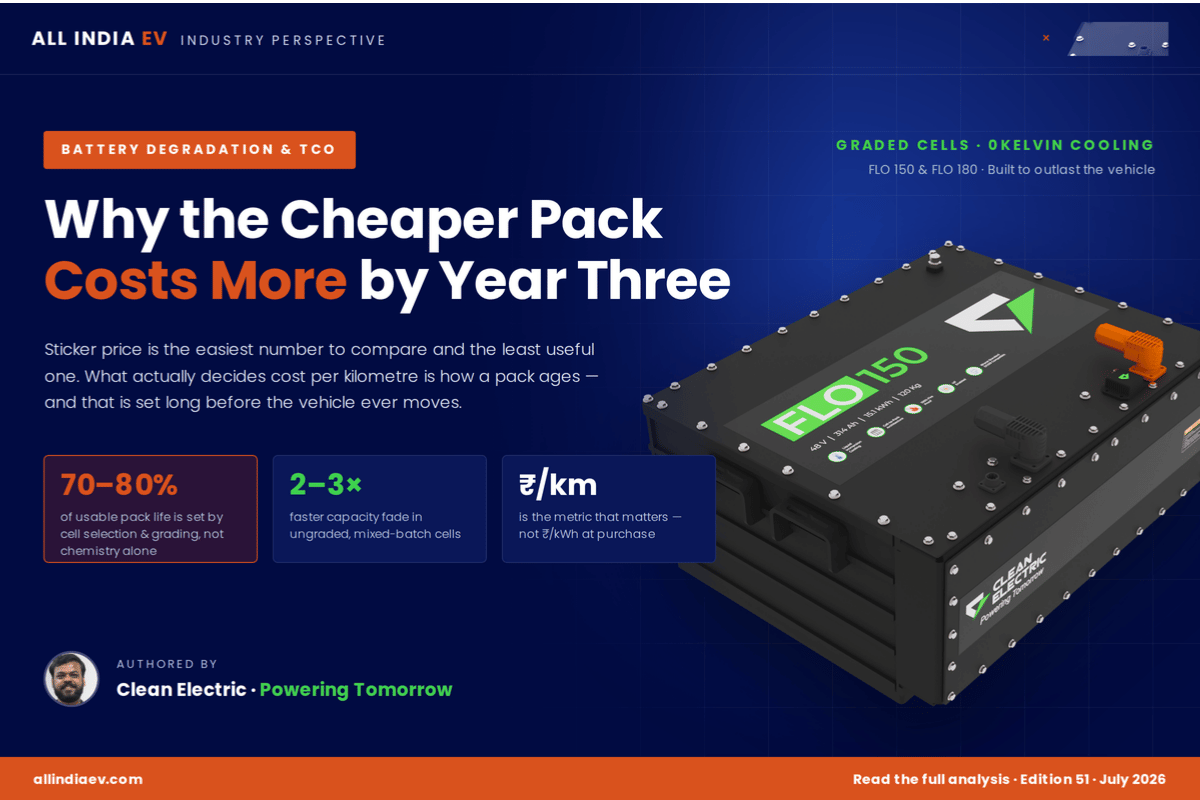
Sticker price is the easiest number to compare and the least useful one. What actually decides cost per kilometer is how a pack ages.
Two packs can leave the factory with the same kWh rating and the same price tag on a spec sheet and still deliver completely different economics three years later. The difference isn’t the chemistry printed on the datasheet. It’s everything that happens to the cells before, during, and after they’re built into a pack.
For an OEM buying at scale, that difference compounds. A pack that degrades faster doesn’t just lose range – it loses resale value, triggers early warranty claims, forces mid-life replacements, and quietly pushes up ₹/km on every vehicle it powers. The pack that looked 8-12% cheaper on day one can end up the more expensive one by year three.
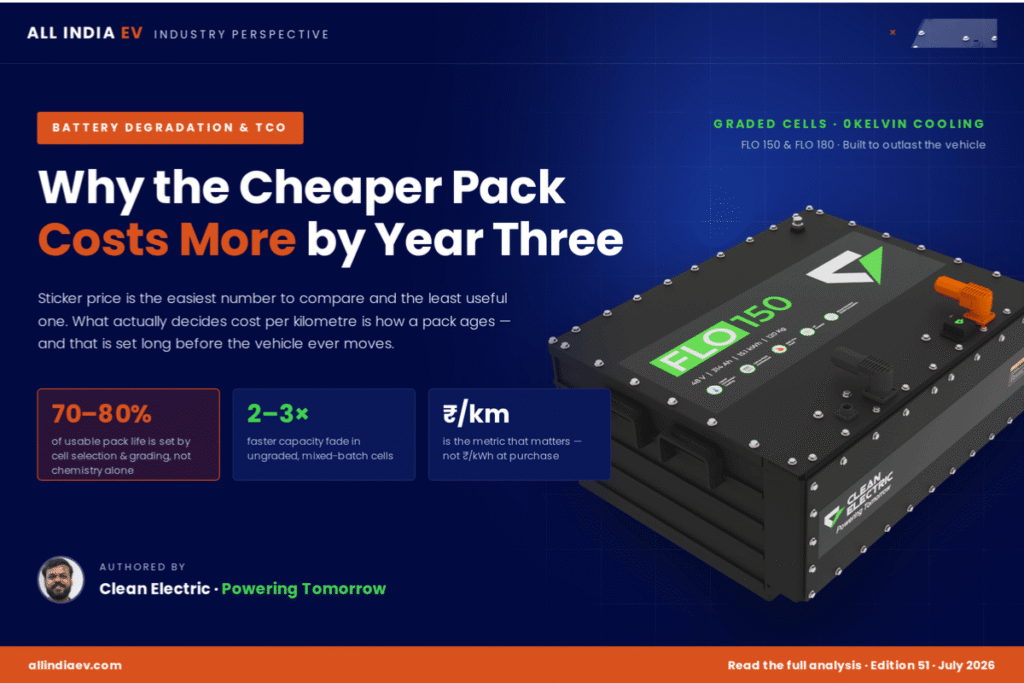
| 70-80% of usable pack life is determined by cell selection & grading, not chemistry alone | 2–3× faster capacity fade typical of ungraded / mixed-batch cells vs. matched, graded cells | ₹/km is the metric that matters – not ₹/kWh at purchase |
WHY PACKS DEGRADE UNEVENLY
The cell you can’t see on a spec sheet
Every cell coming off a gigafactory line has small variances in internal resistance, capacity, and self-discharge rate – even within the same batch. A pack builder has two choices: sort and match cells within tight tolerance bands before assembly, or skip that step to save time and cost.
Unsorted packs work fine on day one. The problem shows up at cycle 400, then accelerates. The weakest cell in a series string sets the ceiling for the whole pack – it hits full charge and empty discharge first, gets cycled harder than its neighbours, and drags the entire pack’s usable capacity down with it. This is the single biggest hidden driver of premature degradation, and it’s invisible on a spec sheet because both packs ship with an identical nameplate rating.
| The mechanism: in a series pack, capacity fade isn’t additive – it’s dictated by the worst-performing cell. One mismatched cell in a 96S string can cap real-world usable capacity 12-18% below nameplate within the first 500 cycles, well before the rest of the pack shows any wear. |
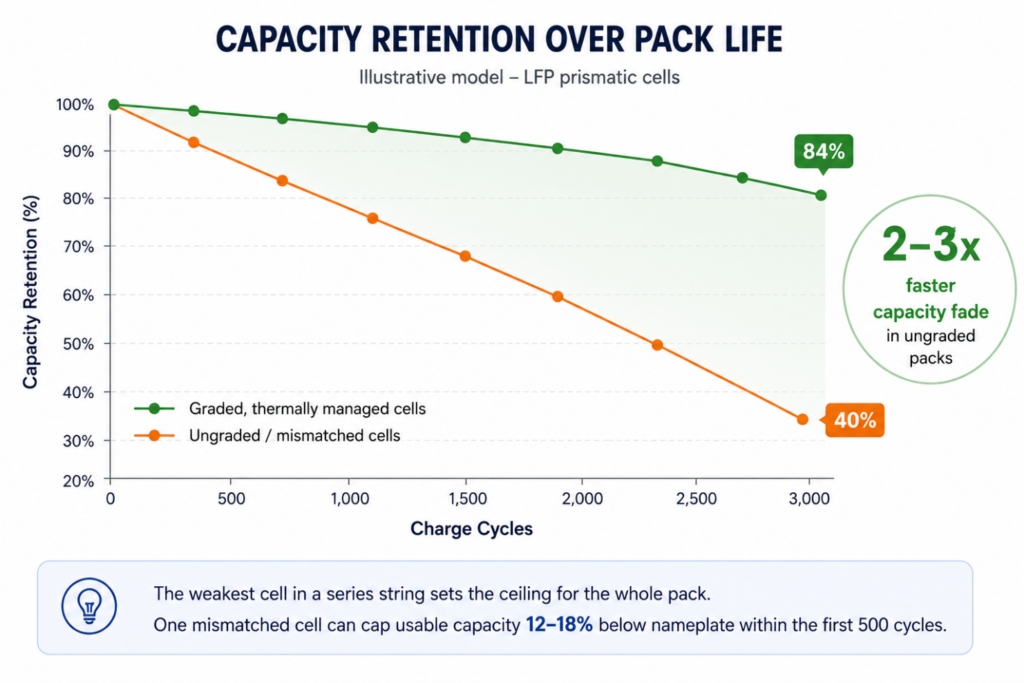
Fig. 1 — Illustrative capacity retention curve: graded, thermally managed cells vs. ungraded/mismatched cells (LFP prismatic cells).
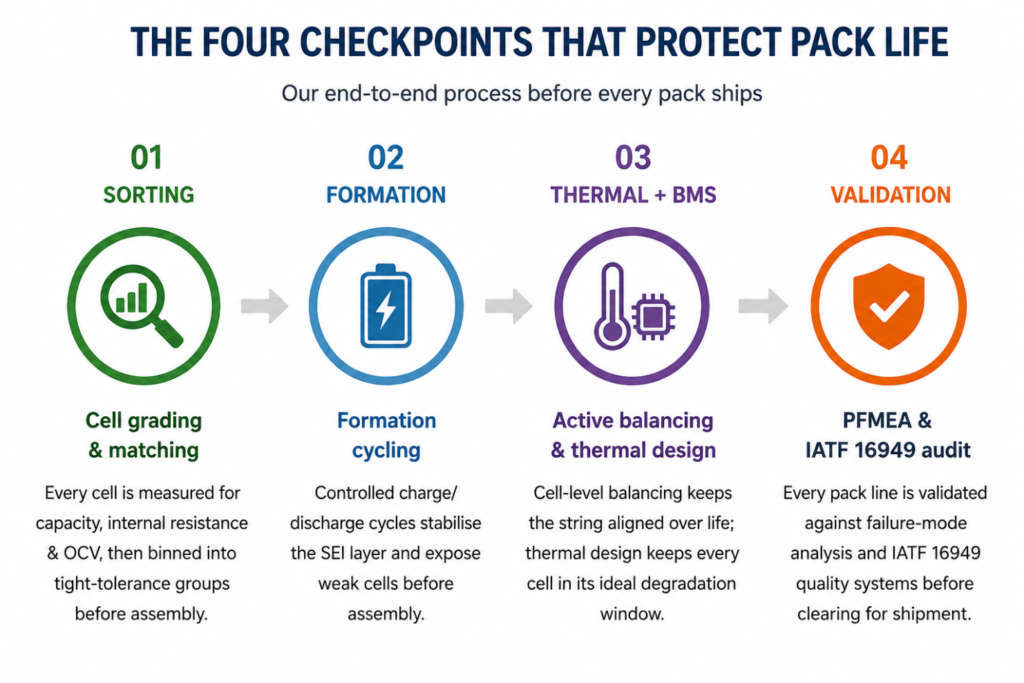
WHAT ACTUALLY PROTECTS PACK LIFE
The 0Kelvin difference
Step 3 above isn’t a generic claim – it’s built on Clean Electric’s patented immersion cooling technology, marketed under the 0Kelvin name. Every cell sits submerged in a circulating, non-flammable dielectric coolant instead of relying on air or a cold plate touching one face of the cell.
- 7-10× higher contact area than conventional cooling, for far superior heat rejection
- Temperature homogeneity across every cell in the pack which is precisely what prevents the “weakest cell drags the pack down” failure mode described above
- Rated for 3,000-4,000 cycles with strong capacity retention, in line with the graded-cell curve in Fig. 1
- Supports rapid charging (15-30 minutes) without the thermal stress that accelerates degradation
- Engineered so thermal propagation and fire are designed to be near-impossible, since the coolant’s high specific heat capacity absorbs and evenly dissipates heat before it can cascade
In other words: uniform cell temperature isn’t a comfort feature – it’s the mechanism that keeps a whole pack’s degradation curve close to its best cell instead of its worst one. Full technical detail: cleanelectric.in/technologies-immersioncooling
THE REAL MATH
Purchase price vs. cost of ownership
Model this on a typical L5 3W deployment doing 100-120 km/day. A pack priced 10% below market often gets there by skipping grading and thermal design and that shows up as a steeper degradation curve, an early capacity-linked replacement, and downtime that idles a revenue-generating vehicle.
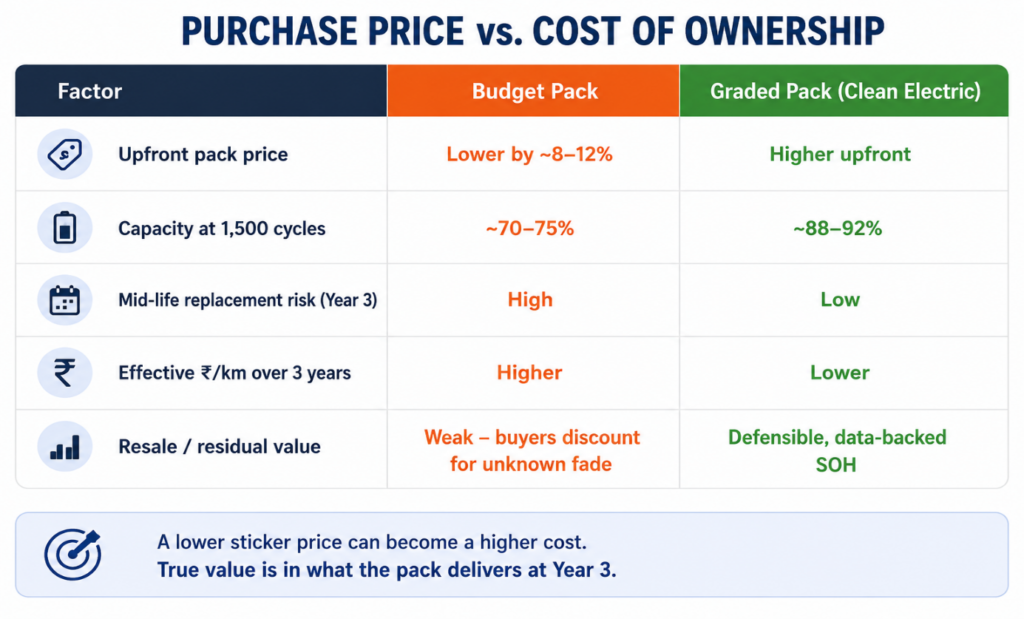
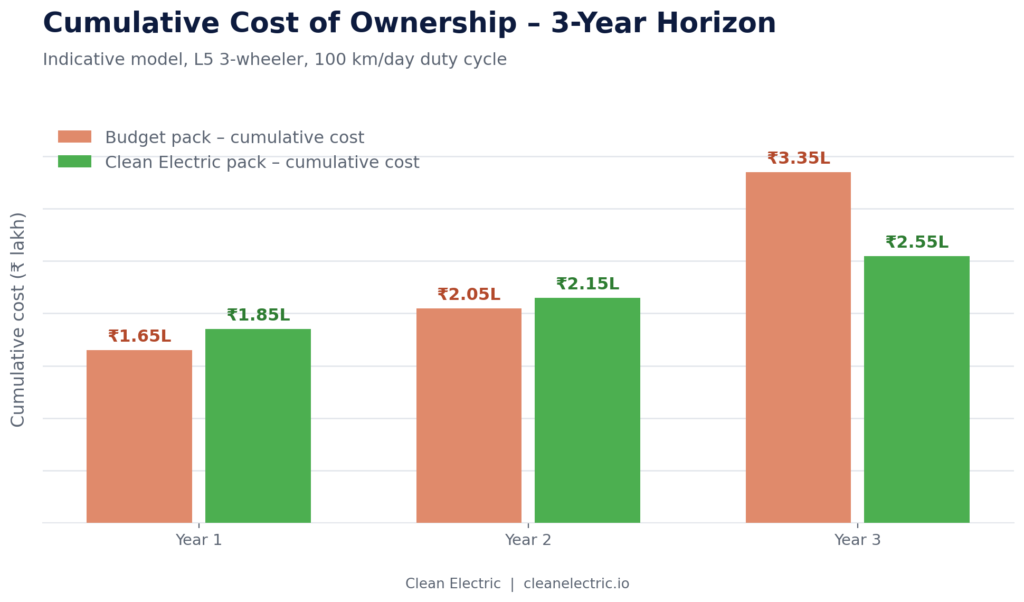
Fig. 2- Indicative cumulative cost of ownership over 3 years, L5 3-wheeler, 100 km/day duty cycle. Actual figures vary by route, load, and charging discipline.
WHAT THIS MEANS FOR YOU
A quote is a promise about year three and beyond, not just day one
When you’re evaluating a pack supplier for a 3W platform, 4W or a bus programme deployment the question worth asking isn’t “what’s the ₹/kWh?” It’s: how are cells graded, how is the pack thermally managed, and can the supplier show you a real capacity-retention curve, not just a datasheet number.
That’s the conversation we have with every OEM and customer before a single pack ships.