

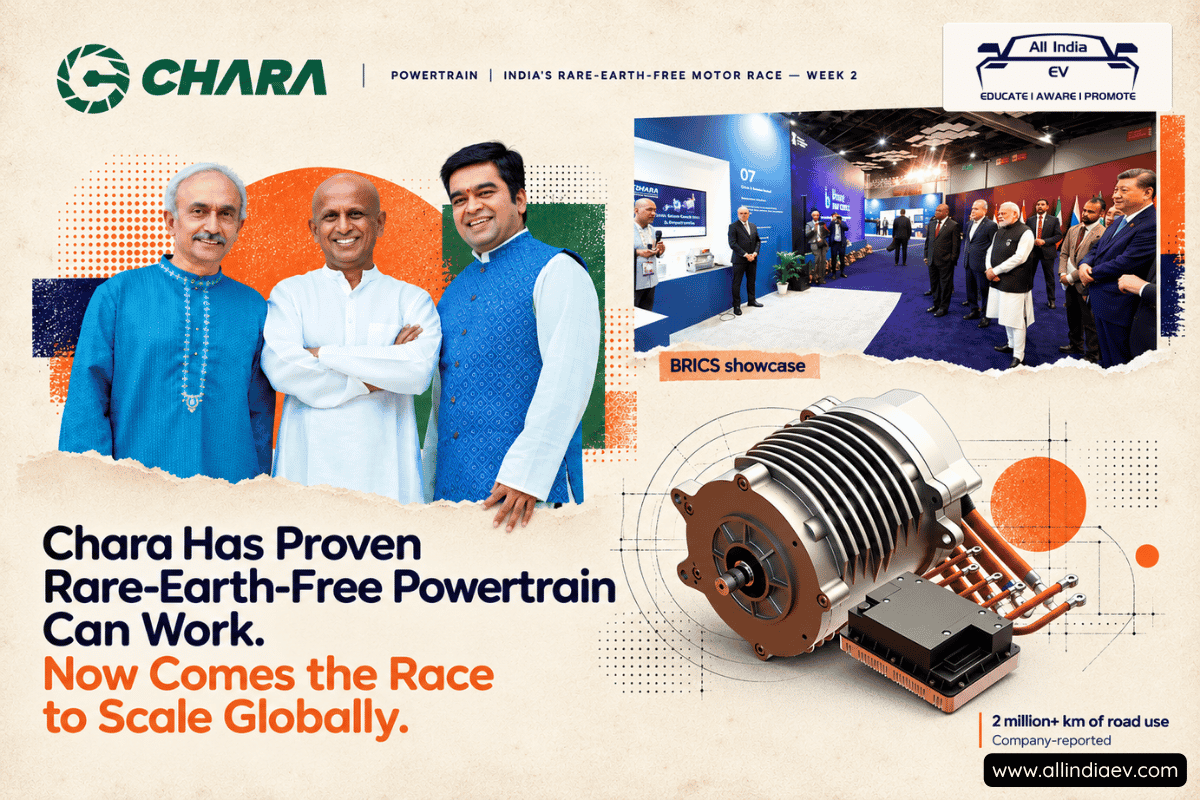
AIEV Powertrain | India’s Rare-Earth-Free Motor Race — Week 2
India’s dependence on rare-earth magnets has created an uncomfortable contradiction in its EV localisation strategy.
- Chara Technologies: The Numbers
- The Architecture: Removing Rare Earths Changes the Motor Physics
- The Motor Is Only Half the Technology
- How Close Is Chara to PMSM Performance?
- Chara SynRM vs Conventional PMSM
- The Economics: Can Removing Magnets Actually Make the Motor Cheaper?
- The economic equation is roughly:
- Commercial Validation Is Becoming More Important Than Dyno Performance
- What Chara has already demonstrated
- What still needs to be demonstrated
- Greaves Could Be Chara’s Shortcut to Scale
- Chara Is Also Expanding Its Own Manufacturing
- Localisation Could Become Chara’s Strategic Advantage
- The Market Chara Should Win First
- What This Means
An electric vehicle may be assembled in India, its battery pack may increasingly be manufactured locally, and its electronics may carry a growing domestic content. Yet one of the most critical parts of its propulsion system—the high-performance permanent magnets inside the motor—can still expose the manufacturer to an internationally concentrated supply chain.
Bengaluru-based Chara Technologies is attacking that dependency at the motor architecture level.
Rather than attempting to localise the same rare-earth-dependent Permanent Magnet Synchronous Motor, or PMSM, Chara has spent several years developing synchronous-reluctance-based motors, integrated controllers and proprietary control software that can deliver traction without relying on rare-earth magnets.
The proposition has now been deployed commercially for over years,moving substantially beyond the laboratory.
Chara says its technology has accumulated more than 2 million kilometres of road use, reached 70+ customers across India and Europe, been commercially deployed for more than two years and achieved ARAI and ICAT certification. Those are company-reported figures, but they illustrate how far the programme has moved from its earlier prototype stage.
The harder question is now different:
Can Chara make rare-earth-free propulsion competitive with PMSM not only technologically, but in cost, weight, reliability and mass-production economics?
Chara Technologies: The Numbers
| Metric | Current position |
| Founded | 2019 |
| Core technology | Synchronous Reluctance Motor systems |
| Current architecture description | SynRM / ferrite-assisted SynRM depending on programme |
| Rare-earth magnets | None |
| Listed mobility peak-power range | Approx. 8 kW–35 kW across standard products |
| Listed peak motor efficiency | 91%–94% |
| Listed controller efficiency | 97%–97.5% |
| Voltage range of listed mobility systems | 48V–400V |
| Current customers | 70+ in India and Europe, company-reported |
| Reported road validation | 2 million+ km |
| Existing manufacturing capacity | Roughly 25,000 systems/year |
| Planned capacity | 100,000 units/year |
| Latest major funding | ₹52 crore Series A, October 2025 |
| Major industrial partnership | Greaves Cotton |
| Applications | 2W, 3W, agricultural, industrial, off-highway and other mobility platforms |
Chara’s current product catalogue, funding disclosures and recent company communications show a company moving from commercial deployment to large-scale mass production..
The Architecture: Removing Rare Earths Changes the Motor Physics
Most high-performance EV powertrains today rely on Permanent Magnet Synchronous Motors.
PMSMs are popular for good reasons:
- High torque density
- Excellent power density
- Strong low-speed torque
- High peak efficiency
- Compact packaging
But much of that performance comes from high-strength permanent magnets, particularly neodymium-based magnets.
Chara takes a fundamentally different approach.
Its core technology is based on the Synchronous Reluctance Motor, or SynRM. Instead of using a permanent magnetic field generated by the rotor, the motor produces torque by exploiting differences in magnetic reluctance created by the rotor geometry.
The company’s public technology material describes a rotor built using specially designed layers of electrical-steel laminations that create magnetic flux paths. Because the rotor does not require current-carrying windings, rotor electrical losses can also be reduced.
But there is an important technical nuance.
Chara’s own technology page describes a SynRM architecture that eliminates permanent magnets, while Greaves Cotton’s current description of the technology it licensed from Chara calls it a ferrite-magnet-based SynRM. Chara founder Bhaktha Keshavachar has also recently described the company’s propulsion system as a ferrite-assisted synchronous reluctance architecture.
Ferrite magnets are permanent magnets—but they do not contain rare-earth elements.
Therefore, the most accurate umbrella description of Chara’s current technology is: Rare-earth-free propulsion rather than assuming every Chara architecture is completely magnet-free.
That distinction will become increasingly important as the technology reaches larger OEM programmes.
Where Chara’s Current Motor Portfolio Sits
Chara’s standard mobility portfolio gives a clearer picture of where the company is currently strongest.
| System | Peak power | Peak torque | Weight | Peak motor efficiency | Target applications |
| SYRGG | 5.5–8 kW | Up to 26 Nm | 9 kg | 91–92% | Medium-speed scooters, low-power 3W, agricultural |
| SYRAH | 7.5–9 kW | 35 Nm | 14 kg | 92% | High-speed scooters, motorcycles, passenger 3W |
| SYRTT | 7-10 kW | 45 Nm | 16 kg | 93% | Motorcycles, passenger 3W, golf carts, forklifts |
| SYRTW | 11–14 kW | 65 Nm | 24 kg | 94% | Cargo 3W, motorcycles,golf carts and agricultural vehicles |
| SYRSH | – 17- 28 kW | 90 Nm | 32 kg | 93.5% | Hybrid carsand off highway applications |
| SYRND | 30kW | 120 Nm | 47 kg | 92% | Higher-load mobility and agricultural applications |
Source: Chara Technologies’ currently published product specifications.
The portfolio reveals something important.
Chara is not currently trying to beat a 200 kW passenger-car PMSM.
Its strongest go-to-market opportunity today sits in low- and medium-power propulsion, where purchase cost, localisation, durability and supply security are critical to OEMs.
That makes three-wheelers, agricultural machines, industrial vehicles and selected two-wheelers logical entry markets.
The company is also developing 50–150kW passenger-car motors, with deployment planned for mid-next year.
This creates a pathway from proven applications today to higher-power segments as the technology and manufacturing platform scales.
The Motor Is Only Half the Technology
One of the most important parts of Chara’s technology may not be visible from outside the vehicle.
It is the controller software.
Reluctance motors have existed for decades. Their historic disadvantages include:
- Torque ripple
- Acoustic noise
- Complex nonlinear magnetic behaviour
- More demanding control requirements
- Difficulty achieving PMSM-like refinement across the operating range
Modern power electronics and computational control have changed that equation.
Chara develops the motor, controller and Drive Control Firmware together. Its control algorithms manage torque, efficiency, thermal behaviour and motor response while also attempting to reduce the characteristics that historically made reluctance motors less suitable for refined automotive applications.
This integrated architecture is strategically important.
Rather than selling a commodity motor, Chara is effectively attempting to own a larger portion of the propulsion IP stack:
Electromagnetics → Rotor design → Mechanical design → Controller hardware → Motor-control algorithms → Vehicle calibration
That creates a potentially stronger moat than simply manufacturing another motor design.
.
Beyond cost volatility & supply-chain security, Chara’s technology taps into a compelling climate tech narrative. With every ton of rare-earth mining generating approximately 2,000 tons of toxic and frequently radioactive waste, the environmental toll is severe. This dynamic offers a natural entry point with OEMs driven by corporate sustainability mandates and decarbonisation goals.
How Close Is Chara to PMSM Performance?
This is the central engineering question.
Chara’s listed motors report peak efficiencies between 91% and 94%, while its controllers operate at approximately 97% to 97.5% peak efficiency.
Founder Bhaktha Keshavachar has argued that the technology can match PMSM performance on torque and power while delivering superior drive cycle efficiency, thereby yielding a 10–15% increase in range.
The trade-off is physical size and mass.
In a recent comparison discussed by Keshavachar, Chara’s motor was described as typically around 5-10 5% heavier than a comparable PMSM because removing high-strength rare-earth magnets requires additional electrical steel and copper. For a representative three-wheeler application, the comparison cited was approximately 16 kg for Chara’s motor versus 15 kg for a comparable PMSM. However, the additional motor weight needs to be considered alongside system-level efficiency. If Chara’s motor delivers 10–15% higher efficiency in the relevant drive cycle, the same battery pack can deliver more usable energy to the wheels, providing higher vehicle range despite the additional motor mass.
Chara SynRM vs Conventional PMSM
| Parameter | Chara rare-earth-free approach | Conventional PMSM |
| Rare-earth dependence | None | Usually significant |
| Rotor materials | Electrical steel; architecture may use ferrite assistance | High-strength permanent magnets |
| Peak efficiency | 91–94% in listed Chara systems | 91-94% |
| Drive Cycle Efficiency | Chara achieved better efficiency vs PMSM giving 10-15% higher range | Lower due to hysteresis losses |
| Motor weight | Around 5-10 % % higher, according to Chara | Lower for equivalent performance |
| Magnet demagnetisation risk | Very low/no rare-earth magnet exposure | Present |
| Supply-chain concentration | Lower | Higher rare-earth exposure |
| Motor-control complexity | Higher | Mature and widely understood |
| Material cost structure | More steel/copper, no rare-earth magnets | Magnet cost can be significant (40% of total cost) |
| Automotive maturity | Developing | Highly mature |
| High-performance passenger cars | Still challenging | Strong fit |
| 3W/off-highway/industrial fit | Potentially strong | Strong |
The opportunity is not about replacing every PMSM application. Different motor architectures will continue to serve different engineering requirements.
Chara’s opportunity is to make rare-earth-free propulsion commercially viable where material security, localisation, cost and efficiency matter.
By eliminating rare-earth magnets, Chara’s architecture offers OEMs a different path to sustainable high-performance electric propulsion, with greater control over the underlying supply chain.
If this can be delivered at scale, the significance extends beyond one motor technology: it gives India the ability to build a globally competitive EV powertrain supply chain with far less dependence on critical minerals.
The Economics: Can Removing Magnets Actually Make the Motor Cheaper?
This is where Chara’s proposition becomes commercially interesting.
Keshavachar has previously estimated that rare-earth magnets can account for roughly 40% of the cost of a comparable PMSM motor in some applications.
Removing those magnets does not translate directly into a 40% cheaper motor because Chara must compensate with additional steel, copper and more sophisticated control.
The company’s more conservative public estimates suggest approximately 15% cost advantage today in some applications, with 15–20% lower cost potentially achievable at scale. These are management estimates rather than independently verified industry cost benchmarks.
That distinction matters.
The economic equation is roughly:
Savings
- No neodymium-based rare-earth magnets
- Reduced exposure to magnet price volatility
- Higher domestic-material sourcing potential
- Lower geopolitical supply-chain exposure
- Software costs spread over increasing production volume
Additional costs/trade-offs
- More electrical steel
- More copper
- Slightly larger/heavier motor in some applications
- More sophisticated controls
- Lower manufacturing maturity compared with established PMSM supply chains
Therefore Chara’s cost advantage will ultimately be determined by production volume, not only by the motor design.
Commercial Validation Is Becoming More Important Than Dyno Performance
A startup can demonstrate efficiency on a motor test bench relatively quickly. Automotive credibility takes years.
Chara reported around 75 customers in testing, homologation or commercial engagement in early 2026, with companies including VST, Greaves and MultiplexEVnamed publicly. Some customers had progressed from initial quantities of three to five systems toward orders of 500–1,000 motors.
More recently, Chara has described its base as 70+ customers across India and Europe and claimed more than 2 million kilometres of accumulated road deployment.
One of the strongest visible field validations comes from MultiplexEV, formerly Bullwork Mobility.
MultiplexEv has used Chara powertrains in tractors, loaders and agricultural equipment since early 2025. Chara says a skid-steer application has accumulated 4,000+ operating hours, while other MultiplexEV platforms use multiple synchronised Chara motors and controllers.
What Chara has already demonstrated
- Motor technology beyond prototype stage
- Commercial deployment
- Homologation activity
- More than one vehicle/application class
- Significant off-highway field operation
- Automotive certifications
- Customer orders moving beyond sample quantities
- Domestic manufacturing capability
- Tier-1 manufacturing partnership
What still needs to be demonstrated
- High-volume passenger EV deployment
- Multi-year durability at automotive scale
- Six-figure annual production quality
- Consistent cost advantage after OEM procurement
- Lower weight/power-density gap versus PMSM
- Large established OEM adoption
- Warranty performance across tens of thousands of vehicles
Greaves Could Be Chara’s Shortcut to Scale
In April 2025, Greaves Cotton and Chara Technologies announced a partnership to manufacture rare-earth-free synchronous-reluctance motor systems for mobility and non-mobility applications.
Greaves subsequently disclosed that it had licensed Chara’s ferrite-magnet-based SynRM technology. This potentially solves a major weakness faced by almost every deep-tech startup: manufacturing credibility.
Large OEMs don’t only ask whether a motor works.
They ask:
- Can the supplier manufacture tens of thousands consistently?
- Can it maintain automotive-grade quality?
- Can it support warranty claims?
- Can production survive demand fluctuations?
- Can the supplier support a vehicle platform for 7–10 years?
An established industrial company such as Greaves can provide scale, manufacturing infrastructure and supplier credibility that would take Chara years and substantial capital to reproduce independently.
However, Greaves said in August 2025 that the programme was still in the development and incubation stage at that point and had not yet materially contributed commercially.
The partnership therefore remains an important indicator of industrial confidence—but production volumes will ultimately matter more than the announcement.
Chara Is Also Expanding Its Own Manufacturing
Chara currently operates manufacturing in Bengaluru’s Peenya area.
At the beginning of 2026, management described capacity of approximately 2,000 motors per month, or around 25,000 annually.
Its October 2025 ₹52 crore Series A, led by Arkam Ventures with participation from Exfinity Venture Partners, Kalaari Capital and IIMA Ventures, was intended partly to finance a larger factory and testing facility capable of increasing capacity toward 100,000 units annually.
Its funding journey also shows how the company has moved from R&D toward industrialisation:
| Period | Funding | Purpose/evolution |
| 2021 | $850,000 seed | Early technology development |
| 2023 | $4.75 million pre-Series A | Team, product development, manufacturing and deployment |
| 2025 | ₹52 crore / ~$6 million Series A | New factory, testing and scale-up toward 100,000 units/year |
The 2021 and 2023 rounds included investors such as Kalaari Capital, CIIE/IIMA Ventures, Exfinity Venture Partners, and Big Capital .
The capital requirement has therefore shifted.
Earlier funding answered: Can the technology be built?
The current capital is increasingly answering: Can it be manufactured repeatedly and economically?
Localisation Could Become Chara’s Strategic Advantage
The localisation argument extends beyond price.
A rare-earth-free architecture substitutes a strategically concentrated material with a combination of electrical steel, copper, aluminium, ferrite materials, electronics and software.
The entire mechanical motor BOM is sourceable in India. .
Power semiconductors and certain electronic components inside the inverter/controller remain part of an international electronics supply chain, so the e-powertrain cannot yet be called completely supply-chain independent.
But the nature of the dependency changes.
Instead of depending on one particularly concentrated permanent-magnet supply chain, sourcing can potentially be spread across a larger ecosystem of materials and electronic components.
For Indian OEMs, this can become an important form of supply-chain insurance.
The Market Chara Should Win First
The data suggests Chara does not need to displace PMSMs across the entire EV industry to build a significant business. Its immediate addressable opportunities are applications which are cost sensitive and open for technology adoption. :
- Electric three-wheelers
- Agricultural machinery
- Tractors
- Forklifts
- Construction equipment
- Industrial vehicles
- Campus vehicles
- Utility EVs
- Selected electric motorcycles and scooters
A 1-2 kg motor-weight difference inside a roughly 750 kg three-wheeler has a very different consequence than the same percentage penalty inside a performance-oriented electric motorcycle.
This is why application selection matters as the technology scales. Chara has also indicated that its next-generation powertrains are being developed to match the weight of comparable PMSM systems, with market deployment expected soon.
The opportunity, therefore, is to expand the advantages of a rare-earth-free architecture across an increasingly broad range of EV applications.
What This Means
Chara Technologies has now crossed an important line in India’s rare-earth-free motor story.
This is no longer simply: Can India develop an EV motor without rare-earth magnets?
Chara has motors, controllers, certifications, manufacturing, customers and traction.
The question has become: Can the technology survive mass-production economics?
The business case is compelling on paper.
Eliminating rare-earth magnets reduces one of the most geopolitically concentrated inputs in an EV drivetrain. Chara’s published motors are already operating at 91–94% peak efficiency, commercial systems are in vehicles, the company reports 2 million+ kilometres of road experience, and manufacturing capacity is targeted to rise toward 100,000 units annually.
The question now is scale.
Can this architecture move from hundreds and thousands of vehicles to tens of thousands and eventually hundreds of thousands, while maintaining performance, manufacturing quality and compelling economics?
Chara has already crossed the line from technology to commercial deployment.
The next step is industrial adoption. The next milestone hence will not be another prototype. It will be a major OEM committing to tens of thousands of Chara-powered vehicles.
If that happens, India’s rare-earth-free motor race will move from a technology breakthrough to an industrial transition.