

DRIVN has become a leading name in India’s 2026 commercial EV market through partnerships and scalable finance.
Additionally, during 2026, DRIVN has managed to put itself repeatedly into the Indian commercial EV conversation.
- DRIVN has become a leading name in India’s 2026 commercial EV market through partnerships and scalable finance.
- 1. First, Understand the Market DRIVN Has Chosen
- India’s truck electrification problem in numbers
- 2. DRIVN Is Effectively Trying to Convert CAPEX Into OPEX
- 3. The DRIVN Partnership Stack
- Publicly disclosed DRIVN relationships reviewed by All India EV Intelligence
- 4. DRIVN Does Not Have a Publicly Confirmed 2,000+ Vehicle Fleet
- 5. The Counterparty View: Why Would These Companies Choose DRIVN?
- What the other side potentially gets
- 6. DRIVN’s Real Product Is Risk Allocation
- The risks inside one DRIVN lease
- 7. Nomura Is the Most Important Partnership in the Entire Structure
- First, DRIVN is not trying to finance an asset-heavy business entirely through venture equity.
- Second, institutional lenders are willing to underwrite at least part of the model.
- Third, DRIVN’s competitive advantage may ultimately become its cost of capital.
- 8. A $140 Million Question
- 9. What Has Actually Reached the Execution Stage?
- AIEV execution tracker
- 10. The EIM Agreement Is Potentially More Important Than Its 1,000-Truck Headline
- 11. JBM + Prasanna Purple May Show How DRIVN’s Bus Architecture Fits Together
- 12. The Bull Case for DRIVN
- 1. DRIVN is attacking a genuine bottleneck
- 2. The company has attracted institutional capital unusually early
- 3. It is building both supply and demand relationships
- 4. Heavy commercial EVs could become an information-rich financing business
- 5. The company is targeting high-utilization use cases
- 13. The Bear Case Is Equally Important
- 1. Asset-heavy growth consumes enormous capital
- 2. Cost of capital can destroy otherwise attractive TCO
- 3. DRIVN owns risks its customers avoid
- 4. India’s secondary market for heavy EVs remains immature
- 5. MoU conversion risk is substantial
- 6. Counterparty concentration can become dangerous
- 14. What We Would Ask DRIVN Before Making an Investment Decision
- Fleet and deployment
- Capital
- Contracts
- Battery and residual value
- Operations
- 15. The DRIVN Investor Scorecard Today
- 16. What DRIVN Must Prove Over the Next 12 Months
- 17. All India EV View
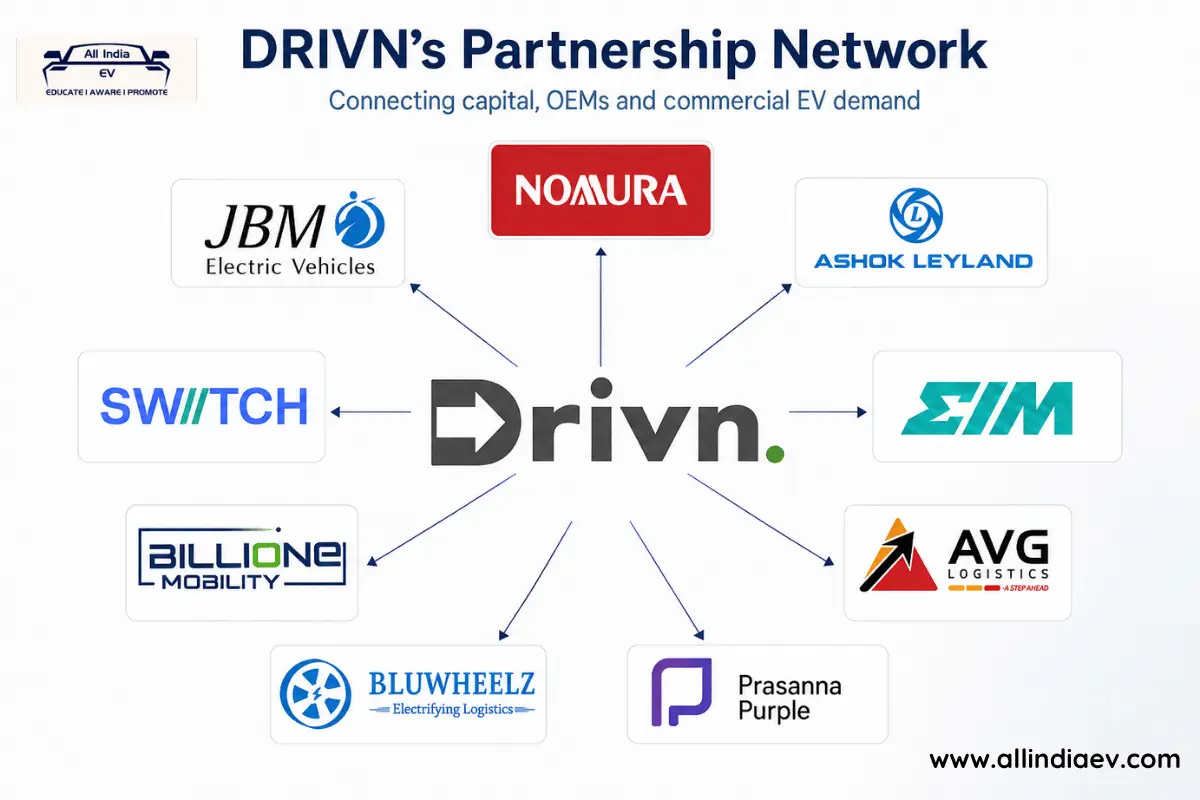
There is Nomura on the capital side. Energy in Motion and JBM Electric Vehicles on the vehicle-supply side. BluWheelz and BillionE Mobility on electric freight. Prasanna Purple on intercity buses. Switch Mobility on EV leasing. Beyond these formal announcements, DRIVN actively collaborates with a broader ecosystem of vehicle manufacturers and charging companies.
For a company founded only in 2025, that is an unusually fast accumulation of ecosystem relationships.
Additionally, DRIVN describes itself as an asset-owning commercial EV platform.
It buys and leases electric buses and trucks under long-term arrangements, not just arranging vehicle finance.
That naturally creates an attractive headline.
But headlines are not the same thing as execution.
However, the question All India EV Intelligence wants to examine is more uncomfortable:
Can DRIVN deliver what the partnership announcements appear to promise, or could the public narrative grow substantially faster than the operating fleet underneath it?
There is also a second question that deserves equal attention. Instead of looking only at why DRIVN wants these partnerships, we should look from the other side of the table.
Why would Nomura finance DRIVN? Why would an OEM such as JBM or Energy in Motion want DRIVN between itself and the operator? Why would fleet operators such as BluWheelz, BillionE or Prasanna Purple choose to lease instead of buying the vehicles themselves?
When viewed from that perspective, DRIVN starts looking less like another EV leasing startup and more like an experiment in reorganizing who owns the asset, who supplies the capital, who operates the vehicle and who ultimately carries the risk.
This report uses publicly available information reviewed through August 2026. It distinguishes formal MoUs and disclosed partnerships from reported ecosystem relationships and, importantly, does not treat announced vehicle numbers as deployed fleet.
1. First, Understand the Market DRIVN Has Chosen
DRIVN is not targeting the easiest part of India’s EV market.
Electric two-wheelers and three-wheelers have already demonstrated meaningful commercial adoption. Heavy trucks are almost the opposite.
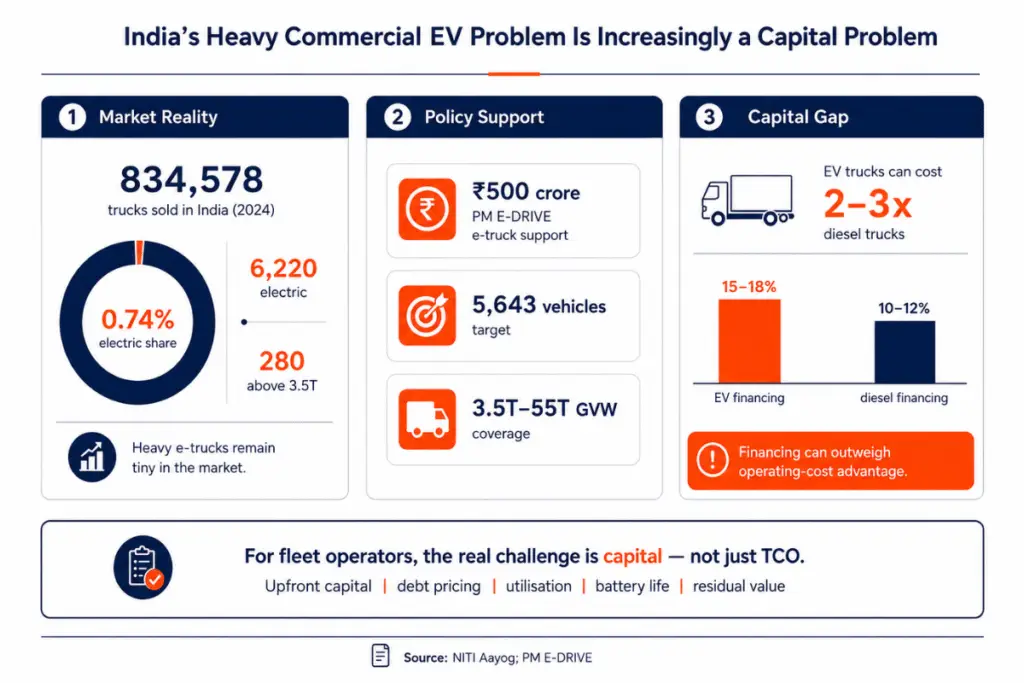
Of the 834,578 trucks sold in India during 2024, only 6,220 were electric, implying penetration of roughly 0.7%. More importantly, 5,940 of those electric trucks were below 3.5 tonnes. Only 280 electric trucks above 3.5 tonnes were sold during the year. These heavier vehicles are the categories relevant to medium- and long-haul freight, where DRIVN is concentrating much of its effort.
India’s truck electrification problem in numbers
| Indicator | Data |
|---|---|
| Total trucks sold in India, 2024 | 834,578 |
| Electric trucks sold | 6,220 |
| Approx. e-truck penetration | 0.7% |
| Electric trucks below 3.5T | 5,940 |
| Electric trucks above 3.5T | 280 |
| PM E-DRIVE e-truck target | 5,643 vehicles |
| PM E-DRIVE allocation for e-trucks | ₹500 crore |
| Eligible PM E-DRIVE truck categories | 3.5T–55T GVW |
Sources: NITI Aayog analysis reported by Indian Express and Mint; PM E-DRIVE.
The government has recognized the problem. PM E-DRIVE now provides ₹500 crore for supporting 5,643 e-trucks in the N2 and N3 categories, covering vehicles from 3.5 tonnes to 55 tonnes GVW. Yet the scheme dashboard itself illustrates how early this market remains. As of late July 2026, the PM E-DRIVE dashboard showed only 55 buyer IDs generated for e-trucks against the scheme target of 5,643 vehicles.
The obstacle is not simply whether electric trucks work.
It is whether someone can finance them economically.
NITI Aayog’s latest climate-financing work notes that electric trucks can cost approximately 2–3 times comparable diesel trucks, while financing rates can reach roughly 15–18%, compared with about 10–12% for diesel, because financiers price in technology and resale-value uncertainty.
That creates the gap DRIVN wants to occupy.
2. DRIVN Is Effectively Trying to Convert CAPEX Into OPEX
A fleet operator buying an electric heavy truck faces several DRIVN challenges.
Additionally, these problems must be addressed concurrently.
- significantly higher upfront acquisition cost;
- potentially higher cost of debt;
- uncertain battery degradation;
- uncertain resale and residual value;
- route-specific charging requirements;
- technology-obsolescence risk;
- maintenance and uptime requirements;
- potentially long payback periods;
- uncertainty around whether the vehicle can be redeployed if the original logistics contract ends.
However, DRIVN proposes to keep much of that risk away from the operator’s balance sheet.
The company says it offers long-tenure operating leases and flexible payment structures. It also provides buyback or residual-value structuring and full lifecycle support. Moreover, DRIVN also explicitly states that battery, residual-value and technology risks can be transferred away from the fleet customer.
This is broadly consistent with NITI Aayog’s DRIVN-aligned recommendations for difficult-to-electrify commercial segments. Moreover, its 2025 EV strategy recommends shifting capital costs toward operating costs.
It also calls for nurturing truck and bus leasing so smaller operators access expensive electric vehicles without full burden.
In other words, DRIVN is entering a market where public policy is increasingly acknowledging the exact structural problem its business model claims to solve. That does not prove DRIVN will succeed.It does explain why the timing makes sense.
3. The DRIVN Partnership Stack
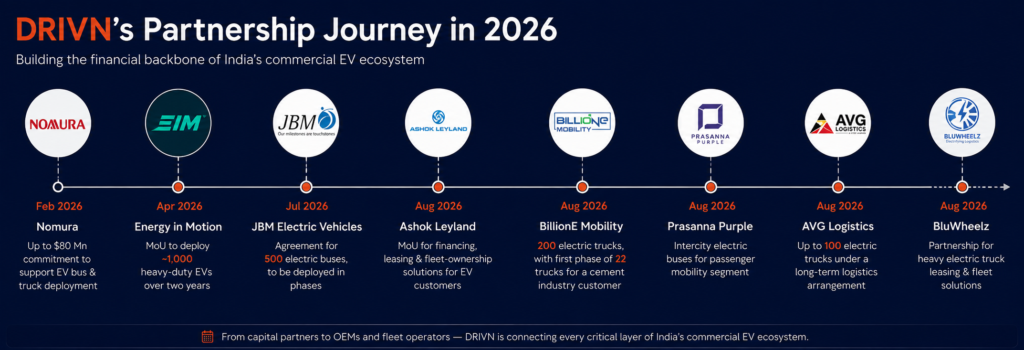
The best way to understand DRIVN is not to count announcements chronologically. It is to position each relationship inside the commercial EV transaction.
Publicly disclosed DRIVN relationships reviewed by All India EV Intelligence
| Partner | Role in ecosystem | Publicly disclosed scale | Structure/status | What has been disclosed on execution |
| Nomura | Institutional capital | Up to $80 million | Financing commitment; mainly senior secured debt plus equity component | Phase 1 targets ~1,000 buses/trucks by Q4 FY27 |
| Energy in Motion | Heavy e-truck OEM + energy | ~1,000 trucks | MoU over two years | Deployment planned through DRIVN customer network |
| BluWheelz | Heavy-freight operator | 300 trucks, 19T+ | Long-term leasing MoU | Planned over 12 months |
| BillionE Mobility | Freight operator / e-Mobility-as-a-Service | 200 trucks | Strategic leasing/deployment partnership | First 22 trucks identified under long-term cement contract |
| JBM Electric Vehicles | Electric-bus OEM | 500 buses | Formal MoU | Phased over one year; intercity coaches first |
| Prasanna Purple | Intercity bus operator | 100 buses | Long-term operating lease partnership | First deployment scheduled from Jul–Aug 2026 |
| Switch Mobility | Electric-bus OEM | Not disclosed | EV-leasing MoU | No vehicle quantity publicly specified |
Sources include company announcements, OEM disclosures and industry publications.
At first sight, this is an impressive pipeline.
But investors should resist one very tempting calculation.
4. DRIVN Does Not Have a Publicly Confirmed 2,000+ Vehicle Fleet
If we simply add the disclosed vehicle quantities from EIM, BluWheelz, BillionE, JBM and Prasanna Purple, we obtain a headline number of approximately:
| Announcement | Vehicles |
| Energy in Motion | 1,000 trucks |
| BluWheelz | 300 trucks |
| BillionE Mobility | 200 trucks |
| JBM Electric Vehicles | 500 buses |
| Prasanna Purple | 100 buses |
| Gross headline total | 2,100 vehicles |
That 2,100 is not DRIVN’s confirmed fleet.
It may not even be DRIVN’s unique vehicle pipeline.
The reason is that these announcements sit at different points in the same transaction chain.
An Energy in Motion truck can theoretically be:
manufactured by EIM → owned/leased by DRIVN → operated by BluWheelz or BillionE → used for a cement or steel customer.
If so, one vehicle may appear in more than one announcement.
Similarly, a JBM bus acquired by DRIVN could ultimately be leased into a downstream intercity operator contract.
Public disclosures do not provide asset-level identifiers that would allow these numbers to be reconciled.
Therefore, All India EV Intelligence does not consider 2,100 vehicles a confirmed DRIVN fleet pipeline. We consider it the gross value of disclosed vehicle-linked announcements before eliminating potential overlap. The Nomura target of approximately 1,000 Phase-1 vehicles should also not be added to that number, since it represents financing capacity for deployments rather than a separate fleet order.
This distinction is essential. The Indian EV market does not suffer from a shortage of announced vehicle numbers.
It suffers from a shortage of clean reconciliation between announcement, financing, procurement, registration, deployment and utilization.
5. The Counterparty View: Why Would These Companies Choose DRIVN?
This is where the DRIVN story becomes more interesting.
Looking at each deal purely from DRIVN’s perspective misses half of the economics.
What the other side potentially gets
| Partner | Problem faced by partner | What DRIVN potentially provides | AIEV Intelligence interpretation |
| Nomura | Need for deployable, asset-backed energy-transition opportunities | Pool of revenue-generating commercial EV assets | Opportunity to deploy private credit into infrastructure-like mobility assets |
| Energy in Motion | Needs customers and scaled deployment for relatively new heavy e-truck platform | Customer origination, vehicle leasing, lifecycle management | DRIVN can become a distribution and financing bridge |
| JBM EV | High bus price can slow conversion from interest to purchase | DRIVN finances/owns asset and leases it to operator | Financing may widen JBM’s addressable private intercity market |
| Switch Mobility | Same EV affordability/ownership barrier | Leasing and structured finance | Could help convert vehicle demand without requiring operator ownership |
| BluWheelz | Scaling heavy EV fleet ties up substantial capital | 19T+ trucks through operating lease | Allows operator to grow vehicle count while preserving balance-sheet capacity |
| BillionE | Needs capital-efficient vehicle scale around contracted freight | Vehicle leasing + financing | Lets BillionE concentrate on operation, charging and customer execution |
| Prasanna Purple | Electrifying intercity fleet requires significant upfront capital | Long-term e-bus operating lease | Enables expansion without owning every high-cost electric coach |
Note: The final column is All India EV Intelligence’s interpretation based on the publicly disclosed commercial structures, not a statement made by the companies themselves.
Nomura’s own rationale is particularly revealing. A Nomura executive quoted at the time of the financing said DRIVN stood out because the model combined asset ownership, data and operational discipline rather than approaching commercial EVs only as a financing transaction. The financier saw the potential for infrastructure-grade returns if the platform could scale electric corridors successfully.
JBM’s rationale is also relatively clear from its announcement. Its 500-bus agreement combines the vehicle with long-term financing, maintenance and charging infrastructure, directly addressing the upfront-capital problem facing private bus operators.
Switch Mobility makes essentially the same argument from an OEM perspective: leasing creates a more accessible route to EV adoption by removing some of the conventional ownership barriers.
On the operator side, Prasanna Purple provides perhaps the clearest example. It currently operates more than 175 daily intercity schedules and has publicly discussed increasing that to around 350 daily services through the partnership. DRIVN’s role is to lease the coaches rather than requiring Prasanna Purple to fund the full acquisition cost itself.
This helps explain why the relationships are not random.
Every participant is trying to move a different risk off its own balance sheet.
6. DRIVN’s Real Product Is Risk Allocation
A diesel truck is already a familiar financial asset.
Banks understand its resale market. Operators understand maintenance. OEM service networks are mature. There is decades of default, utilization and residual-value data.
A heavy electric truck is different.
Its economics depend upon variables that are still being discovered in Indian commercial conditions.
The risks inside one DRIVN lease
| Risk | Who ordinarily faces it? | DRIVN model |
| Initial vehicle CAPEX | Fleet operator | Shifted largely to asset owner / financier |
| Financing cost | Fleet operator | Structured centrally by DRIVN |
| Battery degradation | Owner/operator | DRIVN says it structures lifecycle risk |
| Residual value | Vehicle owner | DRIVN explicitly offers residual-value structuring |
| Technology obsolescence | Vehicle owner | Potentially absorbed/managed within DRIVN platform |
| Charging availability | Operator | Coordinated through charging/energy ecosystem |
| Route suitability | Operator | DRIVN says its technology uses route intelligence |
| Maintenance/uptime | Operator | Integrated into selected offerings |
| Customer credit | Fleet owner | Still remains an important DRIVN underwriting risk |
| Asset redeployment | Vehicle owner | Ultimately becomes DRIVN’s problem if contracts terminate |
DRIVN itself says its platform tracks more than 100 parameters in real time, including battery state of health, asset health and route intelligence. It also claims electric vehicles on its platform can deliver approximately 22–24% lower total cost of ownership than ICE vehicles. These are company-reported figures and should not yet be treated as independently verified fleet economics.
That technology layer could eventually matter enormously.
The valuable dataset is not merely where a truck is located.
For an asset financier, the useful dataset would look more like:
- kilometers operated per month;
- utilization percentage;
- kWh consumed per kilometer;
- charging downtime;
- maintenance downtime;
- battery State of Health trajectory;
- actual versus expected battery degradation;
- lease-payment behavior;
- freight/customer concentration;
- maintenance cost per kilometer;
- residual-value trajectory;
- route-level profitability.
If DRIVN can build credible operating history across hundreds of vehicles, the platform could make an unfamiliar asset progressively easier to underwrite.
That is potentially more defensible than simply having access to vehicles.
7. Nomura Is the Most Important Partnership in the Entire Structure
The individual vehicle MoUs attract more attention because 500 buses or 1,000 trucks make better headlines.
For the investment thesis, Nomura may matter more.
On 2 February 2026, DRIVN disclosed financing commitments of up to $80 million from Nomura. Economic Times reported that the capital was structured largely as senior secured debt with an equity component, to be deployed in two tranches. The stated Phase-1 objective is nearly 1,000 buses and heavy trucks, with DRIVN targeting completion by Q4 FY27.
That tells us several things.
First, DRIVN is not trying to finance an asset-heavy business entirely through venture equity.
That would be economically difficult. Thousands of buses and trucks require an asset-financing architecture in which debt eventually funds a substantial portion of the fleet.
Second, institutional lenders are willing to underwrite at least part of the model.
That is an important validation point, though a financing commitment subject to documentation and conditions is not identical to capital already drawn and deployed.
Third, DRIVN’s competitive advantage may ultimately become its cost of capital.
Consider two otherwise identical leasing companies.
If one can borrow at 11% while another finances vehicles at 16%, the difference flows directly into lease economics, equity returns and competitiveness.
For DRIVN, therefore, operational execution and financing economics are inseparable.
Good fleet performance can improve lender confidence. Improved lender confidence can reduce perceived risk. Lower perceived risk can reduce financing costs. Cheaper financing can produce more competitive lease pricing.
That creates a potentially powerful cycle:
larger operating fleet → better data → better underwriting → lower risk premium → cheaper capital → better lease pricing → larger operating fleet.
But the flywheel only works if the operating data supports the original underwriting assumptions.
8. A $140 Million Question
There is another capital number worth examining carefully.
In April 2026, ET Sustainability reported that DRIVN had assembled a $140 million investment war chest for electric trucks and buses. The same report referenced Nomura’s $80 million backing and described DRIVN as targeting a vehicle asset base exceeding ₹1,200 crore, with ambitions around ₹1,340 crore of assets under management by FY27.
The figure is interesting, but public disclosures currently make the $80 million Nomura commitment considerably easier to understand than the full $140 million figure.
For investors, several questions remain:
- How much of the reported $140 million is committed versus indicative?
- How much is debt?
- How much is equity?
- How much has been drawn?
- What is the average cost of that debt?
- What covenants are attached?
- What is the maturity profile?
- Is financing asset-specific or corporate-level?
- What level of equity must DRIVN contribute against each vehicle pool?
Until these are known, the headline capital pool should not be treated as equivalent to unrestricted deployment capacity.
This is particularly important for an asset-heavy platform.
9. What Has Actually Reached the Execution Stage?
This is the section where the public DRIVN story becomes thinner.
Among the large partnerships reviewed, BillionE provides the clearest disclosed evidence of movement beyond the MoU stage.
The companies announced a 200-truck partnership, but importantly, they also disclosed that the first 22 electric trucks were being deployed under a long-term commercial contract for a cement-sector customer, supported by dedicated charging infrastructure. BillionE subsequently described those 22 trucks as deployed/under deployment and estimated that the project could avoid more than 4,500 tonnes of CO₂ annually.
The other major disclosed partnerships remain more forward-looking in their publicly available descriptions.
AIEV execution tracker
| Partnership | Headline scale | Public execution evidence reviewed | AIEV status |
| Nomura | ~1,000 Phase-1 vehicles | Financing commitment; deployment programme | Capital committed / rollout target |
| EIM | ~1,000 trucks | Two-year MoU | Announced |
| BluWheelz | 300 trucks | 12-month leasing MoU | Announced |
| BillionE | 200 trucks | First 22 tied to long-term cement contract | Early deployment visible |
| JBM | 500 buses | Phased delivery planned over one year | Supply agreement / future deployment |
| Prasanna Purple | 100 buses | First vehicles scheduled Jul–Aug | Deployment commencing/planned |
| Switch Mobility | Not disclosed | Leasing MoU | Framework relationship |
This is not a criticism of DRIVN. Most fleet programs naturally move through several stages before reaching full utilization.
It is, however, why the company’s next twelve months matter much more than the previous six.
The partnership-building phase has largely demonstrated that DRIVN can attract counterparties.
The next phase must demonstrate that DRIVN can convert counterparties into assets and assets into cash flows.
10. The EIM Agreement Is Potentially More Important Than Its 1,000-Truck Headline
DRIVN’s Energy in Motion arrangement deserves closer examination because the architecture goes beyond vehicle leasing.
EIM and DRIVN signed an MoU in April 2026 targeting approximately 1,000 heavy electric trucks over two years. EIM contributes vehicle and energy capabilities, including battery-swapping technology, while DRIVN contributes leasing, financing, customer access, deployment planning and lifecycle support.
From a financing perspective, this is interesting because battery-swapping can separate elements of the economics that are bundled together inside a conventional battery-electric truck.
Instead of treating the truck, battery and energy as one capital asset, it may be possible to allocate:
- vehicle ownership risk;
- battery ownership risk;
- energy usage risk;
- infrastructure risk;
to different counterparties.
That could reduce vehicle acquisition cost or improve asset flexibility, depending on the final commercial structure.
It also creates complexity.
A battery-swapping heavy-truck platform becomes dependent on the availability, reliability and economics of the swapping network. Therefore, the 1,000-truck ambition ultimately needs to be evaluated corridor by corridor rather than merely vehicle by vehicle.
The relevant investor question is not:
Can EIM manufacture 1,000 trucks?
It is:
Can DRIVN and EIM create enough economically viable freight corridors where 1,000 trucks can achieve the utilization required to service their capital?
That is a much harder test.
11. JBM + Prasanna Purple May Show How DRIVN’s Bus Architecture Fits Together
The bus side provides an unusually clean example of how upstream and downstream DRIVN partnerships may eventually connect.
On 13 July, JBM Electric Vehicles signed an MoU to supply 500 electric buses to DRIVN, with phased deployment over one year. The first use case is expected to focus on luxury intercity coaches.
Days later, DRIVN and Prasanna Purple disclosed a partnership to deploy 100 electric intercity coaches through DRIVN’s long-term operating lease model, targeting corridors including Mumbai-Pune, Bengaluru-Chennai and Hyderabad-Vijayawada.
Public disclosures do not explicitly establish that the Prasanna Purple buses will come from JBM.
Therefore, we should not assume that connection.
But economically, these agreements illustrate what the DRIVN architecture is designed to do:
| Layer | Possible role |
| OEM | Produces electric coach |
| DRIVN | Acquires/finances asset |
| DRIVN | Structures operating lease |
| Fleet operator | Operates intercity route |
| Passenger | Pays fare |
| Operating cash flow | Services lease and asset financing |
This is substantially closer to infrastructure investing than conventional consumer EV financing.
The vehicle exists because an operating use case sits underneath it.
That difference is crucial.
12. The Bull Case for DRIVN
There is a legitimate positive investment thesis here.
1. DRIVN is attacking a genuine bottleneck
NITI Aayog explicitly identifies financing for buses and trucks as a major impediment to India’s EV transition and recommends leasing and lower-cost capital solutions. DRIVN’s model is aligned with that structural requirement.
2. The company has attracted institutional capital unusually early
An up-to-$80-million Nomura commitment for a company founded in 2025 is meaningful, particularly because much of the structure is debt rather than conventional startup equity.
3. It is building both supply and demand relationships
DRIVN has vehicle-side relationships with players including JBM, EIM and Switch and operator-side relationships including BluWheelz, BillionE and Prasanna Purple. That reduces the risk of building an asset pool with no operating destination.
4. Heavy commercial EVs could become an information-rich financing business
If DRIVN successfully captures battery, route, utilization and maintenance data at scale, it could build underwriting knowledge that banks and generic NBFCs do not yet possess.
5. The company is targeting high-utilization use cases
Intercity buses, cement logistics, steel freight and industrial corridors offer relatively predictable routes and high kilometers traveled, precisely the type of operating environment in which lower EV running costs have the greatest chance of offsetting higher capital costs.
13. The Bear Case Is Equally Important
DRIVN’s architecture also contains risks capable of compounding rapidly.
1. Asset-heavy growth consumes enormous capital
A software platform can add customers at low marginal capital cost. DRIVN cannot.
Every additional hundred buses or heavy trucks may require substantial new debt and equity. If capital markets tighten, growth can slow even if fleet demand remains strong.
2. Cost of capital can destroy otherwise attractive TCO
DRIVN’s claimed 22–24% TCO advantage is meaningful only if financing, downtime, charging and residual-value assumptions remain within plan.
NITI’s estimate that e-truck financing can cost around 15–18% shows why this matters.
3. DRIVN owns risks its customers avoid
Moving battery and residual-value risk away from the operator does not make those risks disappear. It moves them somewhere else.
In DRIVN’s model, a significant portion ultimately arrives at the asset owner and its financiers.
4. India’s secondary market for heavy EVs remains immature
A diesel truck has a well-understood resale ecosystem. The residual value of a five- or seven-year-old electric heavy truck with a partially degraded battery is much harder to estimate.
DRIVN’s residual-value assumptions may therefore become one of the most consequential inputs in its economics.
5. MoU conversion risk is substantial
The current public partnership pipeline is significantly larger than the clearly disclosed on-road execution. There is nothing inherently unusual about that at this stage, but investors should measure conversion relentlessly.
6. Counterparty concentration can become dangerous
Large fleets operating against a small number of logistics contracts may appear diversified by vehicle count but remain economically concentrated around a few customers or industries.
14. What We Would Ask DRIVN Before Making an Investment Decision
The next level of understanding requires numbers that are not currently visible publicly.
Fleet and deployment
- How many vehicles does DRIVN legally own today?
- How many are buses versus trucks?
- How many are registered?
- How many are currently revenue-generating?
- What is average monthly vehicle utilization?
- How many of the 2,100 gross announced vehicles overlap across supply and operator MoUs?
Capital
- How much of Nomura’s $80 million has been drawn?
- What is the effective interest cost?
- What percentage of vehicle acquisition is debt-funded?
- What equity contribution does DRIVN make?
- What is the average financing tenure?
- How does financing tenure compare with lease tenure?
Contracts
- What percentage of vehicles are purchased only after securing an operator/off-take agreement?
- What is average lease duration?
- Are leases take-or-pay?
- Who absorbs downtime risk?
- What happens if the operator terminates early?
Battery and residual value
- What battery degradation is assumed in the lease model?
- Who pays for battery replacement?
- What residual value is assumed at lease expiry?
- Are OEM buybacks contractually guaranteed?
- Does DRIVN have secondary buyers for off-lease vehicles?
Operations
- What is fleet uptime?
- What is actual electricity cost per kilometer?
- What is maintenance cost per kilometer?
- How much charging infrastructure must be financed for every ₹100 of vehicle assets?
- What percentage of charging is captive versus third-party?
These questions are far more useful than asking how many partnerships DRIVN expects to announce next.
15. The DRIVN Investor Scorecard Today
Based only on publicly available information, our current assessment looks like this:
| Dimension | AIEV assessment | Why |
| Market opportunity | Strong | Heavy EV penetration remains extremely low |
| Problem relevance | Strong | Financing explicitly identified as sector bottleneck |
| Institutional capital access | Strong / promising | Up to $80M Nomura commitment |
| OEM access | Strong | EIM, JBM and Switch relationships |
| Operator demand access | Promising | BluWheelz, BillionE, Prasanna Purple |
| Commercial deployment proof | Early | 22-truck BillionE phase is clearest disclosed marker |
| Unit economics transparency | Limited | Company TCO claims, limited external fleet-level disclosure |
| Residual-value evidence | Unproven | Market still immature |
| Data/technology moat | Promising but unverified | 100+ parameters claimed; underwriting benefit not yet demonstrated |
| Scalability | Unproven | Requires sustained access to large pools of debt |
| MoU-to-deployment conversion | Key variable to watch | Gross announcements substantially exceed disclosed active deployment |
This is why we would currently classify DRIVN as a high-potential architecture with early execution evidence, rather than a proven scaled commercial-EV platform.
16. What DRIVN Must Prove Over the Next 12 Months
The next DRIVN announcement should matter less than the next DRIVN operating disclosure.
For investors, we would track the following metrics quarterly:
| KPI | Why it matters |
| Vehicles announced | Measures commercial pipeline |
| Vehicles ordered | Measures conversion |
| Vehicles financed | Shows capital deployment |
| Vehicles registered | Confirms physical asset creation |
| Vehicles operational | Confirms execution |
| Revenue-generating vehicles | Connects asset to cash flow |
| Fleet utilisation | Determines asset productivity |
| Fleet uptime | Determines operator economics |
| Average lease tenure | Determines revenue visibility |
| Cost of debt | Determines competitiveness |
| Revenue per vehicle | Measures monetisation |
| EBITDA / contribution per vehicle | Measures economic quality |
| Battery SoH degradation | Tests underwriting assumptions |
| Residual-value realisation | Tests long-term economics |
| Customer concentration | Measures counterparty risk |
| Capital committed vs drawn | Measures funding conversion |
A company trying to turn heavy commercial EVs into an institutional asset class should eventually be evaluated with the discipline applied to infrastructure assets, not with the vocabulary normally applied to startup announcements.
17. All India EV View
DRIVN is interesting precisely because the answer is not obvious yet. The easy interpretation is that a young EV company has gone on a partnership-signing spree.
The more serious interpretation is that DRIVN has identified a structural hole in India’s commercial EV ecosystem and is rapidly trying to place itself in the middle of it.
- The vehicle manufacturer does not necessarily want to finance the operator.
- The fleet operator does not necessarily want to own an expensive and technologically unfamiliar asset.
- The conventional lender may not want to underwrite battery and residual-value risk.
- The charging company does not want to own the truck.
- Institutional investors want exposure to the energy transition but need sufficiently predictable cash flows.
DRIVN is effectively trying to connect those disconnected incentives. That is the strongest argument in favor of the company. But connecting the parties is not the same thing as making the economics work.
The current publicly visible DRIVN story contains strong capital access, an unusually broad partnership network and a compelling structural rationale. It also contains a much larger announced pipeline than publicly demonstrated operating scale, limited disclosure on unit economics, unresolved residual-value questions and an inherently capital-intensive growth model.
Both observations can be true simultaneously.
We therefore would not evaluate DRIVN on whether it announces another 500 buses or another 1,000 trucks. The milestone worth watching is much less glamorous:
How many vehicles are actually on the road, what percentage of the time are they earning money, what return is DRIVN making on the capital invested in each vehicle, and does operating evidence allow the company to finance the next vehicle more cheaply than the previous one?
If those numbers begin moving in the right direction, the partnership spree of 2026 will look less like publicity and more like the early construction of a financial infrastructure platform.
If those numbers do not materialize, the same announcements will have to be read very differently.
For now, DRIVN has successfully proved that capital providers, OEMs and fleet operators are willing to sit at the same table.
The next test is whether DRIVN can make that table profitable.