

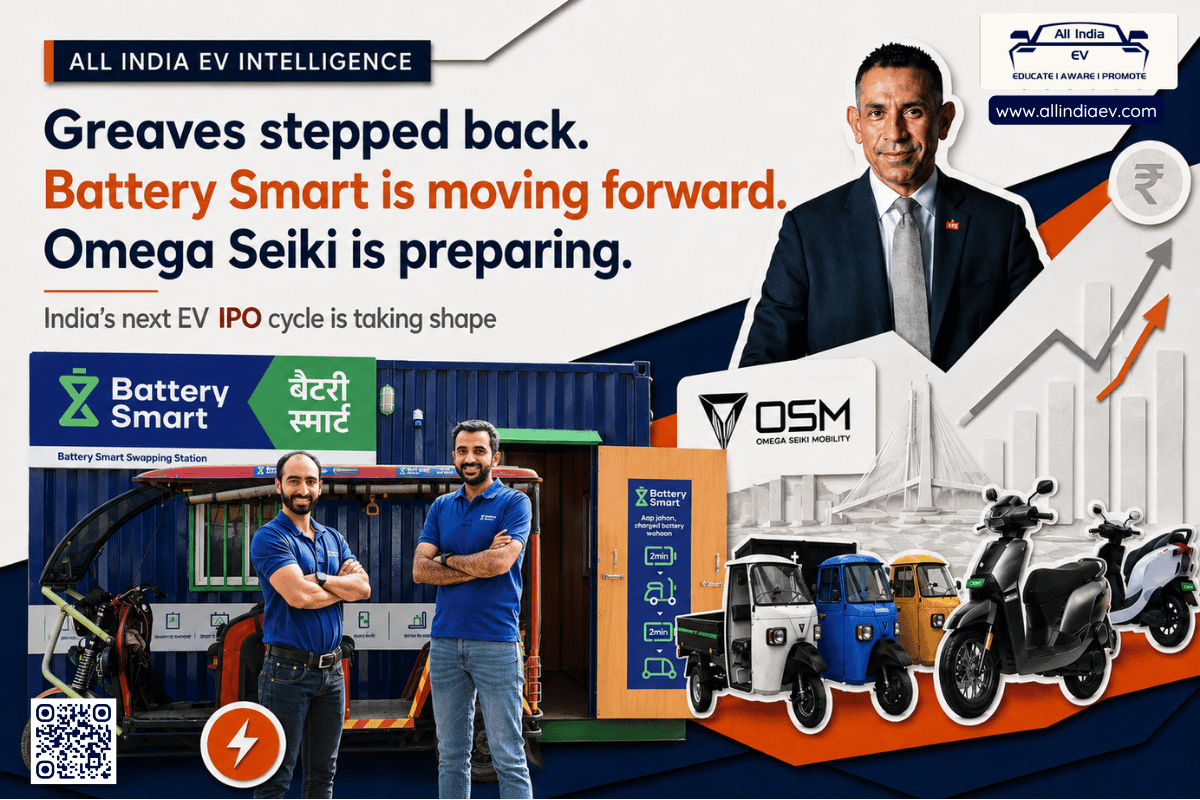
Greaves Electric Mobility stepped back. Battery Smart is moving forward. Omega Seiki Mobility is preparing to enter. Three separate corporate decisions, taken almost simultaneously, that together signal something bigger for India’s EV capital markets.
- Three Companies, Three Capital Decisions
- Greaves Electric Mobility: stepped back
- Battery Smart: moving toward the door
- Omega Seiki Mobility: preparing to enter
- Claims Ledger
- Not A Revenue Comparison, But A Capital Efficiency Question
- The multiple gap
- Applying the Four Lenses
- Why The Next Cycle Reads Differently
- AIEV Intelligence View
Viewed individually, these are routine corporate updates: a rights issue, a Series C round, a pre-IPO funding sprint.
Viewed together, they mark a shift.
India’s first EV IPO wave was built almost entirely around consumer-facing electric two-wheeler manufacturers. The next wave looks structurally different: commercial EV manufacturers, battery-swapping networks, and infrastructure-led businesses are now the ones approaching public markets.
That changes the question investors have to answer.
The first wave asked: can an Indian EV manufacturer scale?
The next wave asks something harder: where does long-term value actually accumulate inside the EV ecosystem?
Three Companies, Three Capital Decisions
Greaves Electric Mobility: stepped back
- Filed its DRHP in December 2024 and received SEBI’s final observations
- As of February 2026, management was reportedly discussing a primary raise of approximately ₹1,000 crore through the proposed IPO
- On July 31, 2026, Greaves Cotton disclosed that Greaves Electric Mobility would not avail the one-time extension on SEBI’s observation validity
- Instead, it moved ahead with a rights issue
- The ₹530 crore rights issue was fully subscribed by existing shareholders, including Greaves Cotton and Abdul Latif Jameel Green Mobility Solutions
- Greaves has said it can revisit a listing later, depending on market conditions
This is not necessarily the end of Greaves’ IPO journey. But it is a signal: a company already deep into IPO preparation chose shareholder capital instead. That choice says something about the trade-off between capital need, valuation expectations, market timing, and the scrutiny that comes with going public.
Battery Smart: moving toward the door
- Reportedly preparing to file draft IPO papers with SEBI in September or October 2026
- Filing expected to use FY26 and June-quarter financials
- SBI Capital Markets reportedly appointed as lead merchant banker
- Network: 1,500+ battery-swapping stations across 75+ cities
- Serves close to 100,000 commercial EV drivers
- Owns 300,000+ lithium-ion batteries
- Around 90% of stations run through franchise partners; Battery Smart retains ownership of the battery assets and supplies the technology/operating layer
Battery Smart is not a conventional vehicle manufacturer. It is part infrastructure company, part energy network, part technology platform, part asset-owner, and its capital needs reflect that hybrid identity.
Omega Seiki Mobility: preparing to enter
- Raised ₹100 crore across back-to-back funding rounds in under a month, per an August 23 BusinessLine report
- Evaluating a public listing; market estimates cited put a potential IPO in the ₹400-500 crore range
- FY26 revenue of approximately ₹333 crore
- FY26 profit after tax of approximately ₹7.3 crore
- EBITDA margin of 7.7%
- A pre-IPO research report cited by the company values OSM between ₹1,775 crore and ₹2,833 crore
OSM’s pitch is the mirror image of Battery Smart’s: not network-first monetised-later, but manufacturing, capacity, product portfolio, and disciplined growth, arriving at the IPO conversation with something relatively scarce among younger Indian EV businesses: reported profitability before listing.
Claims Ledger
| Metric | Company | Figure | Source basis |
|---|---|---|---|
| FY26 turnover | Greaves Electric Mobility | ₹596.98 crore | Company-reported |
| Rights issue size | Greaves Electric Mobility | ₹530 crore | Company-disclosed, fully subscribed |
| Total funding raised | Battery Smart | $211 million+ (~₹1,780 crore+) | Company/media-reported, cumulative |
| Latest round | Battery Smart | ₹185.5 crore Series C | Company-reported |
| Post-money valuation | Battery Smart | ~$430 million (~₹4,075 crore) | Media-reported, tied to latest round |
| FY26 revenue | Battery Smart | ₹358 crore (+43.8% YoY) | Company/media-reported |
| FY26 net loss | Battery Smart | ~₹23.55 crore (narrowing) | Company/media-reported |
| Break-even status | Battery Smart | Operational break-even claimed in FY26 | Company-claimed, not independently verified |
| Growth target | Battery Smart | 70-80% annually, next 3-5 years | Company guidance, forward-looking |
| Recent funding | Omega Seiki Mobility | ₹100 crore across back-to-back rounds | Media-reported |
| Potential IPO size | Omega Seiki Mobility | ₹400-500 crore | Market estimate, unconfirmed |
| FY26 revenue | Omega Seiki Mobility | ₹333 crore | Company-reported |
| FY26 PAT | Omega Seiki Mobility | ₹7.3 crore | Company-reported |
| EBITDA margin | Omega Seiki Mobility | 7.7% | Company-reported |
| Valuation estimate | Omega Seiki Mobility | ₹1,775-2,833 crore | Pre-IPO research report, cited by company |
Two figures in this table carry more weight than the rest for readers evaluating these businesses independently: Battery Smart’s break-even claim and Omega Seiki’s PAT figure. Both are company-sourced. Neither has been tested by public-market disclosure yet, which is precisely what an IPO process would force.
Not A Revenue Comparison, But A Capital Efficiency Question
Comparing these three companies by revenue alone is not useful. Their business models are too different for that.
The more revealing question is what each additional rupee of capital actually builds.
| Company | What capital builds | Where the bet sits |
|---|---|---|
| Battery Smart | Battery inventory, network density, city coverage, transaction volume | Utilisation and recurring swap revenue once density is reached |
| Omega Seiki Mobility | Manufacturing capacity, product range, distribution, R&D | Vehicle sales growth without losing capital discipline |
| Greaves Electric Mobility | Time and growth runway, without triggering public valuation | Optionality to list later on better terms |
The multiple gap
- Battery Smart’s ₹4,075 crore reported post-money valuation against ₹358 crore FY26 revenue implies roughly 11.4x revenue
- Omega Seiki’s cited ₹1,775-2,833 crore valuation range against ₹333 crore revenue implies roughly 5.3x to 8.5x revenue
These multiples are not directly comparable. Battery Smart’s figure comes from an actual funding round; OSM’s comes from a research estimate rather than a priced transaction. But the gap points to what investors may be pricing differently:
- Battery Smart is potentially commanding a premium for network effects, recurring utilisation, and infrastructure density
- Omega Seiki is potentially being evaluated on manufacturing margins, volume growth, and capital efficiency
The public market, once these companies actually list, will be a considerably harsher referee than either private-round investors or research analysts.
Applying the Four Lenses
Demand: Battery Smart’s addressable demand is tied to commercial EV driver adoption of swapping over fixed charging; OSM’s is tied to fleet and commercial buyer appetite for its vehicle categories. Both are demand stories still maturing, not yet demand stories proven at IPO scale.
Supply: Battery Smart controls the asset (batteries) but not most of the physical footprint (90% franchised). OSM controls manufacturing directly. This is a meaningful structural difference in how each company would report capex and asset risk as a listed entity.
Capital: This is the primary lens for this story. Greaves chose private/shareholder capital over public capital. Battery Smart and OSM are both choosing to test public capital, but from very different starting points, one pre-profit and network-heavy, one profitable and manufacturing-heavy.
Policy: None of the three companies’ current capital decisions are described as policy-driven in available reporting. Worth tracking separately whether FAME-linked or state incentive changes affect the IPO timing window for either Battery Smart or OSM.
Why The Next Cycle Reads Differently
India’s next EV IPO wave will not simply add another electric scooter maker to the exchange. If Battery Smart and Omega Seiki both list, investors get exposure to distinct layers of the EV value chain for the first time in the same cycle:
- Vehicle manufacturing
- Commercial mobility
- Battery-as-a-Service
- Charging and swapping infrastructure
- Fleet platforms
- EV financing
- Power electronics and components
Once that happens, comparison becomes possible in a way it hasn’t been before:
- A vehicle manufacturer may show higher revenue but needs continuous capex to keep pace
- An infrastructure platform may burn more capital upfront but could generate recurring revenue once utilisation matures
- A component or technology supplier may never be a household EV brand but could post better margins and more predictable returns
That is the maturation worth watching, not which company lists first, but which business model the market rewards once all three are on the table.
AIEV Intelligence View
For years, Indian EV companies were valued on the future tense: future penetration, future capacity, future share, future profitability.
Public markets change the vocabulary. Listed investors ask about EBITDA, cash flow, depreciation, debt, working capital, return on capital employed, customer concentration, utilisation, and warranty liabilities, and specifically, how much fresh capital is required to generate the next ₹100 crore of revenue.
Greaves’ rights issue is a reminder that capital access and IPO readiness are not the same thing.
Battery Smart’s filing, if it proceeds on the reported timeline, will test whether public investors will pay a premium for an asset-heavy but network-driven battery-swapping model, and whether the company’s break-even claim holds up under listed-company disclosure.
Omega Seiki’s path will test whether profitability and capital discipline earn their own premium in commercial EV manufacturing, a segment public markets have not yet had the chance to price.
None of these three companies is really the story on its own. The story is that India’s EV sector is being asked, for the first time at this scale, to show where value actually sits inside the ecosystem rather than simply how fast it is growing.