

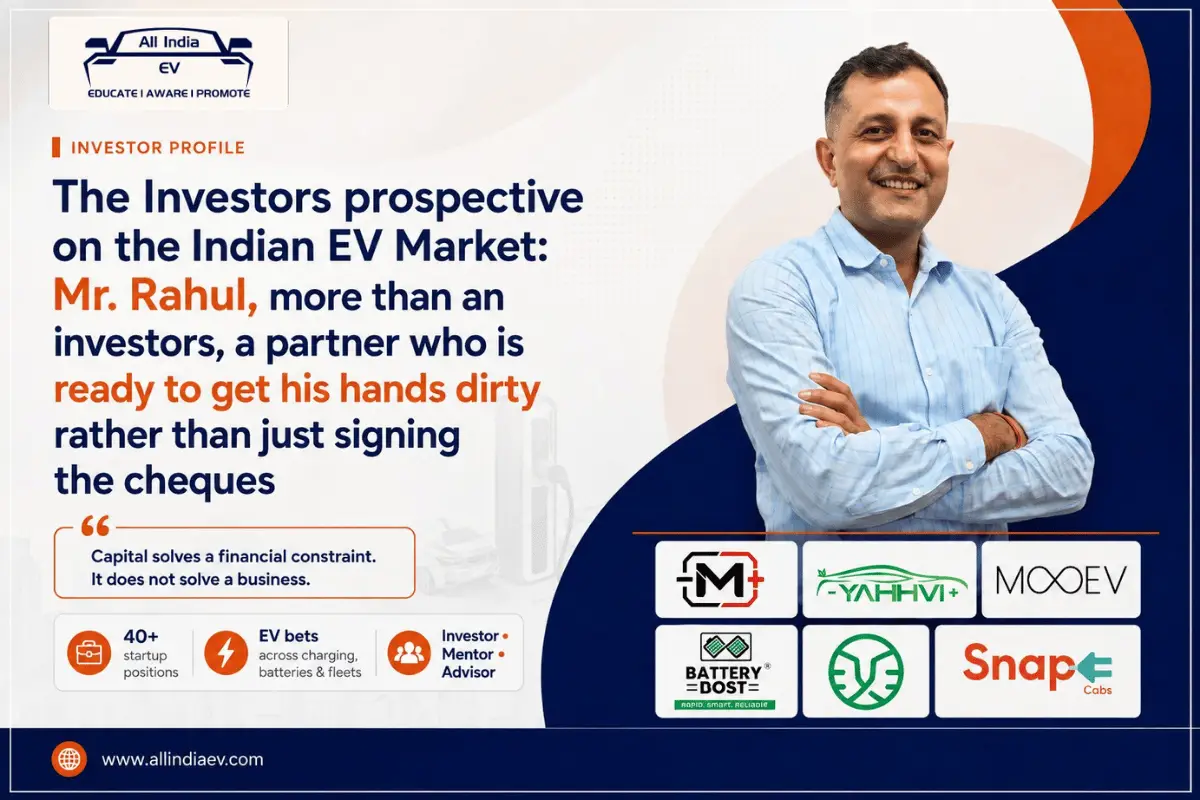
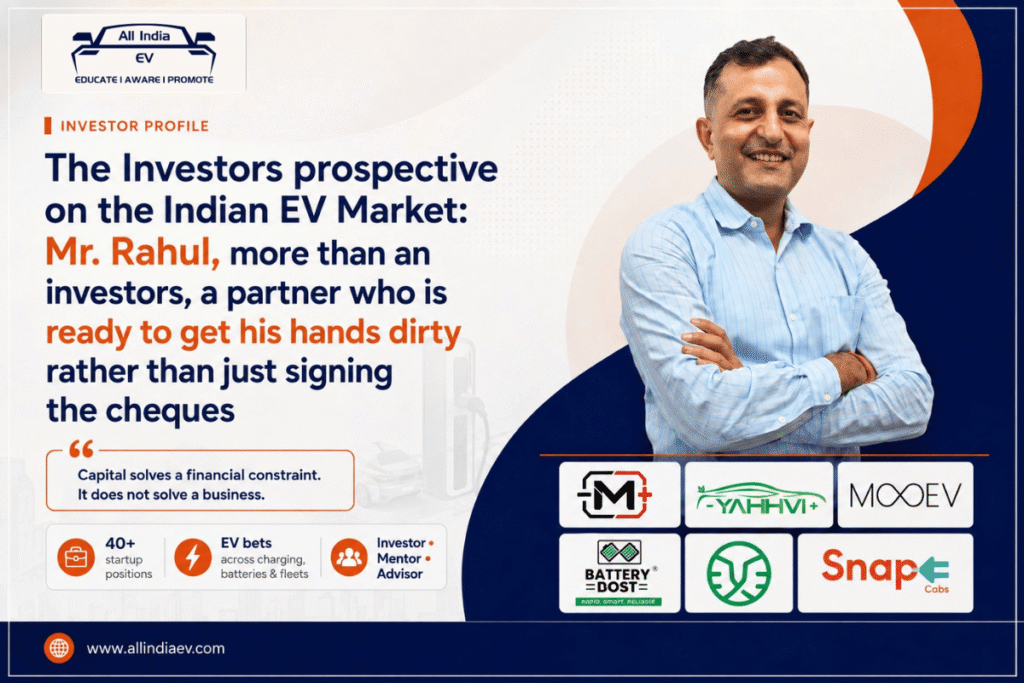
India sold more than 25 lakh electric vehicles in FY2025-26. Investor, operator and mentor Rahul P. Yadav believes the harder question now sits beyond the vehicle: can charging, batteries, fleets, financing and the underlying economics become strong enough to carry the next phase of electrification? All India EV examines the investment philosophy, the portfolio behind it, and where the argument still needs to be tested.
India’s electric vehicle market no longer needs to prove that adoption exists.
- India sold more than 25 lakh electric vehicles in FY2025-26. Investor, operator and mentor Rahul P. Yadav believes the harder question now sits beyond the vehicle: can charging, batteries, fleets, financing and the underlying economics become strong enough to carry the next phase of electrification? All India EV examines the investment philosophy, the portfolio behind it, and where the argument still needs to be tested.
- The Portfolio Tells Us Where He Thinks Value Will Be Created
- “An Introduction Is Useful Once. Good Judgement Compounds.”
- The Mistake He Sees Repeatedly: Confusing Growth With Progress
- India’s EV Opportunity Is Moving Beyond the Vehicle
- Why Commercial Mobility Particularly Interests Him
- The Market May Be Looking at the Wrong Scoreboard
- A Hands-On Investor, But Not a Shadow Founder
- What Strengthens Mr. Rahul’s Thesis, and What Remains Unproven
In FY2025-26, the country recorded 25,50,865 electric vehicle registrations across categories, taking EV penetration to 8.64% of overall automobile sales, according to EVreporter Intelligence. That represented 25.02% year-on-year growth. Electric two-wheelers alone contributed more than 14.7 lakh units. JMK Research, using its own registration methodology, similarly places annual EV registrations above 25 lakh and records March 2026 as India’s strongest-ever EV month at roughly 2.8 lakh registrations.
The demand story, in other words, is becoming increasingly difficult to dismiss.
The infrastructure story is considerably less settled.
As of 22 July 2026, the PM E-DRIVE scheme had supported 26,54,172 electric vehicles since the programme period began in April 2024. The same government response showed 6,562 EV chargers allocated under the scheme and zero installed as of that date. Under the earlier FAME-II programme, 9,583 public charging stations had been installed by 1 July 2026.
These numbers cover different time periods and programmes and should not be compared as equivalent measures of performance. But they reveal something more important about India’s EV transition: moving vehicles into the market and building the commercial ecosystem required to support those vehicles are not the same challenge.
That distinction is central to how Rahul P. Yadav, investor, operator, mentor and advisor across electric mobility, fintech, artificial intelligence and renewable energy, thinks about both startups and India’s EV opportunity.
For the rest of this article, we refer to him as Mr. Rahul.
His thesis is not that India’s vehicle market has become unimportant. It is that vehicle penetration increasingly tells only part of the story. The next phase will be determined by what sits underneath adoption: asset utilisation, financing, battery economics, infrastructure reliability, commercial fleet productivity, operational discipline and whether the companies building this ecosystem can eventually make sustainable money.
His most concise expression of that philosophy applies equally well to a startup and to the wider EV market.
“Capital solves a financial constraint. It does not solve a business.”
For All India EV, that is where this profile becomes more interesting than a conventional investor interview. Mr. Rahul is not merely arguing that the market should look beyond the vehicle. His disclosed investments and operating roles suggest that he has increasingly placed himself in precisely those layers of the ecosystem.
The portfolio, therefore, deserves to be read alongside the philosophy.
The Portfolio Tells Us Where He Thinks Value Will Be Created
Mr. Rahul’s professional journey did not begin in venture investing. His career has moved through engineering, banking, fintech and operating roles, including L&T, ICICI Bank and YES Bank, where he worked in areas including fintech and open banking, before moving deeper into entrepreneurship, investing and startup advisory roles. He has also been associated with India Accelerator, Techstars and TiE Delhi-NCR. His publicly disclosed investment footprint extends to more than 40 positions.
It is the EV and energy portion of that portfolio that is particularly revealing.
| Company | Disclosed involvement | Layer of the market |
| Yahhvi | Strategy & Growth | EV charging infrastructure |
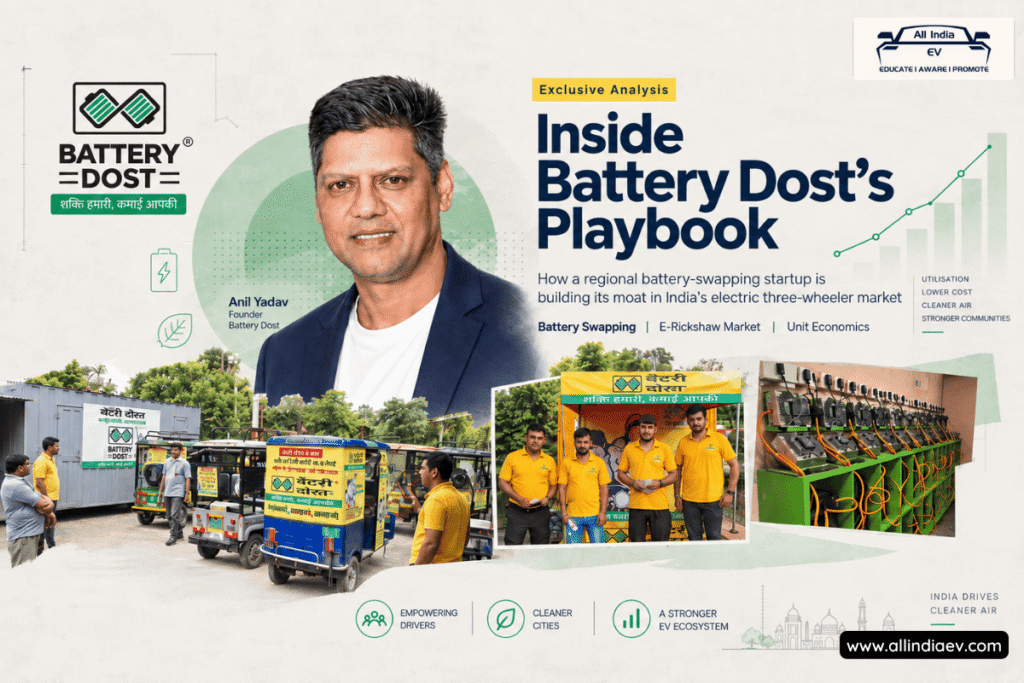
| Battery Dost | Advisor | Battery swapping |
| Battery OS | Angel Investor | Battery intelligence |
| Mechlae Energy | Advisor | Energy |
| SustVest | Angel Investor | Renewable-energy financing |
| Snap-E Cabs | Angel Investor | EV fleet and mobility |
| Vahb | Board Advisor | AI-led predictive maintenance and fleets |
| REGRIP | Angel Investor | Tyre circularity |
| MOOEV Technologies | Angel Investor | Heavy-duty electric mobility |
| Green Tiger Mobility | Angel Investor | EV retrofitting and affordable mobility |
Roles are based on positions publicly disclosed by Mr. Rahul and have not been independently audited by All India EV.
The pattern matters more than the individual company names.
Most of these positions sit around the vehicle rather than inside mainstream consumer EV manufacturing. Charging, battery intelligence, swapping, fleet operations, financing, predictive maintenance, circularity and retrofitting dominate the disclosed EV and energy exposure.
That makes Mr. Rahul’s argument about the next phase of electric mobility more credible than if it existed only inside an interview.
His capital allocation appears broadly consistent with his stated thesis.
This does not prove that the thesis will generate superior investment returns. All India EV does not have portfolio-level information on entry valuations, follow-on rounds, realised exits, failures or investment performance. But it tells us something useful about where Mr. Rahul believes value could emerge as the industry matures.
And that is increasingly in the operating system surrounding electrification.
“An Introduction Is Useful Once. Good Judgement Compounds.”
When asked why he continues spending time with other founders while his own ventures already demand significant attention, Mr. Rahul does not describe mentorship as a charitable extension of investing. He describes it as another form of company-building.
Years spent inside businesses, he argues, eventually produce pattern recognition.
The sectors may change, but the questions frequently do not. Is the problem real? Will a customer genuinely pay to solve it? Does the economic model survive outside a presentation? Can a small team translate its early success into repeatable operations? Can the company continue functioning when funding becomes harder, demand softens or competitors begin compressing margins?
“I don’t think building companies is something you ever really switch off from.”
The value of experience, in his view, is not that an investor automatically knows what a founder should do. It is that someone who has seen businesses operate through different stages may recognise certain failure patterns before they become expensive.
“One of the most valuable things I can offer is not necessarily another cheque, but pattern recognition, knowing what tends to work, what usually breaks, and where founders can save years of avoidable mistakes.”
That leads Mr. Rahul to draw an important distinction between access and judgement.
Startup investors frequently describe their network as part of the value proposition: customer introductions, talent, capital providers, institutional stakeholders, strategic partners and future investors. Mr. Rahul considers those things useful, but secondary.
“An introduction is useful once. Good judgement compounds.”
There is an uncomfortable truth underneath that statement.
Founders rarely suffer from a shortage of encouragement.
Startup environments are structurally optimistic. Founders have to believe. Employees need momentum. Existing investors want growth. Future investors want an expanding narrative. Customers want confidence that the company will still exist tomorrow.
The consequence is that many people around the company have incentives to reinforce the direction in which it is already travelling.
The rarer relationship is with someone capable of saying that the direction may be wrong.
“Someone has to ask the difficult questions.”
For Mr. Rahul, that is where active mentorship becomes useful. The role is not to make decisions for the entrepreneur, but to challenge assumptions strongly enough that the founder makes a better decision.
That could mean questioning a market expansion, pushing back on a valuation-driven fundraising strategy, testing whether customer growth is actually creating gross profit, or simply being willing to say that a product or business model is not working.
The difference matters because capital can often postpone the consequences of a bad decision.
It cannot remove them.
The Mistake He Sees Repeatedly: Confusing Growth With Progress
Among all the failure patterns Mr. Rahul identifies, one sits above the others.
“The biggest mistake is confusing growth with progress.”
It is an important distinction because almost every visible startup metric can move upward while the quality of the underlying company moves in the opposite direction.
Revenue can increase while contribution margins deteriorate. Customer acquisition can accelerate while retention weakens. Geographic expansion can make the company larger while making every operational problem harder to control. Funding can increase while the business becomes more dependent on external capital simply to maintain its existing scale.
A company can therefore look stronger from outside while becoming more fragile internally.
Mr. Rahul sees four recurring causes: companies scaling before achieving genuine product-market fit, founders focusing excessively on valuation and fundraising, management teams underestimating the operational complexity created by scale, and organisations hiring aggressively before building the systems and accountability required to manage that growth.
His observation on operational scale is particularly relevant to EV businesses.
“What works with 10 customers can completely break with 1,000.”
In software, scale can sometimes be achieved with relatively low marginal complexity. Electric mobility is different. Many business models combine hardware, credit, energy, vehicles, physical infrastructure, field operations, service teams and geographically distributed assets.
A charging company does not merely acquire users. It has to secure sites, obtain power, install equipment, maintain uptime, resolve payment issues and ensure that sufficient energy flows through each asset.
A fleet company does not merely add vehicles. It adds drivers, financing obligations, maintenance, charging schedules, dispatch complexity and residual-value risk.
A battery-swapping company does not merely open stations. It must manage battery inventory, asset rotation, charging cycles, degradation, availability and station economics.
Scale can therefore magnify operational weakness very quickly.
Mr. Rahul’s counter-model is far less glamorous than the vocabulary commonly associated with startups.
Discipline.
Understanding customers deeply. Knowing the unit economics. Managing cash. Building repeatable processes. Creating accountability before headcount makes accountability difficult. Making uncomfortable decisions while they are still relatively inexpensive.
“Fast growth is valuable. But profitable, repeatable and defensible growth is what creates a company. The market often celebrates the former and eventually rewards the latter.”
The current EV funding environment makes that argument particularly relevant.
Tracxn’s live India EV dataset currently tracks more than 2,600 EV companies, with roughly 500 having received funding and 133 reaching Series A or beyond. It also reports a sharp decline in EV equity funding in 2026 compared with the same period of 2025. The exact counts move as the database is updated, but the broader signal is clear: only a minority of companies in the sector receive institutional funding, and capital is not distributed evenly across the ecosystem.
That does not prove that capital-heavy companies are weak or that bootstrapped companies are stronger. It does make one point harder to ignore: access to capital is selective, cyclical and never a permanent operating model.
Eventually, the company itself has to work.
India’s EV Opportunity Is Moving Beyond the Vehicle
This is where Mr. Rahul’s startup philosophy and his view of electric mobility intersect.
For much of the past decade, the dominant EV question in India was adoption.
Would buyers accept electric two-wheelers? Could electric three-wheelers compete with conventional alternatives? Would passenger-car buyers trust EV range? Could fleet electrification work? Would OEMs commit manufacturing capacity?
Those questions have not disappeared, but the market has advanced significantly.
India now records more than 25 lakh annual EV registrations, with two- and three-wheelers accounting for the overwhelming majority of volumes.
For Mr. Rahul, the investment opportunity therefore extends far beyond putting additional vehicles on the road.
“India’s EV opportunity is significantly larger than simply selling electric vehicles.”
He points towards charging infrastructure, battery swapping, battery financing, fleet solutions, energy management, BESS, software, recycling, financing and specialised commercial EV applications.
The logic connecting these opportunities is that electrification creates new infrastructure and financial requirements that did not exist in precisely the same form in the internal-combustion ecosystem.
Electric vehicles need reliable energy access. Batteries create new questions around health, second life and residual value. Commercial fleets require financing structures that recognise EV operating economics. Charging assets need sufficient utilisation. High-duty-cycle vehicles create increasingly complex relationships between energy cost, battery degradation and productive uptime.
In other words, selling the vehicle is increasingly only the beginning of the commercial relationship.
Why Commercial Mobility Particularly Interests Him
Mr. Rahul is especially interested in commercial EV applications because the investment proposition can be tested against harder economics.
Consumer behaviour contains subjective variables: brand aspiration, design, technology preference, environmental motivation and novelty.
Commercial mobility strips away much of that romance.
A delivery fleet, cab operator or commercial vehicle owner is buying an earning asset.
The relevant questions become measurable: how much does the vehicle cost per kilometre, how many hours can it operate, how frequently is it unavailable, what does financing cost, how quickly does the battery degrade, what revenue can the asset generate and what is left after all operating expenses are paid?
“For a fleet operator, the question is not whether an EV is fashionable. It is whether the vehicle can deliver a lower total cost of ownership, higher utilisation and predictable operations.”
That is why commercial mobility can become one of the most revealing laboratories for India’s EV transition.
Electric powertrains can offer meaningful operating-cost advantages in high-utilisation use cases. But those advantages are only bankable if the surrounding system performs reliably.
An EV that is cheaper per kilometre but regularly unavailable because charging infrastructure is inadequate can destroy fleet productivity.
A battery with attractive headline economics can become difficult to finance if lenders have insufficient data on degradation and resale value.
A charging station can be technologically excellent and financially poor if too little energy flows through it.
This is what Mr. Rahul means when he talks about moving the conversation from adoption to economics.
The Market May Be Looking at the Wrong Scoreboard
One of Mr. Rahul’s strongest arguments concerns the industry’s fixation with EV penetration.
“Where I think the market sometimes gets the story wrong is by treating EV penetration as the primary measure of success. Vehicles sold are only one part of the equation.”
He is not suggesting that penetration is irrelevant.
Without vehicles, there is no EV ecosystem.
His point is that penetration is an input into the next stage of the market, not evidence that every layer underneath it is working.
The PM E-DRIVE data provides a useful illustration.
As of 22 July 2026, the programme had supported more than 26.5 lakh EVs while no chargers had yet been installed under its charging-infrastructure component, despite thousands of chargers having been allocated. Again, the two interventions involve different implementation mechanisms and should not be treated as directly comparable execution rates. But the contrast does demonstrate that vehicle incentives and infrastructure execution face very different operational challenges.
The earlier FAME-II programme had produced 9,583 installed public charging stations by 1 July 2026, showing that public infrastructure deployment is happening, only through a longer and more complicated process.
For Mr. Rahul, that complexity matters because every additional electric vehicle eventually creates dependencies elsewhere in the system.
“If the infrastructure doesn’t work, financing doesn’t work, battery residual values remain uncertain, utilisation is poor and operators cannot achieve attractive economics, adoption will eventually slow.”
All India EV believes this is the point in Mr. Rahul’s thesis worth paying closest attention to.
India’s EV market has spent years building excellent visibility around vehicle registrations. We know which OEM sold how many vehicles, which segment grew fastest and which state has the highest penetration.
The second-generation scoreboard needs to go deeper.
| Metric worth tracking | What it tells the market |
| Charger utilisation and energy throughput | Whether charging assets have real demand |
| Operational uptime | Whether deployed infrastructure actually serves vehicles |
| Fleet vehicle utilisation | Whether commercial EVs generate productive kilometres |
| EV financing approval and default trends | Whether lenders understand and can price EV risk |
| Battery residual values | Whether batteries are becoming financeable long-life assets |
| TCO by commercial use case | Whether electrification creates durable customer economics |
| Station-level swapping economics | Whether network expansion translates into viable infrastructure |
| Service and warranty cost per vehicle | Whether volume growth remains economically healthy |
None of these replaces registrations.
Together, however, they tell us whether registrations are creating a sustainable market.
A Hands-On Investor, But Not a Shadow Founder
Mr. Rahul’s conviction that judgement matters explains why his role in portfolio companies often extends beyond capital.
He describes involvement across strategy, business-model refinement, fundraising, financial structuring, partnerships, customer conversations and difficult management decisions.
“If I invest in a company and genuinely believe in the founder and the opportunity, I would rather contribute my experience, network and judgement than simply wait for the next funding round.”
It is an appealing model, but one that deserves scrutiny.
Hands-on investors can add considerable value. They can also become overly influential, slowing decisions or creating a second centre of authority inside a startup.
Mr. Rahul recognises that tension.
“I am there to strengthen the founder, not replace the founder.”
For him, the boundary lies in accountability.
The investor can challenge. The advisor can question assumptions. The mentor can introduce customers, capital or strategic partners. They can help frame a difficult decision and, when necessary, roll up their sleeves around a specific problem.
But the entrepreneur must continue owning the company.
“An advisor who starts running the company without accountability is dangerous. Equally, an investor who refuses to engage when the company genuinely needs help is not necessarily adding much value.”
This is also where All India EV would introduce some caution.
A hands-on advisory model is easy to describe and difficult to evaluate from outside. The real evidence lies in outcomes: whether founders retain decision authority, whether portfolio companies improve after intervention, whether the advisor creates organisational capability or dependence, and ultimately whether the companies become stronger businesses.
Mr. Rahul himself provides the appropriate test.
“Ultimately, I don’t want founders who depend on me. I want to help build founders and organisations that eventually don’t need me in the room to make the right decision.”
That is perhaps the best definition of successful mentorship in the entire conversation.
If the mentor remains indispensable forever, the organisation may have gained expertise without actually developing it internally.
What Strengthens Mr. Rahul’s Thesis, and What Remains Unproven
There are several reasons All India EV finds Mr. Rahul’s broader argument compelling.
First, his disclosed portfolio broadly follows the thesis he articulates. Charging, batteries, financing, fleets, circularity and specialised mobility appear repeatedly. He is not describing an ecosystem opportunity while investing exclusively in mainstream vehicle brands.
Second, his banking and fintech experience is relevant to where many EV problems are now moving. Batteries, fleets and charging infrastructure are increasingly financial assets as much as engineering products. Residual values, debt structures, utilisation and predictable cash flows will determine how cheaply those assets can ultimately be financed.
Third, his preference for commercial mobility puts the thesis in an area where outcomes can be measured. A commercial vehicle either creates workable lifetime economics or it does not.
And fourth, the market itself is beginning to become less forgiving. As capital becomes more selective, businesses built around weak unit economics have less room to finance their way through structural problems.
But there are questions the available information cannot answer.
Mr. Rahul describes pattern recognition as one of the most valuable things he offers founders. The real evidence would be portfolio outcomes: survival rates, follow-on funding, operating improvement, realised exits and examples where his intervention materially changed a company’s trajectory.
Similarly, more than 40 disclosed investment positions create an obvious question about depth. An investor can hold many positions, but genuine operational involvement is time-intensive. Which companies receive deep engagement and which represent conventional angel investments is not fully visible externally.
There is also an inherent tension in working simultaneously across adjacent parts of an ecosystem. Operating, advisory and investment roles can create access to valuable information, but they also require strong boundaries around confidentiality and conflicts.
None of those questions invalidate the thesis.
They simply separate an interesting investment philosophy from a demonstrated investment track record.
A premium industry platform should make that distinction.
All India EV – Market Intelligence