

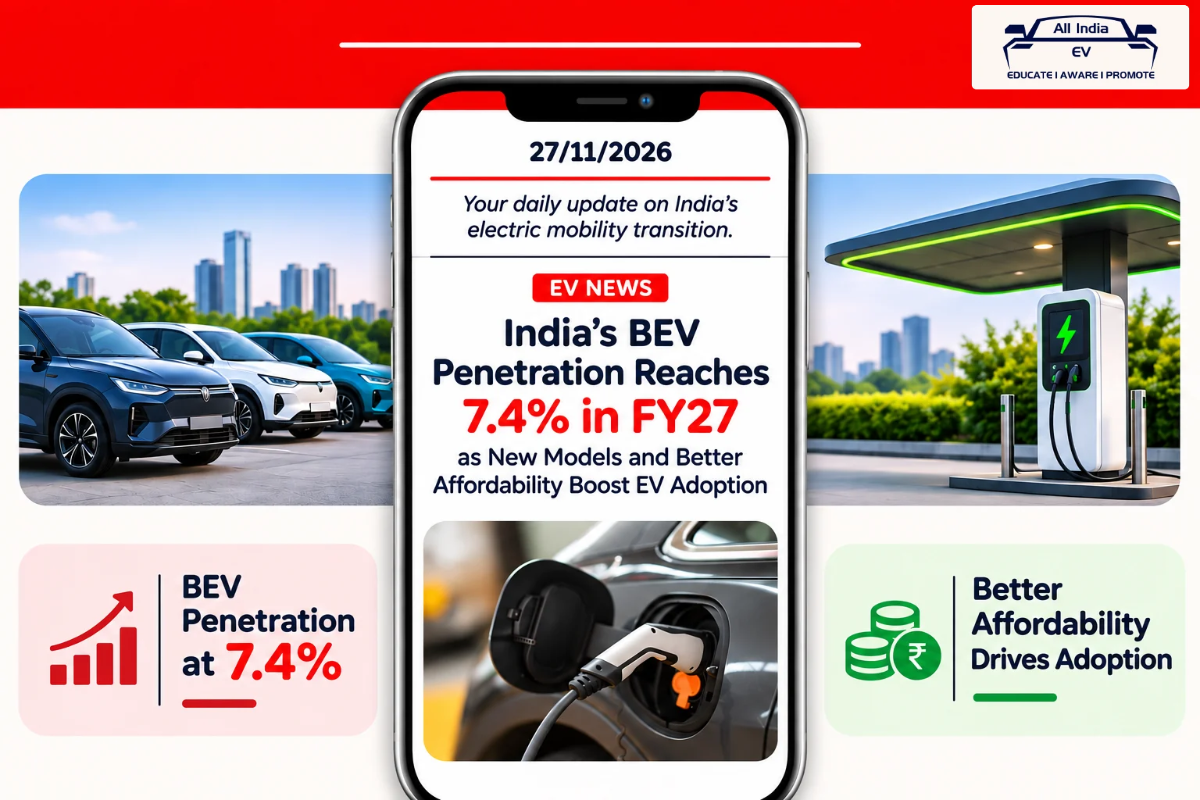
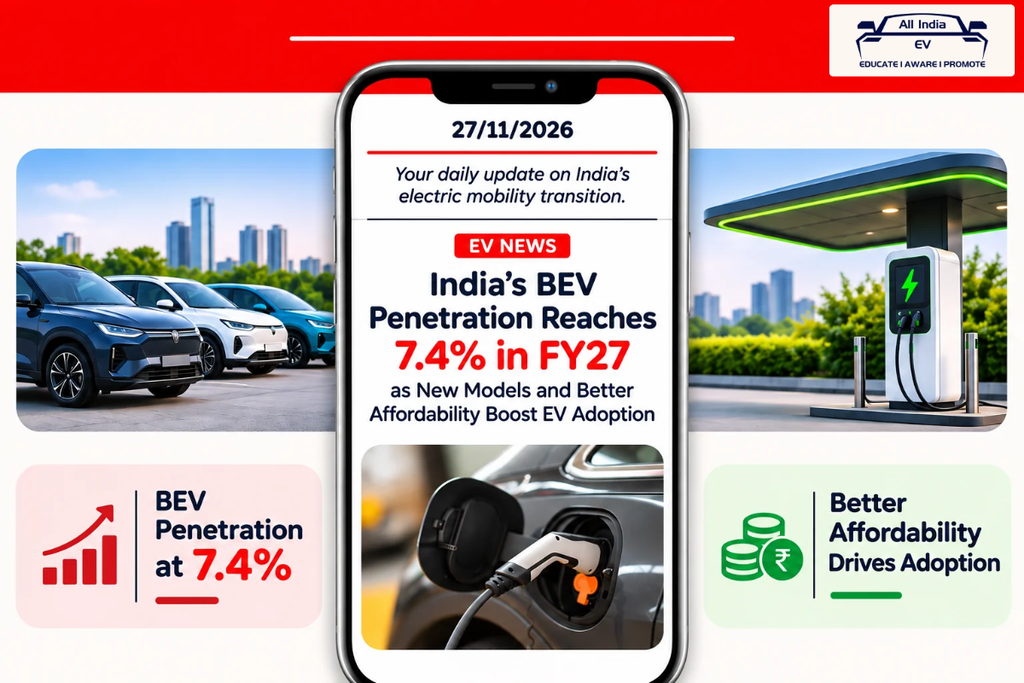
India’s electric vehicle market is witnessing steady growth, with battery electric vehicles (BEVs) increasing their share of domestic passenger vehicle sales to 7.4% during the first seven months of FY2026-27. According to Moody’s Ratings, the penetration level has improved significantly compared with previous financial years, highlighting the growing acceptance of electric mobility among Indian consumers.
BEV penetration stood at 2.6% in FY2024-25 before increasing to 4.4% in FY2025-26. The latest growth indicates that electric passenger vehicles are gradually moving beyond the early-adopter segment and gaining a stronger position in India’s automotive market.
Moody’s expects India’s electric vehicle adoption to accelerate further over the next 12 to 18 months. Several factors, including new electric vehicle launches, expanding charging infrastructure, improved driving ranges and better affordability, are expected to support the next phase of market expansion.
New EV Launches and Affordability to Drive Market Growth
The increasing availability of electric passenger vehicles across different price segments is playing an important role in expanding India’s BEV market. Automakers are introducing new models with improved battery technology, longer driving ranges and advanced features to attract a wider customer base.
Improving affordability is another major factor supporting electric vehicle adoption. Lower battery costs, technological advancements and increasing competition among manufacturers are creating opportunities to bring electric vehicles closer to conventional petrol and diesel vehicles in terms of overall ownership costs.
The expansion of public charging infrastructure is also expected to strengthen consumer confidence. Better charging accessibility can address range-related concerns and make electric vehicles more practical for everyday commuting and longer journeys.
Interestingly, India’s BEV market has continued expanding despite the absence of direct cash purchase incentives. Moody’s highlighted the favourable tax structure as an important factor supporting adoption. Battery electric vehicles currently attract 5% Goods and Services Tax (GST), compared with 18% for small internal combustion engine passenger cars.
Tata Motors Positioned to Benefit from EV Expansion
Among Indian automakers, Tata Motors Passenger Vehicles is expected to remain an important beneficiary of the country’s electric mobility transition. The company is currently India’s largest electric passenger vehicle manufacturer and has established a strong presence in the domestic EV market.
According to Moody’s, BEVs contributed approximately 21% of Tata Motors Passenger Vehicles’ total sales during the first half of FY2026-27, compared with 14% in FY2025-26.
The growing contribution of electric vehicles to the company’s overall sales highlights the increasing importance of electrification in its product strategy. Continued model launches and improvements in battery technology could further strengthen its position in the domestic electric passenger vehicle segment.
India’s EV Transition to Include Multiple Technologies
Moody’s expects India’s automotive industry to follow a diversified transition involving battery electric vehicles, compressed natural gas (CNG) vehicles and hybrid technologies rather than relying on a single powertrain solution.
This approach reflects the different affordability requirements, driving conditions and infrastructure availability across Indian markets. While BEVs are expected to gain momentum, CNG and hybrid vehicles will continue serving consumers who are transitioning towards cleaner mobility alternatives.
Global EV Growth Forecast Revised Downwards
While India’s electric vehicle market continues to expand, Moody’s has revised its global BEV penetration expectations. The agency now expects battery electric vehicles to account for 35-40% of global light vehicle sales by 2035, compared with its earlier forecast in the mid-40% range.
The revision reflects weaker policy support, particularly in the United States, and slower adoption across several international markets. Global BEV penetration is expected to reach approximately 17% in 2026, compared with 16% in 2025.
China remains the world’s largest electric vehicle market, accounting for around 62% of global BEV sales in 2025.
For India, the latest figures indicate a positive outlook. With expanding product choices, improving affordability and stronger charging infrastructure, the country is moving towards a broader electric mobility ecosystem. The coming years will be important in determining how quickly electric passenger vehicles become a mainstream choice for Indian consumers.