

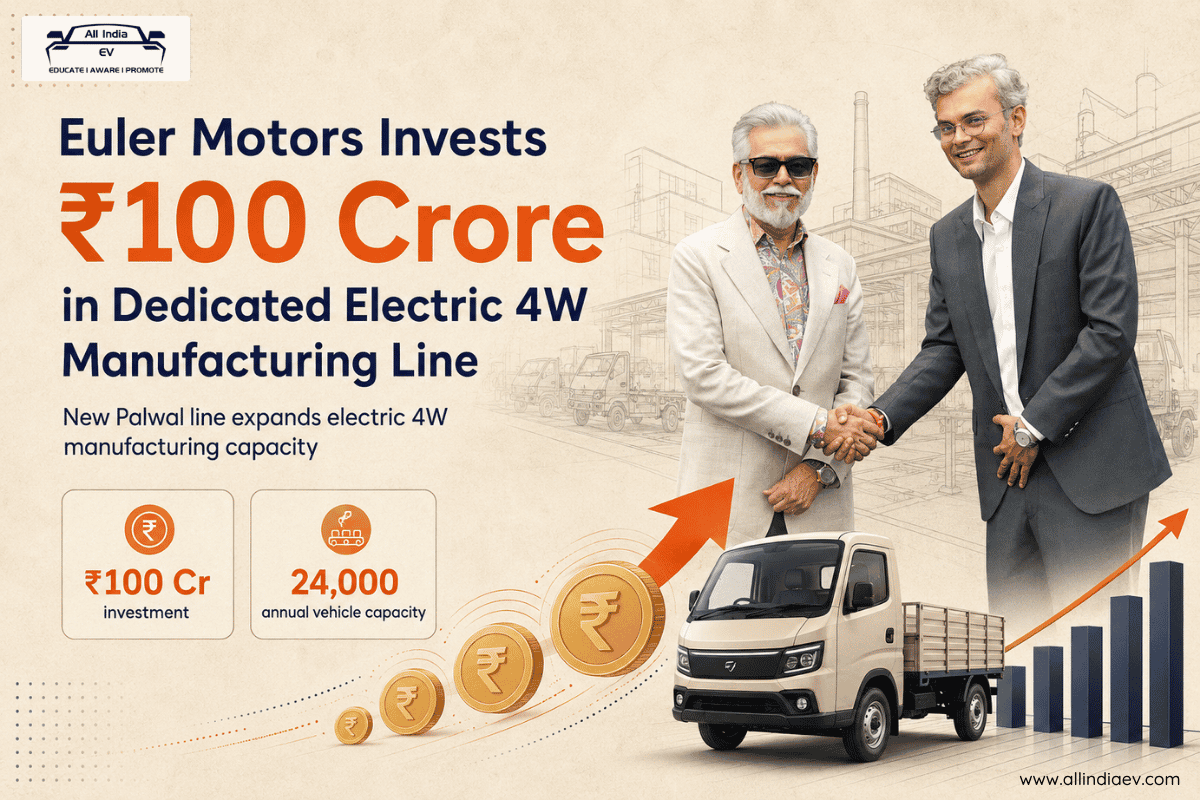
Euler Motors has inaugurated a dedicated electric four-wheeler manufacturing line at its Palwal facility in Haryana, backed by an investment of ₹100 crore as the commercial EV manufacturer prepares to scale production of its growing four-wheel cargo portfolio.
The expanded manufacturing operation now covers approximately 40 acres and provides annual production capacity of up to 24,000 vehicles.
The facility will manufacture Euler’s four-wheel commercial EV portfolio, including the Turbo EV 1000 one-tonne electric truck and Storm EV.
At full utilisation, the new operation can work across two regular shifts along with a third hybrid shift.
Manufacturing Goes Deeper Than Final Assembly
Euler has equipped the facility with an automated four-wheel assembly conveyor line, dedicated assembly areas, a body shop and an integrated battery-pack assembly line.
The company is also bringing several core vehicle systems in-house, including work around chassis, axles and battery packs.
Vehicle and component testing has been integrated across the production process.
Battery packs are subjected to thermal cycling, thermal shock, vibration, water-wading, drop, mechanical-shock and abuse testing, while drivetrain, suspension, steering and other vehicle systems undergo checks during assembly.
For commercial electric vehicles, such testing matters because reliability directly affects earning potential.
Unlike a private passenger vehicle, a truck taken off the road due to an unexpected fault represents lost operating revenue.
Euler’s Four-Wheeler Volumes Are Rising
The investment comes as Euler reports rapid growth in its four-wheel electric commercial vehicle business.
Founder and CEO Saurav Kumar said the company’s monthly four-wheeler sales increased from roughly 40 vehicles in April last year to around 800 vehicles in June this year.
Euler also estimates that EV penetration in the relevant one-tonne four-wheel commercial vehicle category has risen from around 1% to approximately 5.8%, with the company claiming around 28% share of that electric segment.
The new manufacturing capacity therefore appears designed around actual volume expansion rather than purely future expectations.
The Bigger Commercial EV Opportunity
India’s last-mile electrification story initially gained traction through electric three-wheelers because high daily utilisation made EV economics relatively attractive.
Four-wheel light commercial vehicles are the next, more difficult frontier.
They require higher payload capability, stronger performance, greater range reliability and pricing capable of competing with deeply established diesel and CNG products.
Euler’s ₹100 crore manufacturing investment shows that manufacturers increasingly believe this segment is beginning to cross from pilot volumes into a scalable commercial market.
The real test will be capacity utilisation.
A factory capable of producing 24,000 vehicles annually creates industrial capability, but sustained demand must ultimately fill that line.
If Euler’s recent four-wheel sales momentum continues, Palwal could become an important indicator of how quickly India’s electric LCV market moves from a niche category into mainstream commercial mobility.
Explore the EV Investment & Funding