
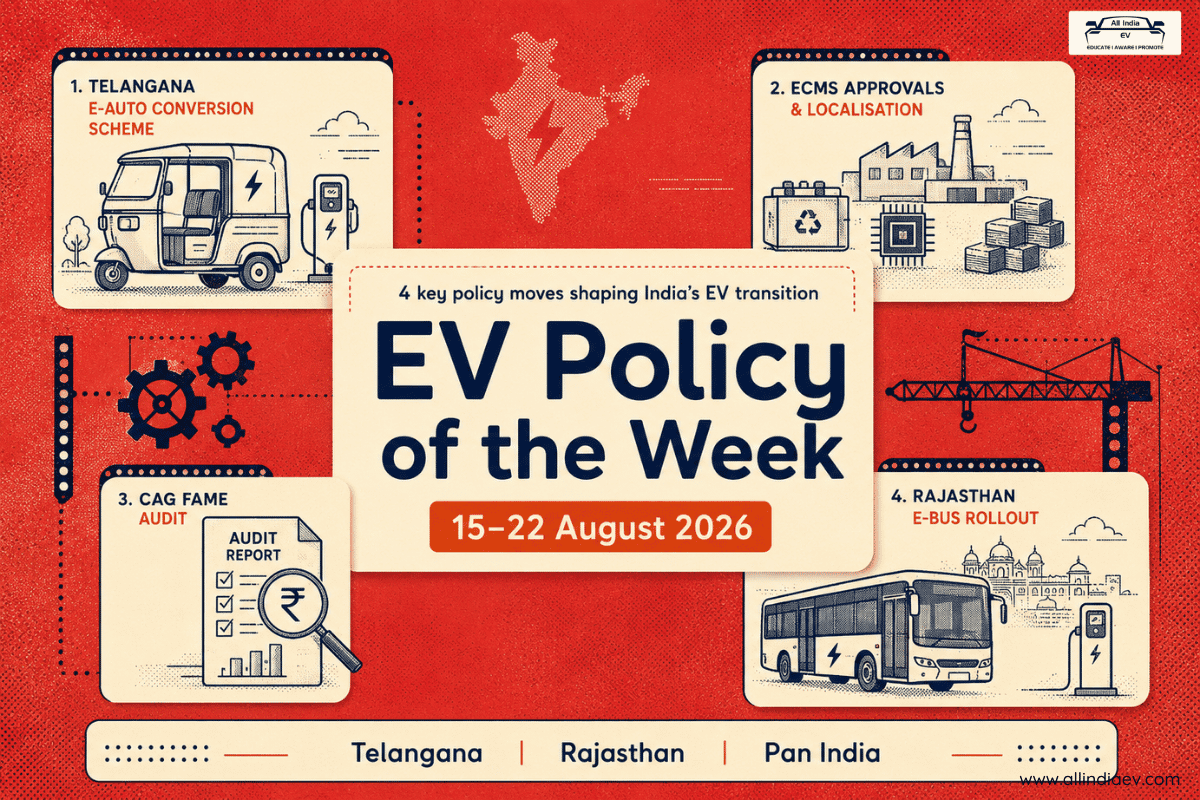
India’s electric mobility policy landscape saw activity across vehicle conversion, domestic component manufacturing, policy accountability and electric public transport between August 15 and 22, 2026.
Telangana approved a ₹200 crore programme targeting the electrification of 18,766 petrol and diesel auto-rickshaws. The Centre cleared another 31 manufacturing projects under the Electronics Components Manufacturing Scheme, including strategically important battery materials. Meanwhile, a CAG audit raised questions over FAME implementation, and Rajasthan continued putting government-backed electric buses into operation.
Here are the major EV policy developments of the week.
Telangana Targets 18,766 ICE Autos With ₹200 Crore EV Scheme
Telangana has approved the Telangana Auto Rickshaw Electric Conversion Scheme 2026, targeting petrol and diesel auto-rickshaws operating within Hyderabad’s Core Urban Region Economy, or CURE.
The government has proposed a ₹200 crore budget for the programme, covering 18,766 eligible auto-rickshaws, including 11,254 diesel and 7,512 petrol vehicles.
Eligible owners can receive financial assistance of up to ₹1.50 lakh.
Importantly, operators have two pathways: retrofit the existing vehicle using an approved electric conversion system or replace the ICE auto with a new factory-built electric three-wheeler.
For India’s electric three-wheeler industry, the scheme is noteworthy because it moves beyond incentives for new EV purchases and directly targets the existing ICE vehicle population.
If executed effectively, Telangana could create a useful model for cities trying to electrify legacy commercial fleets rather than waiting for natural vehicle replacement cycles.
Centre Clears 31 More ECMS Projects
The Ministry of Electronics and Information Technology approved 31 additional projects under the Electronics Components Manufacturing Scheme, representing ₹6,844 crore of new proposed investment.
Across all ECMS approvals, 106 projects with ₹69,548 crore of investment have now been sanctioned. Of these, 38 plants have commenced manufacturing while another 16 are in advanced construction or machinery-installation stages.
For the EV industry, the interesting part sits upstream in the battery and powertrain supply chain.
The latest projects include graphite anode material from Epsilon C2GR, acetylene black from PCBL Chemical, electrolyte additives from Acutaas Chemicals and rare-earth permanent magnets from Quantum Magnetics.
This matters because India’s EV localisation challenge is shifting.
Local assembly of vehicles and battery packs is no longer sufficient. Policy is increasingly moving toward the materials and components sitting deeper inside batteries, motors and power electronics.
CAG Flags ₹468 Crore in FAME Incentives
The week’s most important policy-accountability development came from the Comptroller and Auditor General of India.
Its audit found that nearly ₹468 crore in FAME incentives had been paid to manufacturers despite violations of localisation requirements.
The audit also highlighted slow execution of charging infrastructure. Of 2,877 charging stations approved under FAME-II, only 148 had been commissioned within the period examined by the audit.
This is important for the current policy environment because India continues to use public money to accelerate EV adoption through schemes such as PM E-DRIVE.
The lesson from FAME is fairly straightforward: subsidy allocation needs to be accompanied by stronger verification, implementation tracking and post-disbursement accountability.
Announced budgets are not the same thing as achieved outcomes.
Rajasthan Expands E-Bus Operations Across Eight Cities
Government-backed electric public transport also continued scaling during the week.
Chartered Speed reported deployment of 71 electric buses across Rajasthan’s eight major urban centres under the PM e-Bus Sewa framework.
Operations now cover Jaipur, Jodhpur, Kota, Bikaner, Ajmer, Udaipur, Bhilwara and Alwar. The company’s larger Rajasthan programme is backed by an order exceeding 800 electric buses and around 22 MW of charging infrastructure.
Rajasthan has been allocated 1,150 buses under PM e-Bus Sewa, making it one of the larger state-level electric bus programmes.
The policy significance is increasingly about execution rather than allocation.
Sanctioning buses creates the pipeline. Getting vehicles, depots, chargers and operators working together creates the actual transport system.
The Bigger Policy Story This Week
The four developments reveal different stages of India’s EV policy transition.
Telangana is creating demand. ECMS is localising supply chains. Rajasthan is deploying publicly supported vehicles. The CAG audit is asking whether previous policy spending actually delivered what was promised.
That combination is increasingly what India’s EV transition needs.
The next phase cannot be measured only by subsidy amounts or vehicles sanctioned. The more useful metrics will be how many ICE vehicles are actually converted, how much domestic manufacturing reaches commercial production, how many government-backed buses enter daily service and how effectively public incentives are audited.
For EV policy, the conversation is gradually moving from announcement to execution.