
FirstElement Launches the First Hydrogen Truck Station in the World
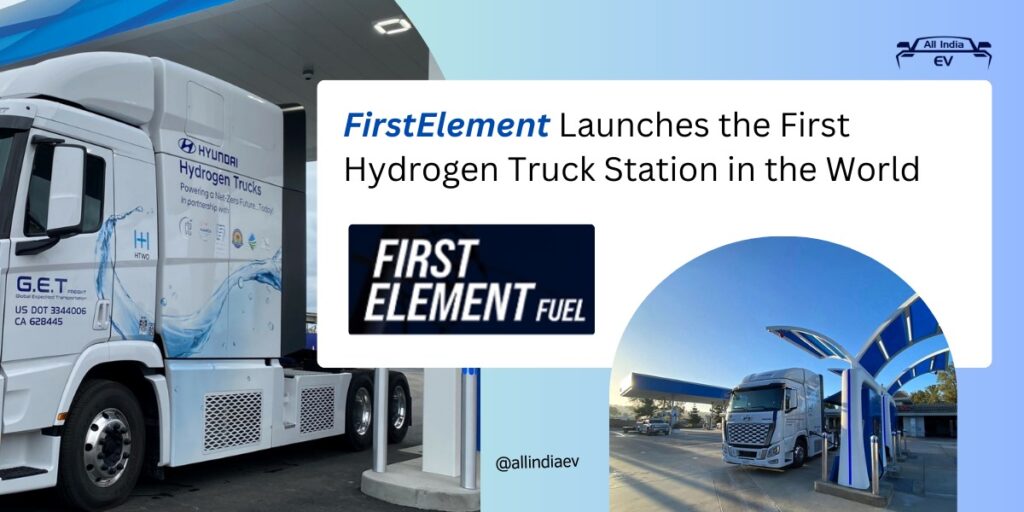
FirstElement Fuels has set up the world’s first large-scale hydrogen filling station for heavy-duty commercial vehicles just outside the Port of Oakland.
FirstElement hosted public tours and demonstrations of its new filling station this week. It is being referred to as the first of its kind.
The company, which located near the Port of Oakland, claims that their hydrogen pumps can “fill” a truck’s hydrogen tank in as little as 10 minutes, which works out to be as many as 200 trucks every day based on their calculations. Regarding customers, the company states that the fueling station is now being used by 30 Hyundai Xcient semi trucks and a number of Nikola hydrogen fuel-cell-powered automobiles.
Liane Randolph, chair of the California Air Resources Board (CARB), and Tyson Eckerle, clean transportation advisor for Gov. Gavin Newsom’s business development office, were among the state authorities present at the station’s inauguration ceremony. The Oakland station was primarily funded by the California Energy Commission and CARB.
According to Eckerle, the US federal government is providing $8 billion to kickstart the “hydrogen economy,” and he anticipates that there will be enough money to construct up to 60 more hydrogen truck stations similar to this one in California, which could theoretically accommodate 1,000 buses and 5,000 trucks.
Alexander Vlaskamp, CEO of MAN Trucks, put it best when he stated that hydrogen could never successfully compete with BEVs.
He is correct in saying that there is no reason to think hydrogen has any kind of future when there are level playing fields. However, since there are no fair playing fields and remarks like Eckerle’s, in addition to a $8 billion federal budget and some purportedly reliable industry experts praising hydrogen’s potential as a fuel, we must take this seriously (at least for the time being).
More EV News
Still, it appears that the public’s perception of hydrogen is beginning to shift negatively. Outlets that a few years ago might not have challenged a manufacturer’s claims on a hydrogen-fueled car today appear more than happy to do so.
Hydrogen production is sometimes a highly dirty process. Today, methane—a fossil fuel and major contributor to greenhouse gas emissions—is needed to manufacture the majority of hydrogen. Using an electrolyzer to separate the hydrogen and oxygen in water, the industry is working on alternatives to methane burning for green hydrogen production. Another option is to capture and store carbon dioxide from methane burning. Without government subsidies, both options are excessively costly.
Whether FirstElement’s assertions regarding the viability of its hydrogen or the usefulness of its filling station will persuade many battery electric absolutists remains to be seen. Consider the method used by the business to produce hydrogen. According to FirstElement, their hydrogen is produced using natural gas as “feedstock” by its Las Vegas-based provider, Air Liquide. The hydrogen it produces is considered “green” since it is produced using a blend of natural gas and biogas that is over 60% renewable.
Furthermore, there should be one or two asterisks next to the claim of 10-minute fast fills. This is because FirstGreen is able to fill at 900 bar (15,000 psi) thanks to revolutionary “cryopump” technology from Bosch Rexroth. Although it might appear sufficient to pump 100 kg into a tank in roughly ten minutes, cryogenically chilling hydrogen is a high-energy technology that needs a lot of electricity to run. It claims that the hydrogen that has been stored will provide the electricity.
To be fair, though, Bosch offers some suggestions here to assist station owners in making the most of all that electricity. According to Dave Hull, regional vice-president of Bosch Rexroth, “cold is like gold.” You exude such icy intensity. I have fought to eliminate heat for my entire career. With that energy, you could power the air conditioning or Rock Star energy drink refrigerators for a whole station. Bosh has a dedicated division for building technology and heat pumps.