

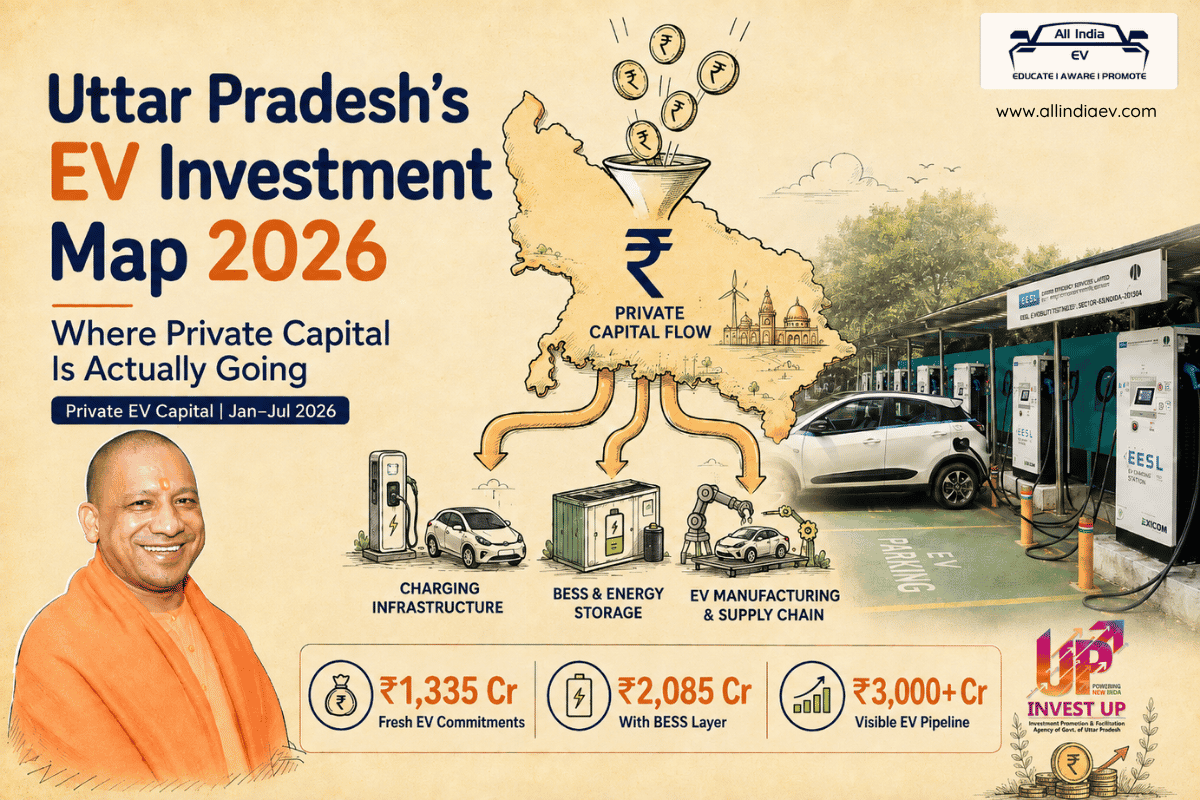
Uttar Pradesh is becoming India’s next EV manufacturing hub, anchored by a wave of fresh investment.
What All India EV Intelligence found: There is no single large electric passenger-car factory driving this story. Instead, private capital is entering the value chain at multiple points at once: electric commercial vehicles, motorcycles, chargers, power electronics and energy storage. The headline crore figure depends entirely on which of these layers get counted, and most public coverage does not say which layer it is counting.
This report separates the layers.
Claims Ledger
| Figure in circulation | What it actually represents | Status |
|---|---|---|
| “₹1,335 crore in EV investment” | Sum of three fresh, EV-specific 2026 commitments (TWI, Neenjas, Advance Panels) | Verified from public filings and news reports, treated as commitments not commissioned capacity |
| “₹2,085 crore in EV investment” | The ₹1,335 crore figure plus GoodEnough Energy’s ₹750 crore BESS expansion | Verified, but includes stationary battery storage, not EV traction batteries |
| “₹3,000+ crore EV investment pipeline” | The above plus Ashok Leyland’s ~₹1,000 crore Lucknow plant | Verified, but combines a 2026 announcement with a project originally committed in September 2023 |
| “TWI’s ₹1,100 crore hybrid EV motorcycle plant” | Investment commitment listed by Invest UP at Davos | Company/government-announced commitment; no public data yet on location, capacity, timeline or localisation |
| “Ashok Leyland’s Lucknow facility is India’s newest EV plant” | Greenfield clean-mobility facility in Sarojini Nagar, commissioned January 9, 2026 | Verified as commissioned; capex and job figures sourced to Moneycontrol and Financial Express |
All India EV Intelligence does not add the full value of automotive-component investments to the EV total unless their EV-specific allocation can be independently established. This is why the headline number in this report is presented in layers rather than as one figure.
Four Lenses: Capital, Supply, Demand, Policy
Capital: three fresh commitments, one operating factory
The Investment Tracker below lists every project All India EV Intelligence identified in the January to July 2026 window.
| Company | Location | Investment | Segment | Status in 2026 |
|---|---|---|---|---|
| TWI Group of Companies | Uttar Pradesh | ₹1,100 Cr | Hybrid-electric motorcycles | Fresh investment commitment |
| Neenjas Electric | YEIDA, Greater Noida | ₹169 Cr | EV chargers and power electronics | LoI issued, project progressing |
| Advance Panels & Switchgears | YEIDA region | ₹66 Cr | EV chargers plus electrical equipment | Project allotment |
| GoodEnough Energy | Noida | ₹750 Cr | BESS manufacturing | Expansion announced |
| Ashok Leyland | Lucknow | ~₹1,000 Cr total planned | Electric buses and commercial EVs | Plant commissioned |
| DENSO | Gautam Buddha Nagar | ₹250 Cr | Hybrid/EV motor generators | Earlier investment progressing |
The largest fresh, EV-specific commitment of the period came from TWI Group of Companies. During Uttar Pradesh’s engagement at the World Economic Forum in Davos, Invest UP listed a ₹1,100 crore commitment from TWI for a hybrid EV motorcycle manufacturing plant in the state. This single project accounts for the majority of the clearly identifiable fresh EV investment tracked in this window.
The strategic logic is worth noting separately from the number. India’s electric two-wheeler market has so far been dominated by scooters; electric motorcycles remain a comparatively underdeveloped category despite the size of India’s conventional motorcycle market. If TWI’s project moves from commitment to construction, Uttar Pradesh gains exposure to a segment most other states have not prioritised.
But the commitment should be read as exactly that. Public documentation reviewed by All India EV did not specify plant location, proposed annual capacity, product launch timeline, localisation percentage, or a commissioning date. The next meaningful intelligence checkpoint is not another MoU headline; it is land allocation and capex deployment.
Ashok Leyland represents the opposite case: execution rather than commitment. Its greenfield clean-mobility facility in Sarojini Nagar, Lucknow, spans roughly 70 acres and was inaugurated on January 9, 2026, focused primarily on electric commercial vehicles. Total planned capex is reported at approximately ₹1,000 crore, with around ₹252 crore deployed in the initial phase. Production capacity begins near 2,500 vehicles annually, with expansion planned toward 5,000. The facility is expected to support roughly 1,000 direct and 2,000 indirect jobs.
The important accounting distinction: this is not a fresh 2026 announcement. Uttar Pradesh signed the MoU with Ashok Leyland in September 2023; the plant moved through land allocation, development and construction before commissioning this year. All India EV Intelligence classifies it separately from 2026’s fresh commitments for that reason, even though a commissioned factory arguably signals more than another new MoU. States build manufacturing ecosystems by converting announcements into factories, not by collecting announcements.
➡️ Supply: two clusters forming around different layers of the value chain
Placed on a map, the investments split into two distinct geographies rather than one EV hub.
Greater Noida / YEIDA is developing around the electronics and infrastructure layer: chargers, onboard charging systems, power electronics, electrical equipment, motor-generator technology and energy storage.
Neenjas Electric is the clearest example. The company plans to invest approximately ₹169 crore in a facility in YEIDA’s Sector 8D, for which YEIDA issued a Letter of Intent covering roughly 20,000 square metres of industrial land. The facility is expected to manufacture onboard and off-board chargers, high-IP-rated charging equipment, AC-DC converters and related energy products, targeting electric two-wheelers, three-wheelers and light commercial vehicles.
This matters because EV charging discussion tends to focus on public charging stations and overlook the electronics stack inside the vehicle itself. The onboard charger converts external AC electricity into the DC electricity the battery needs; power conversion, protection systems and charging controls are all part of the localisation story as EV production scales. Neenjas is therefore better understood as an investment in India’s EV power-electronics layer than as a “charging-station investment.” The location adds to the case: YEIDA and Greater Noida offer proximity to NCR’s automotive ecosystem, the Yamuna Expressway, upcoming airport-linked logistics infrastructure, and existing electronics manufacturing capability.
Advance Panels and Switchgears adds a second, smaller data point to the same cluster. Among a set of YEIDA-region industrial allotments announced in May 2026, the company committed approximately ₹66 crore covering power transformers, switchgear, electronic products and EV charger manufacturing. Not all of that capital is EV-specific, since the product portfolio extends beyond chargers, but it remains relevant: as charging deployments scale, the bottleneck shifts from “where are the chargers” to “who manufactures the electrical infrastructure around them,” including transformers, HT/LT panels, switchgear, protection systems, metering and cabling. A supplier capable of covering multiple parts of that stack gains exposure to the charging-infrastructure market even where chargers are only one line of business.
Lucknow is emerging as the anchor for electric commercial-vehicle manufacturing, built around Ashok Leyland. An anchor commercial-vehicle plant typically pulls in bus-body suppliers, wiring harness manufacturers, thermal-management companies, battery-pack suppliers, motor and inverter makers, HVAC suppliers, charging companies, fleet-maintenance providers and telematics firms. Electric buses are also one of the more predictable EV demand categories, since procurement is tied to institutional and public-transport electrification rather than individual consumer sentiment. The ₹1,000 crore capex figure is therefore only the first layer; the larger economic effect, if it materialises, will come from supplier localisation around the plant.
TWI’s motorcycle project could add a third vehicle-manufacturing layer, depending on where the plant is eventually sited.
➡️ Energy: a storage layer, not an EV-battery layer
GoodEnough Energy’s Noida facility is the largest single battery-related number in this report, and the one most likely to be miscounted. In January 2026, the company disclosed plans to invest ₹750 crore over three years to expand capacity from an initial 7 GWh to more than 25 GWh.
All India EV Intelligence does not add this figure to the pure EV manufacturing total, because the facility is primarily built for stationary battery energy storage systems rather than EV traction batteries. Excluding it from the EV conversation entirely would be equally inaccurate, however. High-power EV charging creates a grid-management problem that scales with deployment: a single 30 kW charger is a minor load, but a hub with multiple 120 kW or 240 kW chargers is not. For electric bus depots, heavy-truck corridors, logistics hubs and highway charging stations, battery storage can support peak shaving, demand-charge management, renewable-energy integration, backup power and load balancing, potentially reducing the scale of grid upgrades required.
GoodEnough therefore belongs in an EV-adjacent energy infrastructure category. The distinction matters because battery announcements are increasingly folded into EV investment totals without that qualification; not every battery factory is an EV battery factory.
➡️ Policy: incentive design built for manufacturing scale, not just announcements
The Uttar Pradesh Electric Vehicle Manufacturing & Mobility Policy defines separate categories for large projects, mega projects, integrated EV projects and battery facilities. A Mega EV Project begins at ₹500 crore of eligible fixed capital investment; an Integrated EV Project requires at least ₹3,000 crore.
For charging infrastructure, the state offers a 20% capital subsidy of up to ₹10 lakh per charging station for the first 2,000 eligible stations meeting prescribed conditions, and up to ₹5 lakh per battery-swapping station. The policy also provides incentives for battery manufacturing and tiered stamp-duty reimbursement depending on project category and geography.
Incentive design alone will not determine Uttar Pradesh’s position in the EV industry. The more durable advantage is the combination of market size, NCR proximity, expressway connectivity and an industrial geography stretching from Gautam Buddha Nagar toward central and eastern UP, which supports both manufacturing and eventual demand.
The number, restated in layers
Based on publicly identifiable projects reviewed by All India EV Intelligence for January to July 2026:
- Fresh, clearly EV-specific commitments: TWI Group (₹1,100 Cr) + Neenjas Electric (₹169 Cr) + Advance Panels & Switchgears (₹66 Cr) = approximately ₹1,335 crore
- Including EV-adjacent energy storage: add GoodEnough Energy’s ₹750 crore BESS expansion = approximately ₹2,085 crore
- Including capacity commissioned this year from an earlier commitment: add Ashok Leyland’s ~₹1,000 crore Lucknow plant = the visible EV and EV-adjacent industrial pipeline exceeds ₹3,000 crore
All India EV Intelligence does not describe the ₹3,000+ crore figure as fresh EV investment attracted during 2026. That framing would mix new commitments, a project first announced in 2023, and adjacent energy-storage investment into a single number, which is precisely the kind of conflation this report is designed to avoid.
All India EV Intelligence View
Uttar Pradesh does not yet have the depth of an established automotive cluster such as Tamil Nadu, Maharashtra or parts of Gujarat. What is notable about January to July 2026 is not the total, but the shape: companies are entering multiple layers of the electric-mobility industrial chain rather than converging on vehicle assembly alone. Ashok Leyland anchors electric commercial vehicles. TWI could add electric motorcycles. Neenjas introduces specialised charging electronics. Advance Panels adds charger and electrical-infrastructure capability. GoodEnough adds an energy-storage layer that could eventually support power-intensive charging infrastructure.
Whether this becomes an ecosystem or remains a collection of separate projects will depend on five things: how quickly announced MoUs convert to land allotment; how much committed capex actually gets deployed; whether tier-1 and tier-2 suppliers locate around the anchor manufacturers; whether EV components end up manufactured locally rather than only assembled; and whether Uttar Pradesh develops enough in-state EV demand to create a manufacturing-and-market feedback loop.
Uttar Pradesh did not become India’s largest EV manufacturing state in 2026. It did not need to. The more relevant development is that the state is building the industrial layers underneath an EV ecosystem rather than chasing a single headline factory. If the next wave of investment connects Lucknow’s vehicle manufacturing with Greater Noida’s power electronics and charging technology, Uttar Pradesh’s role shifts from a large EV consumer market to a meaningful participant in India’s EV manufacturing map.
The metric worth tracking from here is not the value of the next MoU. It is the conversion rate: announcement to land, land to construction, construction to production. That sequence, not the crore figure attached to any single press release, will show whether Uttar Pradesh’s EV story is being built on the ground or only on paper.
All India EV Intelligence will continue tracking these investments based on project status rather than announcement value alone.
Sources: Invest UP, The Times of India, Hindustan Times, Business Standard, The Financial Express, Moneycontrol, Ashok Leyland corporate disclosures.