

Policy Momentum and Clean Energy Demand Rise as Weak Supply Chains Slow Large-Scale Battery Recycling
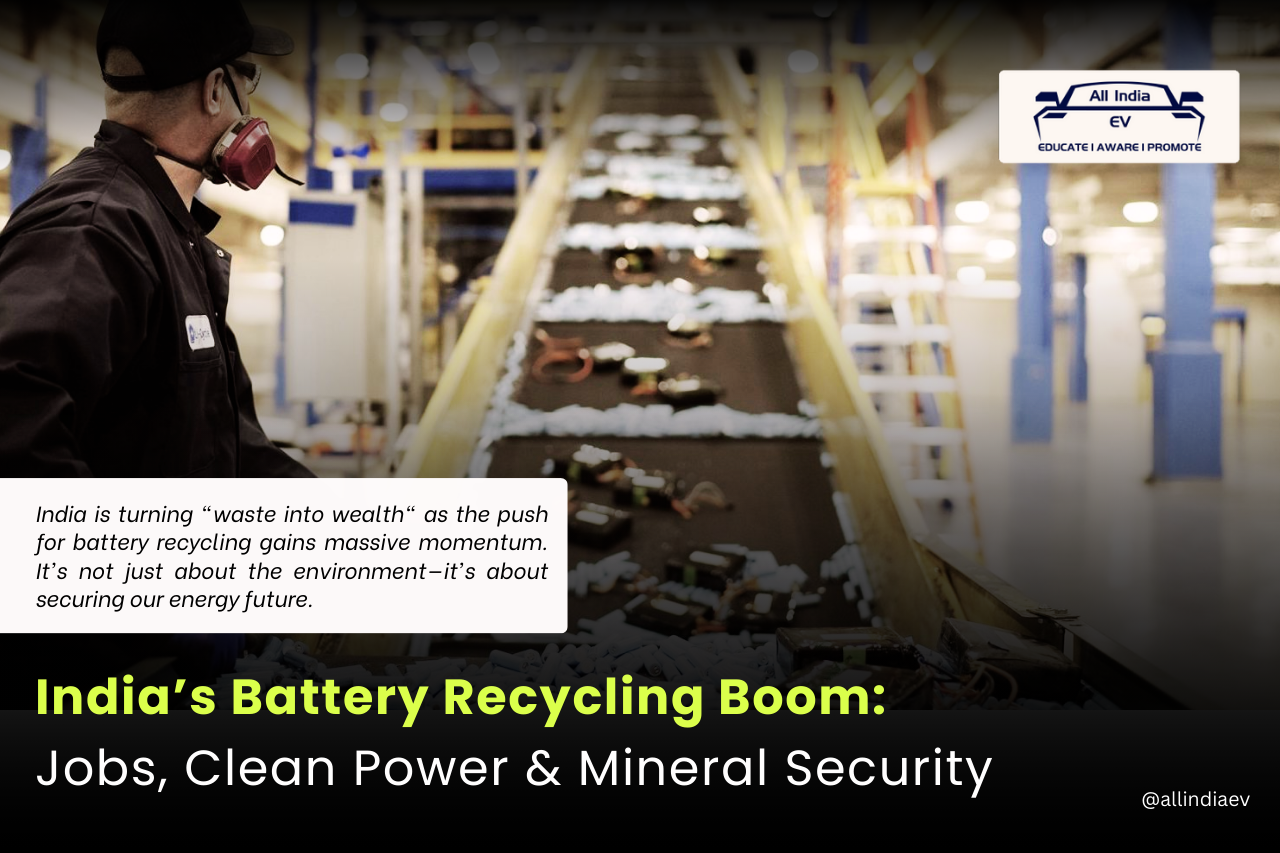
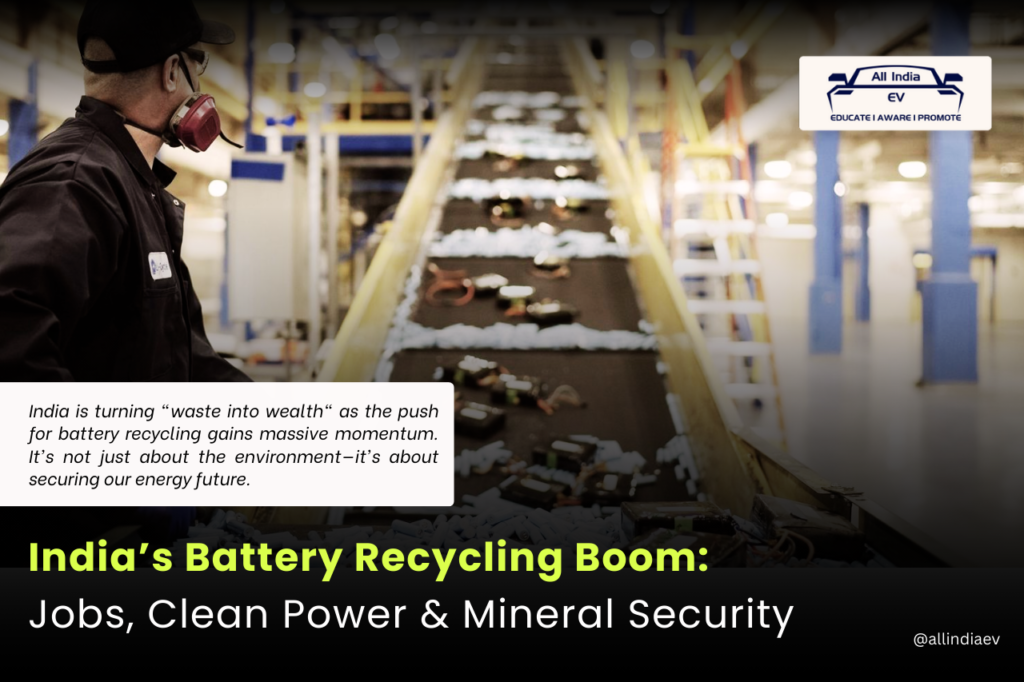
India’s ambitious transition to clean energy and electric mobility is bringing battery recycling into sharp focus, positioning it as a strategic industry that promises green jobs, reduced import dependence and a more sustainable EV ecosystem. As electric vehicles (EVs), smartphones and renewable energy storage systems proliferate across the country, the challenge of managing used batteries is rapidly turning into an economic and environmental opportunity.
Over the past decade, India has seen the early rise of a battery recycling ecosystem aimed at recovering valuable minerals from spent lithium-ion batteries. These include lithium, cobalt, nickel, copper and aluminium, all of which are critical for EV manufacturing and solar energy storage. Recovered materials can be fed back into domestic supply chains, helping India reduce reliance on expensive and geopolitically sensitive imports.
“More than 40 per cent of India’s copper and aluminium needs are already met through recycling, and we aspire to reach similar levels for lithium, cobalt and nickel,” said Rajat Verma, Founder and CEO of Noida-based Lohum Cleantech. The seven-year-old company is among a growing number of firms investing in battery manufacturing, recycling and repurposing technologies.
According to a November study by renewable energy think tank RMI, a formalised battery recycling system in India could create nearly 100,000 green jobs and meet up to 40 per cent of the country’s demand for key battery minerals. As EV adoption accelerates, the report estimates that India’s battery recycling and reuse industry could grow into a $9 billion market, driven largely by demand from electric mobility and grid-scale energy storage.
“What makes battery materials unique is that they’re not like plastics,” said Marie McNamara, Manager with RMI’s India programme. “These metals can be recycled almost indefinitely without losing quality or strength, making them ideal for a circular economy.”
Capacity Exists, but Systems Lag Behind
Despite the promise, significant challenges remain. India currently has around 60,000 tonnes of battery recycling capacity, but a large portion of it remains underutilised. The reason lies in fragmented supply chains and the dominance of the informal recycling sector, which employs an estimated four million workers dealing with all kinds of scrap materials, often without formal contracts or safety standards.
More EV News
Experts say this informal structure makes it difficult to ensure environmentally sound recycling and to channel recovered materials back into organised manufacturing.
Policy Progress Meets Ground-Level Gaps
India is one of the world’s largest emitters of greenhouse gases, even as it rapidly expands clean energy through solar power and electric vehicles. To address battery waste, the government introduced Battery Waste Management Rules in 2022, mandating safe disposal, collection targets and strict penalties for non-compliance.
However, implementation has lagged behind policy intent. While producers are required to meet recycling targets, there are no standardised collection points for discarded batteries, forcing companies to build their own systems. Industry experts argue that the absence of a well-structured, nationwide recycling framework has slowed progress.
“From a policy standpoint, India has moved surprisingly fast,” said Jaideep Saraswat of the Vasudha Foundation, “but the supporting supply chains and infrastructure are still missing.”
How EV Battery Recycling Works
A typical electric car battery measures about 1.5 metres in length, weighs up to 400 kilograms and is designed to last 8–12 years or around 160,000 kilometres. When recycled properly, up to 90 per cent of an EV battery’s materials can be recovered.
Common recycling methods include mechanical shredding, where battery modules are crushed into fine powder, and smelting, which uses high-temperature furnaces. These processes are followed by chemical treatments to extract individual metals. Alternatively, used batteries can be repurposed for second-life applications, such as storing solar or wind energy for homes and small businesses.
Environmental and Safety Concerns
Improper recycling practices pose serious risks. Illegal dumping of toxic contaminants, emissions of carbon monoxide and hazardous gases, and wastewater containing heavy metals can harm soil, air and water if not managed responsibly.
“We haven’t expanded much in India because clean recycling operations are still undervalued,” said Nishchay Chadha, CEO of ACE Green Recycling, which operates in India. He noted that safe recycling requires higher upfront investment and strict compliance.
The Need for Formalisation and Skills Training
Experts emphasise that formalising the recycling workforce is key to scaling the industry safely. RMI’s McNamara called for training programmes to help informal scrap workers transition into formal jobs, alongside government support for companies willing to hire and upskill them.
“Formalisation will drive safety, accountability and environmental responsibility, especially given the toxic and high-value nature of batteries,” she said.
Reducing Dependence on Imported Minerals
Globally, China dominates the critical mineral supply chain, from mining to refining, according to the International Energy Agency. India currently lacks operational lithium mines and depends heavily on imports. Effective battery recycling could partially offset this dependence, strengthening India’s energy security.
While recycling alone may not be immediately profitable, Chadha pointed out that China treats it as a strategic necessity rather than a standalone business. “They may lose money on recycling, but they make it work across the entire value chain,” he said.
An Industry Poised for Take-Off
Despite the hurdles, industry leaders remain optimistic. “If the current momentum continues, India could create five multibillion-dollar battery recycling giants,” said Verma of Lohum Cleantech.
As India’s EV revolution gathers pace, battery recycling is emerging as a cornerstone of sustainable growth, offering a rare convergence of economic opportunity, environmental protection and strategic mineral security.
Comment by the Author
India’s battery recycling journey is no longer a peripheral sustainability issue—it is fast becoming a strategic pillar of the country’s EV and clean energy ambitions. If policy intent is matched with robust collection systems, workforce formalisation, and investment in safe recycling technologies, battery waste can be transformed into a powerful domestic resource. Done right, recycling will not only create green jobs and cut mineral import dependence, but also anchor a truly circular EV ecosystem that strengthens India’s long-term energy and industrial security.