

China-Market MG4 Anxin Edition and Liquid–Solid Batteries: Fast Charging, Long Range, and What Budget Pricing Really Signals
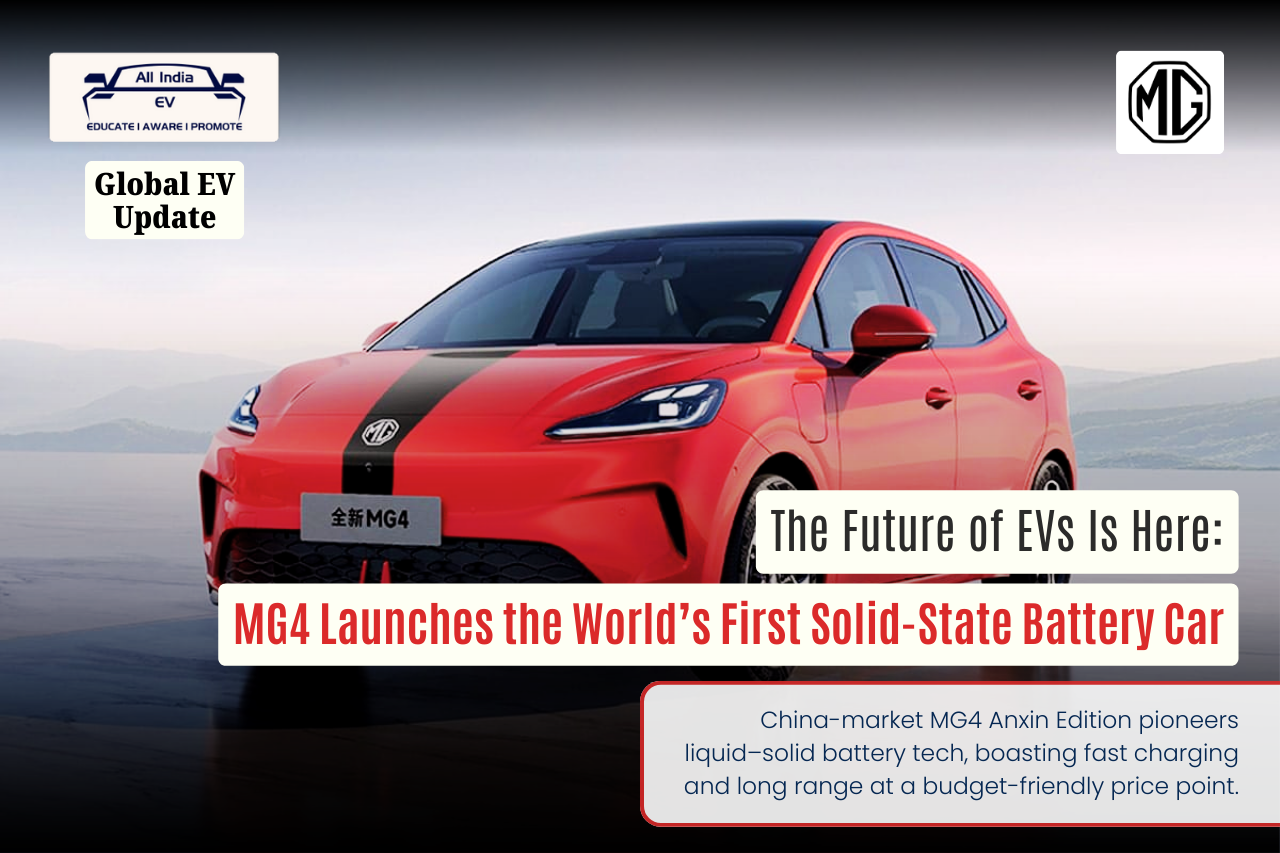
MG’s announcement that it has begun deliveries of the MG4 Anxin Edition in China — described in some coverage as the “world’s first mass-produced solid-state battery EV” — is significant not because it finally delivers a moonshot battery, but because of how it advances the battery roadmap and what it reveals about industry trajectories.
What the tech really is:
Contrary to hype-leaning descriptions, this is not a “true” solid-state battery as most OEMs define it (i.e., fully solid electrolyte, lithium metal anode, radical energy-density leap). The Anxin Edition uses a semi-solid / liquid-solid hybrid system: a manganese-based lithium-ion pack with ~5% liquid electrolyte — far below typical levels, but not devoid of liquid chemistry.
This subtle classification matters:
- It retains core lithium-ion chemistry, with incremental density and safety improvements rather than paradigm-shifting breakthroughs.
- It doesn’t reformulate the core materials ecosystem (cathodes, separators, electrolyte supply chains, manufacturing facilities) the way true solid-state cells would.
So the Anxin Edition is less a leap to a new battery era and more an accelerated incremental node on the current battery trajectory.
Execution Versus Evangelism — A China Playbook
What is genuinely noteworthy is MG’s execution strategy:
- Rapid commercialization of a next-gen battery variant in a mass-market product priced aggressively (~102,800 yuan), not as an expensive halo car.
- Deliveries starting in late December 2025 with projected expansion beyond China in 2026.
This aligns with an industrial logic visible across China’s EV ecosystem: instead of hoarding emerging chemistry for flagship models, players are integrating near-term battery innovations into high-volume platforms.
More EV News

For senior decision-makers in markets like India or Europe, this execution model — innovation built into affordability, not premium exclusivity — is a strategic signal: battery advances will influence mainstream adoption curves sooner than many product roadmaps assume.
Technology Tradeoffs — Real but Subtle
From a technical lens, the benefits touted for semi-solid battery tech are real but measured, not transformative:
- Thermal and safety advantages: reduced liquid content lowers risks of runaway events and improves stability.
- Energy density and CLTC range: real but roughly on par with existing LFP packs (530–537 km CLTC) rather than class-disruptive.
- Fast charging: 2C capability (~21 min from 30–80%) is competitive but not unprecedented at the system level.
However, the practical performance envelope doesn’t radically outstrip what optimized LFP or NMC packs deliver today — particularly once you adjust for China’s CLTC test cycle biases. This nuance is critical for engineers and planners who must map technology prospects to real-world utility.
Systems Impacts — Supply Chain and Manufacturing
The MG rollout underscores several systemic shifts:
- Supply Chain Modulation: Semi-solid batteries still leverage upstream lithium-ion materials, meaning existing cathode, anode, and electrode supply chains remain relevant. They delay — but do not obviate — the need for new solid electrolyte manufacturers or Li-metal anode processors.
- Manufacturing Scalability: MG (SAIC) demonstrates that gradations in battery chemistry can be industrialized at scale quickly, leveraging current gigafactory setups with adaptations rather than greenfield builds.
For policymakers and industrial strategists, this means solid-state technology doesn’t have to displace existing infrastructure to contribute to commercial EV growth. Hybrid chemistries may be the practical bridge for capacity expansion.
Policy and Competitive Implications
MG’s timeline — China deliveries now, global rollout in 2026 — pressures EV ecosystems in markets seeking to leapfrog EV adoption. Three implications demand scrutiny:
- Technology import and standards: Should regulatory frameworks predefine metrics (e.g., gram-equivalent energy, safety thresholds) to avoid overclaiming in nascent chemistries?
- Local exchange rates and cost competitiveness: Affordable next-gen battery tech from China could further compress margins for local OEMs unless cost parity or supply incentives are structured.
- Infrastructure expectations: Faster charging (~20 min) becomes the baseline expectation; policy must factor this into grid and public charging strategies.
For OEMs and platform leads:
MG’s maneuver shows that incremental battery evolution in a volume vehicle can outcompete slower, premium-only strategies at scale. This poses a strategic question: is your battery roadmap too focused on headline breakthroughs (e.g., true solid-state) at the expense of competitive execution now?
A Critical Takeaway
The MG4 Anxin Edition is a reframing event: not because it solves the battery problem, but because it reframes how the industry gets to the next battery phase.
It’s a pragmatic step, blending existing tech with incremental chemistry refinements, deployed at scale at competitive price points. For decision-makers, the debate shifts from “when will solid-state arrive?” to “how do semi-solid and other transitional chemistries reshape product segmentation, supply chains, and competitive positioning in the next 18–36 months?”
Only by situating this launch within broader systems — policy frameworks, supply continuity, cost curves, and ecosystem dynamics — can its true impact be assessed.
Comment by Author:
The MG4 Anxin Edition matters less as a headline “solid-state breakthrough” and more as a case study in execution. It shows how transitional battery chemistries can be commercialised at scale, at mainstream price points, without waiting for perfect technology.
For policymakers, OEMs, and ecosystem planners, the real lesson is strategic: the next phase of EV adoption will be shaped not by moonshot batteries, but by how intelligently incremental advances are deployed across cost, infrastructure, and supply chains.